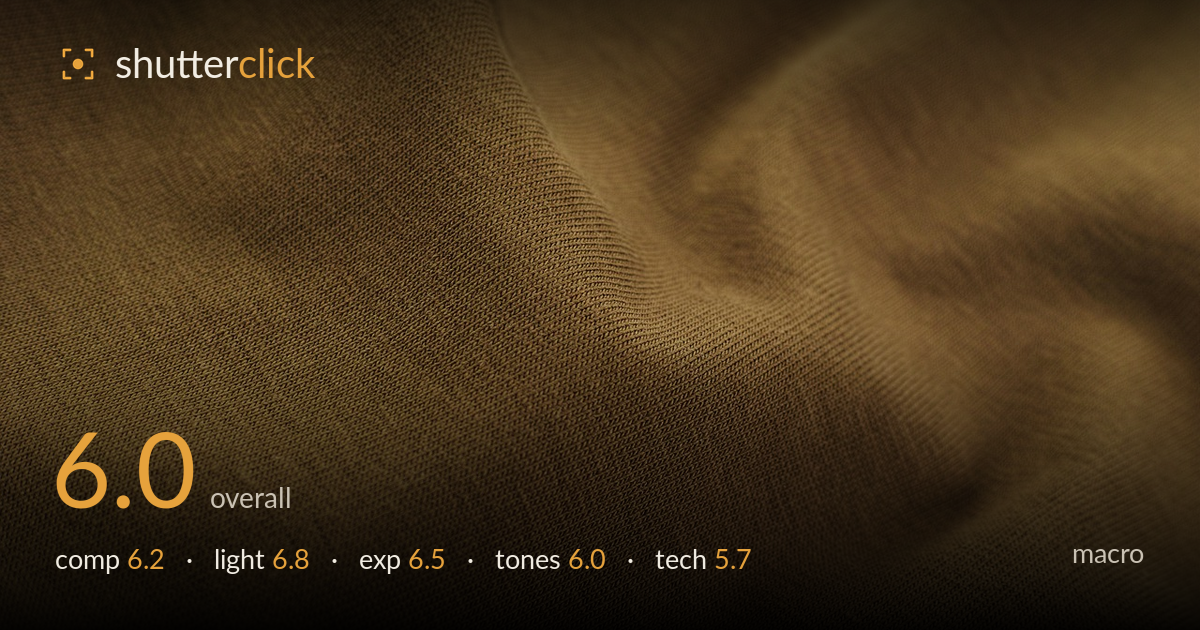
Folds in olive fabric
Photo by Engin_Akyurt

No EXIF metadata in this file
Technical analysis based on visual assessment only.
A close study of folded fabric that reads more as texture than as a resolved macro image. The raking light across the folds is the strongest element, sculpting soft ridges and valleys with gentle gradation, and the olive tone carries a quiet, understated mood. What most holds it back is the lack of a clear point of sharpest focus — the weave never resolves into crisp detail anywhere in the frame, so the eye has nothing to lock onto. The composition of diagonal folds has rhythm but no anchor. As a texture plate it works; as a macro statement it needs one decisively sharp region.
The diagonal run of folds gives the frame a natural flow from lower left toward upper right, and the soft ridge near centre creates a loose focal ridge. But the arrangement stays even and undirected — there is no single dominant fold or contrast point to anchor the eye. The frame reads as a continuous field rather than a composed image. A stronger single crease, or a crop isolating the deepest shadow valley against the brightest ridge, would give the eye a destination and turn pattern into structure.
The soft, raking light is the most successful choice here, skimming across the folds to reveal gentle relief and the subtle sheen of the weave. Shadows fall away smoothly into the valleys, and the highlights on the ridges roll off without harshness. The direction from upper right works well for the fold geometry. Slightly harder or lower side light would deepen the texture and separate the weave threads more emphatically, but as it stands the illumination is even and flattering to the material.
Brightness is handled sensibly for a mid-toned subject, with no blown highlights on the ridges and shadow valleys retaining detail rather than blocking to black. The histogram sits in the midtones as the muted fabric demands. The overall level runs a touch dark, which suits the mood but flirts with muddiness in the lower-left corner. A marginally brighter exposure, or a lifted shadow floor, would open the weave detail in the darker folds without sacrificing the restrained atmosphere.
The olive-brown palette is cohesive and calm, and the monochromatic range suits a quiet material study. White balance leans warm, which flatters the fabric but also flattens tonal separation between ridge and valley. Contrast is gentle throughout, which reinforces softness but leaves the image feeling slightly flat and hazy. A modest contrast lift and a touch more tonal separation in the midtones would give the folds more three-dimensional presence while keeping the muted, earthy character intact.
Focus is the core issue. For a macro study the weave should be tack-sharp across at least one clear plane, but here no region resolves into crisp thread detail — the whole frame carries a soft, slightly hazy quality, whether from a focus miss, camera shake, or a very shallow plane falling between the folds. The shallow apparent depth of field is appropriate for the subject, but that makes precise focus placement even more critical, and the sharpest available plane never quite lands on well-lit thread structure. Noise is low and the tonal rendering is clean, so the capture itself is stable in that respect. On a reshoot, focusing precisely on a well-lit ridge, stopping down a little to extend the sharp zone, and using a tripod with a remote or timer would guarantee bite where it counts. Focus stacking across two or three ridge planes would resolve the depth problem entirely and let the weave read at full resolution.
What would elevate it
Tags
Shot something like this?
Expert photo critique, on demand — scored across six categories, EXIF-aware. Start with 3 free critiques, no credit card.
critique my photo — free