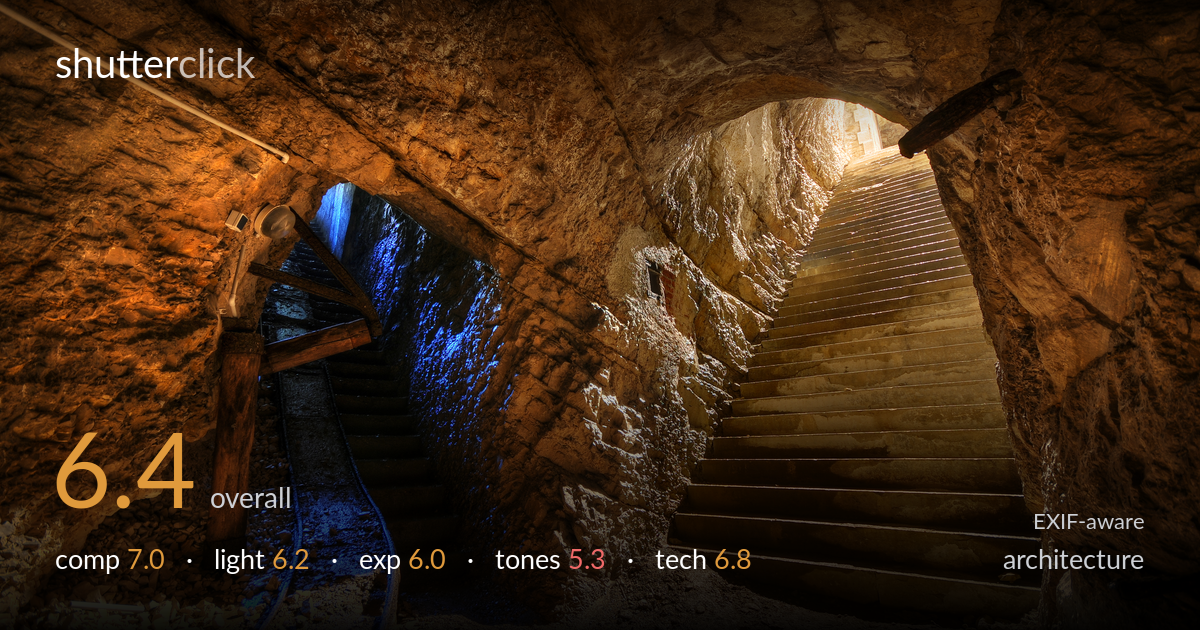
Forked underground passage
Photo by Thomas Bresson

| Focal length | 10 mm |
| Aperture | f / 5.6 |
| Shutter | 15.5 s |
| ISO | ISO 200 |
| Exp. comp. | 0.0 EV |
| Shot at | 09:57 · Nov 6, 2012 |
A strong subterranean composition is undermined by heavy-handed HDR processing. The fork in the passage — a lit stone staircase rising right, a darker rail-lined tunnel descending left — gives the frame a genuine sense of choice and depth, and the wide lens exaggerates the cave's enveloping curve effectively. What most holds it back is the tonal treatment: the orange rock is oversaturated and crunchy, while the cold blue cast on the left tunnel reads as an artificial white-balance clash rather than natural ambient light. Dialling back the tone-mapping would let the genuinely interesting space breathe.
The split path is the picture's best idea — the warm staircase curving up to the right plays against the cold descending tunnel on the left, and the rock arch frames both convincingly. The 10mm view wraps the viewer inside the space and the foreground rubble anchors the bottom. The wooden post and lamp at left add a useful interruption. The staircase slightly dominates while the left tunnel's promise stays underexplored; a fraction more space given to the dark fork would balance the two competing routes more evenly.
Light is doing real narrative work here — the daylight spilling down the right staircase pulls the eye upward and models the stone steps with soft gradation. The left tunnel relies on a cold raking light that sculpts the wet wall texture. The problem is the two sources read as clashing colour temperatures rather than a deliberate contrast, and the HDR has flattened the directional cues so shadows lack a clear anchor. Letting one light source dominate would give the scene more spatial logic.
The long exposure has gathered detail across an enormous brightness range, from the bright stair top to the shadowed tunnel floor, with little outright clipping. That said, the tone-mapping has compressed the midtones into a uniform glow that robs the scene of true blacks — nothing fully recedes into shadow, which weakens the sense of depth. The staircase highlights at the top edge are close to blown. A more restrained tone curve preserving some genuine shadow would restore dimensionality.
This is the weakest element. The orange rock is pushed well past natural saturation into an almost coppery, processed look, and the cold blue on the left tunnel sits uneasily against it as a white-balance conflict rather than a complementary pairing. Local contrast haloing around the arch edges betrays aggressive HDR. The mid-tones lack clean separation and the overall palette feels synthetic. Pulling saturation down, warming the blue toward neutral, and easing the clarity would make the stone read as stone again.
The settings are well chosen for the conditions. At 10mm on the D300's APS-C sensor this is an extremely wide view, ideal for engulfing the viewer in the cave, and f/5.6 holds adequate depth across the frame given the wide focal length — front rubble to distant stairs stays acceptably sharp. ISO 200 keeps noise clean, and the 15.5-second exposure on a tripod was the right call for this dark interior. Focus sits well on the mid-ground stonework. The trade-off is the extreme wide angle stretches the foreground rocks and curves the arch, which suits the drama but exaggerates perspective heavily. The verticals on the right wall lean outward — expected at 10mm but worth correcting for an architecture frame. The single biggest technical limitation is not capture but processing: the multi-exposure HDR blend has introduced edge halos and flattened tonal hierarchy. The raw frames clearly hold the information; a gentler merge would serve them better.
What would elevate it
Tags
Shot something like this?
Expert photo critique, on demand — scored across six categories, EXIF-aware. Start with 3 free critiques, no credit card.
critique my photo — free