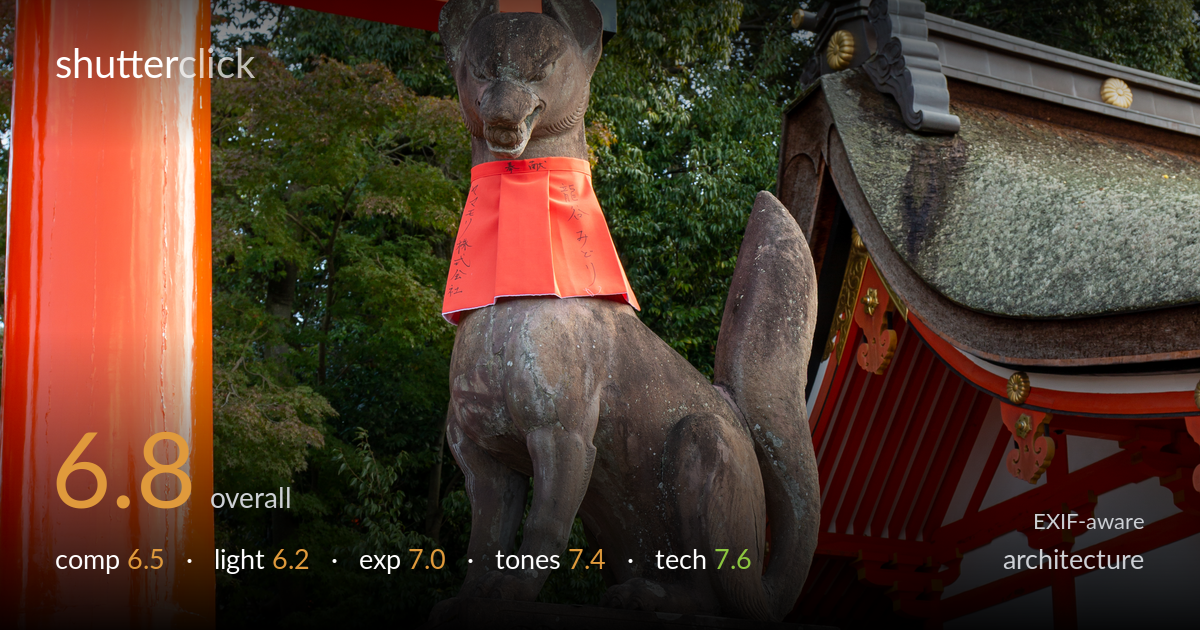
Fox guardian at the shrine gate
Photo by Balon Greyjoy

| Focal length | 38 mm |
| Aperture | f / 7.1 |
| Shutter | 1/125 s |
| ISO | ISO 320 |
| Exp. comp. | 0.0 EV |
| Shot at | 11:02 · Nov 10, 2018 |
A confident environmental study of a Fushimi Inari fox guardian, framed against the vermilion torii and shrine architecture for strong cultural context. The vertical orientation suits the statue and the bilingual carved pedestal anchors the base with weight and meaning. What most holds it back is depth balance: the foreground torii pillar dominates the left edge and the shrine roofline crowds in from the right, leaving the fox slightly boxed. Flat midday light under tree cover also mutes the stone's surface. A small step right and a touch more separation between fox and roof would sharpen the read.
The vertical frame fits the standing fox and its tiered pedestal, and the carved characters give the base genuine narrative weight. The vermilion torii pillar on the left and the shrine roofline on the right bracket the subject with context, which works for an architectural-cultural read. But that left pillar is heavy and slightly competes, while the roof eave intrudes close to the fox's tail, crowding the negative space behind. The statue sits a little low and central. A half-step right would open separation between fox and roof and let the torii frame rather than block.
Light here is soft, overcast and filtered through the tree canopy behind, which keeps the stone evenly lit and avoids harsh shadow on the fox's face — useful for legibility. The trade-off is flatness: the weathered, lichen-spotted texture of the stone reads muted because there is no raking direction to model its surface. The vermilion lacquer holds its punch under this diffuse light, but the fox itself lacks dimensional shaping. A lower, angled side light, or shooting nearer golden hour, would carve the stone's relief and lend the guardian more presence.
Exposure is well judged across a tricky range. The bright vermilion torii holds its saturation without clipping, the white shrine wall on the right retains detail, and the grey stone pedestal keeps a full set of midtones with the carved characters clearly legible. Shadows under the eave and in the background foliage stay open enough to read. The histogram looks balanced with no obvious blown highlights despite the strong orange. Zero exposure compensation was the right call here under even, diffuse light — nothing needs rescuing.
Colour is the image's strongest suit. The vermilion of the torii and shrine plays cleanly against the cool grey granite and the muted green canopy — a classic Inari palette rendered with believable saturation rather than over-pushed. White balance reads neutral, the stone holding faintly warm tones against cooler shadow. The orange bib breaks the monochrome stone with a welcome accent. Contrast is gentle, suiting the overcast conditions, though a touch more local contrast on the stone would lift its texture without disturbing the overall harmony.
Settings are sound and well matched to the subject. At 38mm on the 24-70 f/4L, f/7.1 delivers enough depth of field to hold the fox, its pedestal and the shrine behind acceptably sharp while still softening the background foliage slightly. Focus sits accurately on the fox's head and the carved stone reads crisply. 1/125s is more than adequate for a static statue handheld at this focal length, and ISO 320 keeps noise invisible with clean shadow detail. The lens choice is appropriate — a standard zoom giving a natural perspective without distortion on the architecture. The vertical verticals of the torii and shrine posts stay reasonably true, with only mild convergence from shooting slightly upward, which suits the genre's stricter standard well. The only refinement worth noting is that a marginally wider aperture would not have helped here; the chosen depth is correct. Execution is clean and deliberate throughout — this is a technically confident capture with no real errors.
What would elevate it
Tags
Shot something like this?
Expert photo critique, on demand — scored across six categories, EXIF-aware. Start with 3 free critiques, no credit card.
critique my photo — free