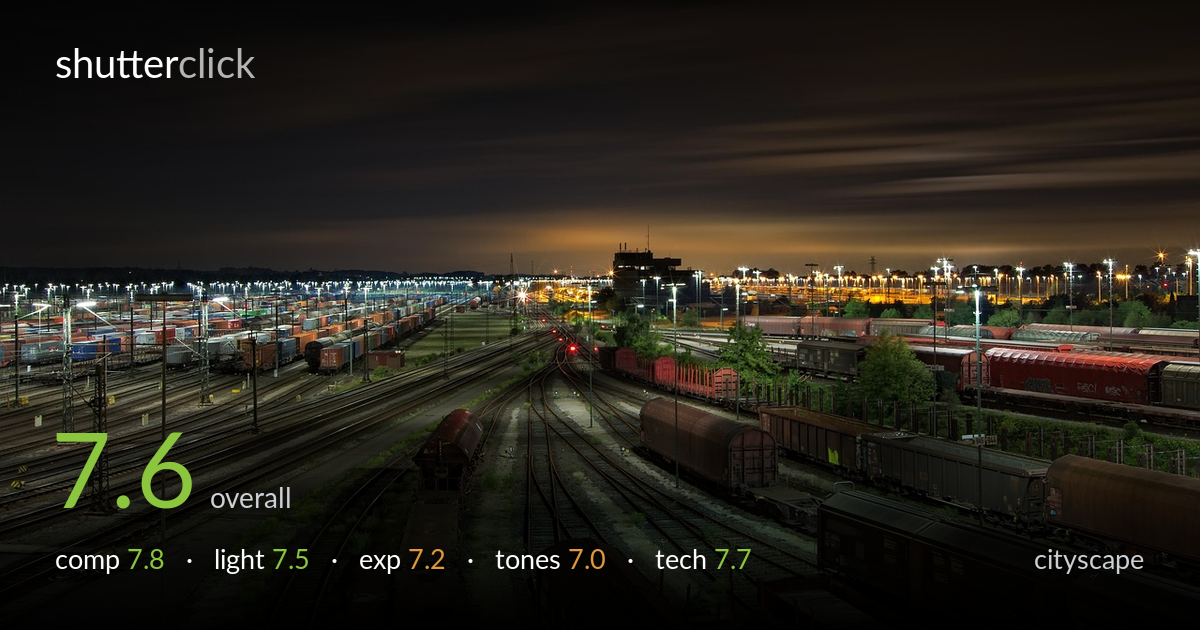
Freight yard at night
Photo by fotolehrling

No EXIF metadata in this file
Technical analysis based on visual assessment only.
A confident industrial cityscape that uses the converging rail lines to pull the eye through a sprawling freight yard toward a glowing horizon. The elevated vantage and the web of tracks fanning out from the foreground give real depth and a strong sense of scale. What holds it back most is the sky: the long-exposure cloud movement reads more as a muddy brown smear than a dramatic streak, and the upper third is dead weight tonally. The warm sodium glow on the horizon is the strongest element and could carry more of the frame. A cleaner colour balance and a touch more shadow lift would sharpen the whole.
The elevated viewpoint is well chosen, letting the multiple track lines converge and fan across the frame as strong leading lines that organise an otherwise chaotic yard. Depth is excellent — foreground rolling stock, mid-ground signal towers, and the distant lit horizon all read clearly. The horizon sits low, which suits the genre. The main weakness is the upper third: a large expanse of featureless dark sky adds little, and the busy right side of wagons crowds slightly. A tighter vertical crop would concentrate attention on the tracks and lights.
The mix of cool mercury-vapour yard lamps and the warm sodium glow along the horizon creates an effective colour contrast that gives the scene atmosphere. The low ambient light renders the foreground tracks with enough modelling to show their texture and converging geometry. The distant artificial glow is the most compelling light in the frame and anchors the composition. The sky, however, receives no meaningful light and stays flat. Capturing this nearer blue hour would have lit the cloud movement and balanced the tonal weight between earth and sky.
The exposure is well judged for a difficult night scene — the foreground holds detail in the tracks and wagons without crushing to black, and the bright yard lamps and horizon glow stay largely controlled rather than blowing out. The long exposure has gathered enough light to keep shadows readable. The sky is the soft spot: it sits in an awkward dim brown midtone that lacks both true black depth and any highlight interest. A slightly shorter exposure with shadow recovery in post would protect the lamp highlights while keeping foreground detail.
The cool-warm split between the bluish yard and the amber horizon is the tonal backbone, and it works. Contrast is reasonable for night. The trouble is the sky's colour cast — a heavy, muddy brown that feels neither natural nor intentional and drags the whole upper half down. White balance leans warm overall, which suits the sodium glow but muddies the clouds. Pulling the sky toward a cleaner neutral or deep blue, and deepening the shadows there, would let the lit areas sing with more separation.
Execution of the long exposure is solid. Focus holds well across the foreground tracks and the nearer rolling stock, and the depth of field is deep enough to keep the distant yard acceptably sharp — appropriate for this kind of wide cityscape. Noise is well controlled in the shadows, suggesting a low ISO and a tripod-steadied exposure, which is exactly right here. The cloud blur confirms a multi-second shutter, and it has been held steady with no visible camera shake in the static elements. The main technical limitation is that the long exposure smeared the clouds into an indistinct mass rather than coherent streaks — partly a function of cloud direction and speed on the night. A graduated approach, or blending a shorter sky frame, would preserve cloud structure. Otherwise the lens choice and vantage are well matched to the subject, rendering the geometry of the rails cleanly without obvious distortion at the edges.
What would elevate it
Tags
Shot something like this?
Expert photo critique, on demand — scored across six categories, EXIF-aware. Start with 3 free critiques, no credit card.
critique my photo — free