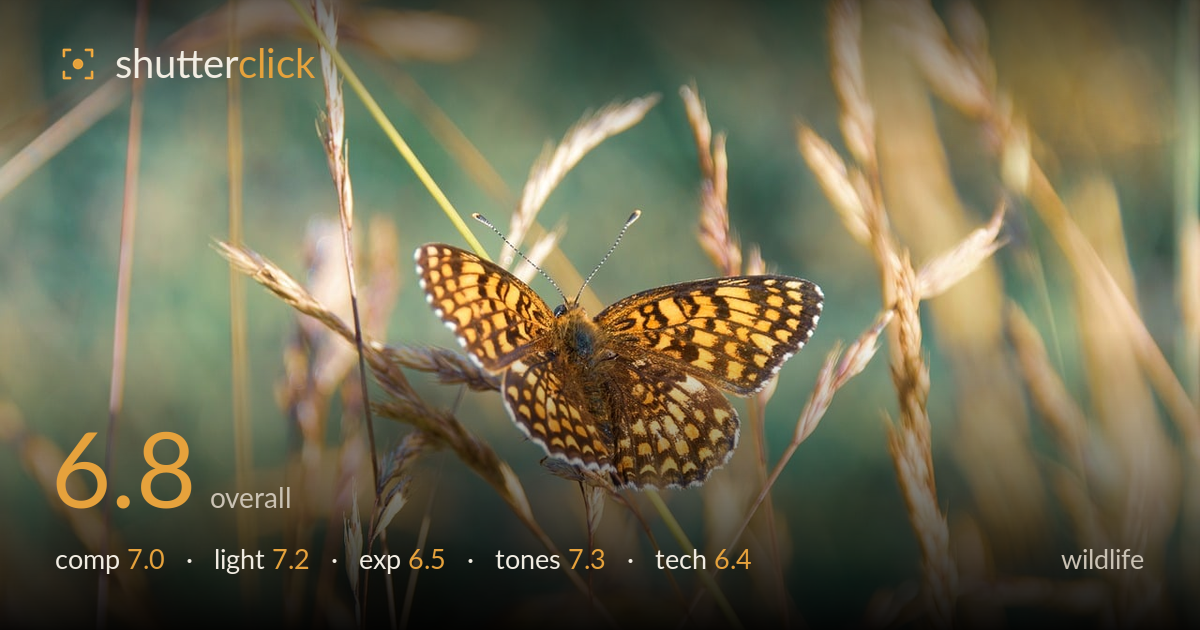
Fritillary with wings spread in dry grass
Photo by wal_172619

No EXIF metadata in this file
Technical analysis based on visual assessment only.
A fritillary with wings spread, warmly backlit in dry grass — an appealing subject caught in a decisive open-wing pose. The soft golden palette and creamy background give the frame a pleasant, airy mood. What most holds it back is focus: the sharpest plane sits on the wing edges and upper markings rather than the head and thorax, so the eye never lands on a truly crisp anchor. Foreground grass blades cross the butterfly and slightly compete with it. Tighter focus on the head and a cleaner path to the subject would lift this from a nice grab to a strong wildlife frame.
Placing the butterfly slightly left of centre with its wings filling the middle third works, and the diagonal grass stems add movement and context. However, several out-of-focus blades cut directly across the wings and body, creating visual clutter that competes with the subject rather than framing it. The lower foreground is busy and unresolved. More breathing room above the antennae would help, and a shooting angle that kept crossing stems off the wings would isolate the insect more cleanly against the soft background.
Warm, low-angle light rakes across the scene and gives the grasses a glowing, backlit quality that suits the mood. The butterfly's wings catch enough light to show the orange-and-brown patterning without harsh specular hotspots. The direction is largely frontal-to-side, which keeps the wing markings legible. A touch more directional light to model the body and separate it from the equally warm background would add depth, since subject and surroundings currently share a very similar tonal register.
Exposure is generally well controlled for a bright, high-key scene. The wing highlights hold their orange without clipping, and shadow areas on the body retain detail. The overall brightness leans light, which fits the airy feel, but the thorax and head sit slightly dark against the luminous wings and could use a subtle local lift. No blown backgrounds or crushed blacks of concern — the histogram appears to sit comfortably in the upper midtones with room to spare on both ends.
The palette is cohesive: warm ambers and straw yellows in the grass, cooler sage green washes in the background, and the orange wings echoing the surroundings. White balance leans warm, which is flattering here. Contrast is gentle and appropriate for the soft mood. The one risk is that the subject's colours are so close to the background that separation suffers; a slight cooling of the background greens or a nudge of saturation on the wings would help the butterfly stand apart without breaking the harmony.
The main technical weakness is focus placement. On a wildlife shot the sharpest plane belongs on the eye and head, but here critical sharpness falls on the leading wing edges and some upper wing markings while the thorax, head, and antennae are noticeably softer. With wings this large and the insect nearly parallel to the sensor, a slightly smaller aperture would have carried more of the body in focus without losing the creamy background. The shallow depth of field renders the foreground grass as soft veils that partly obscure the subject. Shutter speed appears sufficient — there is no visible motion blur — and noise is well managed in the bright light. The lens delivers pleasant, smooth bokeh and good micro-contrast where focus lands, showing the wing scales cleanly. Prioritising single-point focus on the head, or stopping down a stop or two, would resolve the softness that currently keeps this from being tack-sharp where it matters most.
What would elevate it
Tags
Shot something like this?
Expert photo critique, on demand — scored across six categories, EXIF-aware. Start with 3 free critiques, no credit card.
critique my photo — free