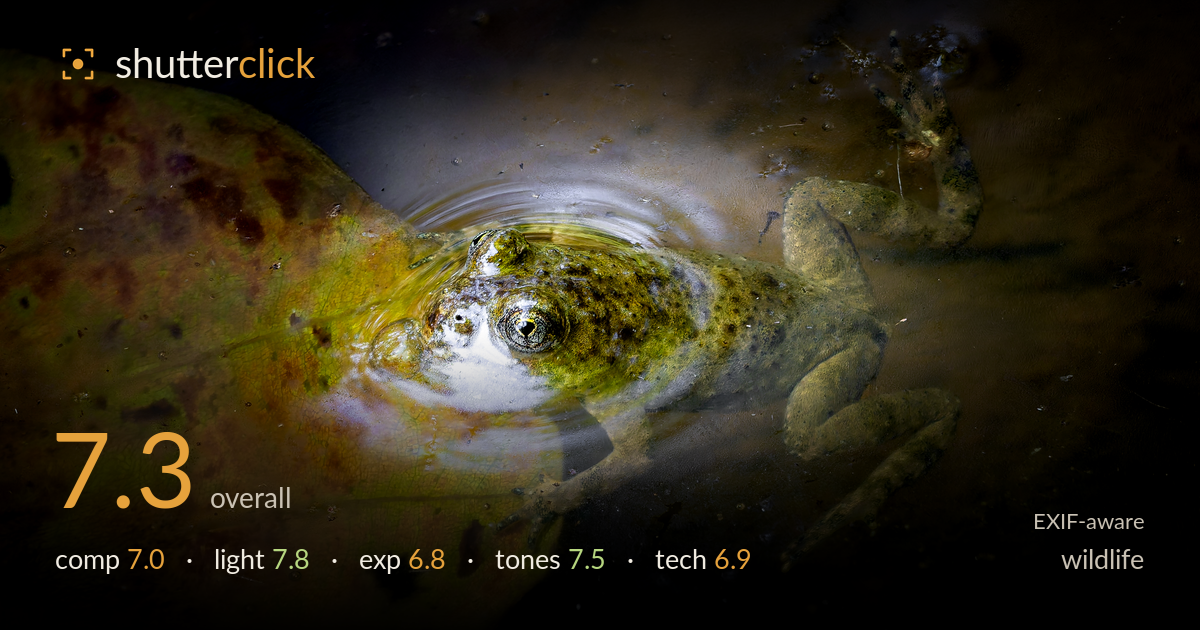
Frog surfacing in a spotlit pond
Photo by Kresimir Jukic
.jpg)
| Focal length | 211 mm |
| Aperture | f / 8.0 |
| Shutter | 1/100 s |
| ISO | ISO 800 |
| Exp. comp. | 0.0 EV |
| Shot at | 10:49 · Aug 8, 2026 |
A frog half-submerged at the waterline, its eye catching light against a dark pond, makes for an atmospheric and intimate wildlife study. The floating leaf and the submerged rear legs visible through the water add genuine storytelling and depth, and the pool of light around the head draws the eye exactly where it belongs. What most holds the image back is the softness of the eye — the critical focal plane isn't quite tack sharp, and at 211mm handheld at 1/100s that's the likely culprit. The heavy vignetting also feels applied rather than natural, crowding the edges. A cleaner eye and a lighter hand on the darkening would elevate this considerably.
The placement of the frog's head slightly left of centre with the light pool circling it works well, and the diagonal of the leaf leads into the subject. The submerged legs trailing to the right give a strong sense of the animal's full form beneath the surface — a nice narrative touch. The dark upper region is a lot of dead space, though, and the frame feels weighted toward the lower half. A crop that reduced the black expanse at top would tighten the balance and give the subject more presence.
The pool of light isolating the frog's head against surrounding darkness is the image's strongest asset — it reads almost theatrical and pulls attention immediately to the eye and mouthline. The soft falloff around the waterline ripple is handled with restraint. The translucent glow through the shallow water over the rear legs is a lovely secondary detail. The only caution is that the lighting relies heavily on this single bright zone; a touch more fill on the body would keep it from feeling like it drops off too abruptly into the murk.
Exposure is largely well judged for a dark, moody subject — the bright waterline reflection near the mouth is close to clipping but retains just enough texture. The deep shadows in the upper and lower corners crush to near black, which suits the mood but sacrifices any hint of surrounding context. The midtones on the frog's back hold detail nicely. The heavy vignette that darkens the frame edges looks added rather than optical, and a more measured application would preserve a more natural sense of the scene.
The warm ochre and olive palette of the frog and leaf against the cool near-black water is pleasing and cohesive, and the greens on the head read as natural. White balance sits comfortably, with the highlight on the water leaning slightly cool for a nice contrast against the warm leaf. Saturation is pushed a little in the leaf's rust tones, which edges toward over-rich, but it holds. The tonal range from the bright reflection down to the shadowed edges is broad and well used, giving the frame real depth.
At 211mm handheld, 1/100s is on the slow side, and the eye — the make-or-break plane for wildlife — is soft rather than crisply resolved. The catchlight and iris detail are visible but not biting, which is the image's chief technical shortfall. f/8 was a sensible depth-of-field choice for a subject spanning near and far through water, keeping both the head and the submerged legs reasonably readable. ISO 800 is well within this sensor's comfortable range and noise is not an issue. The IS on this lens helps but can't fully overcome the shutter-to-focal-length mismatch. A shutter closer to 1/250s or faster, braced or on a support, would have secured the eye. Focus appears to have landed slightly behind or in front of the eye — likely the shallow effective depth combined with the water surface confusing acquisition. Overall the settings are reasonable; the execution on focus and shutter is what needs tightening.
What would elevate it
Tags
Shot something like this?
Expert photo critique, on demand — scored across six categories, EXIF-aware. Start with 3 free critiques, no credit card.
critique my photo — free