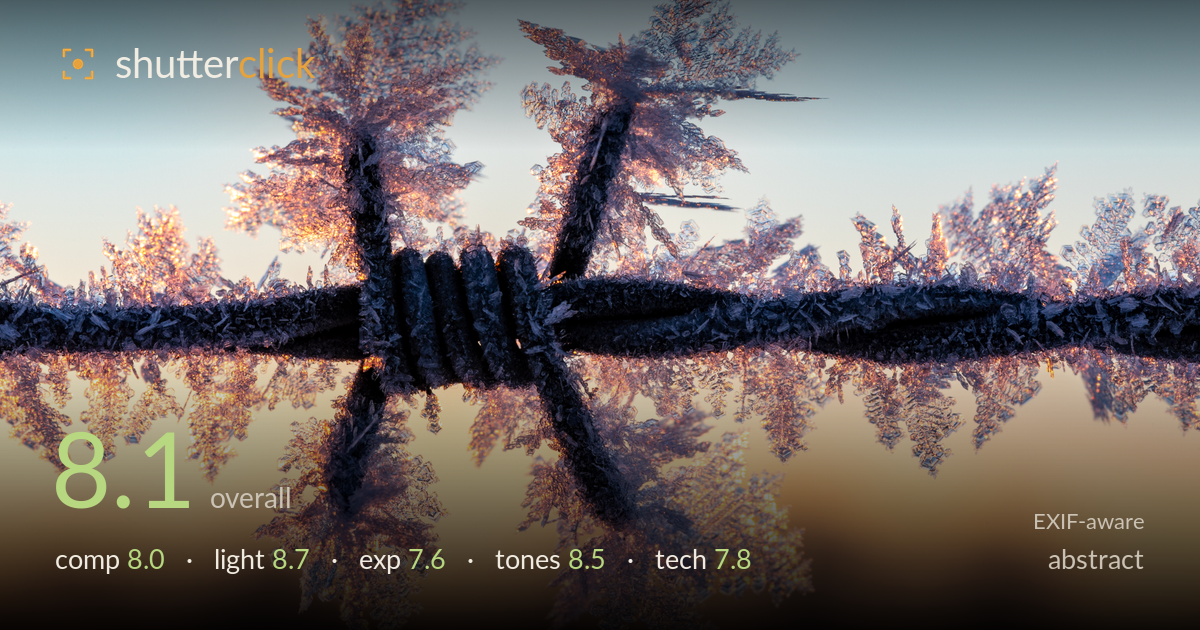
Frost crystals on barbed wire at sunrise
Photo by Dietmar Rabich

| Focal length | 105 mm |
| Aperture | f / 18.0 |
| Shutter | 1/6 s |
| ISO | ISO 100 |
| Exp. comp. | 0.67 EV |
| Shot at | 06:57 · Feb 14, 2021 |
Backlit ice crystals along a barbed-wire strand become a graphic, near-symmetrical study of frost against a warm-to-cool gradient — a strong seeing of an ordinary subject transformed by light. The horizontal wire splitting the frame, mirrored above and below, gives the composition its rhythm and its risk: it teeters toward a perfectly bisected frame. What most holds the image back is the wire sitting almost dead-centre and the deep shadow strip crossing the lower foreground, which pulls weight downward without adding detail. The crystal detail catching the low sun is the real reward here, and it carries the frame.
The near-mirror arrangement of frost above and below the wire is the graphic idea, and it reads clearly. The two upright crystal clusters give vertical counterpoint to the strong horizontal, and the twist of wire anchors the centre. The weakness is that the wire bisects the frame almost exactly, and the composition leans on symmetry without a dominant focal accent to break the tie. The dark out-of-focus band across the bottom edge adds visual weight but no information. A slightly higher wire placement would let the warm base breathe.
Low-angle backlight is the making of this frame — it rims each ice spicule and turns the crystals into glowing filaments, separating them cleanly from the graduated sky. The warm sun low in the background against the cool blue upper sky builds a natural temperature contrast that gives the frost dimension. Direction is ideal for revealing the translucent structure of ice; the light passes through the crystals rather than bouncing off them. Timing at golden hour was the decisive choice and it pays off throughout.
The +0.67 EV lift keeps the frost luminous without blowing the brightest crystal tips, and the sunlit background holds its glow rather than clipping to white. Highlights on the ice edges retain texture, which matters most here. The trade-off is the lower foreground, where the shadowed band goes near-black with little recoverable detail — a deliberate-looking silhouette but a heavy one. Overall the exposure decisions read as controlled, balancing a wide brightness range from backlit sun to shadowed wire with restraint.
The warm-to-cool gradient is the tonal engine — amber and gold at the base rising into soft blue does a lot of the emotional work. Saturation is held in check so the frost stays believable rather than candied, and the pinks in the crystal highlights feel earned by the light, not pushed. Contrast between the near-black wire and glowing ice is strong without crushing the midtones in the crystals. White balance sits warm, appropriate to the hour. A touch more separation in the shadow band's tones would help.
At 105mm and f/18, depth of field is stretched to hold both banks of frost across the wire, and it largely succeeds — the crystal detail on the central clusters is crisp and reads sharply. That aperture, however, sits well into diffraction territory on the 5D Mark IV, softening the finest ice filaments slightly; f/11 to f/13 would likely have recovered a hair of critical sharpness while still carrying adequate depth. ISO 100 keeps the file clean, essential for the smooth background gradient. The 1/6s shutter is only viable on a tripod, and there's no evidence of shake, so support was sound — though any breeze on the delicate crystals at that speed risks blur, and a faster shutter would insure against it. Focus falls correctly on the crystal plane. The 105mm macro is well suited to this working distance and rendering. Solid execution overall; the main technical lever left on the table is a wider aperture to sidestep diffraction.
What would elevate it
Tags
Shot something like this?
Expert photo critique, on demand — scored across six categories, EXIF-aware. Start with 3 free critiques, no credit card.
critique my photo — free