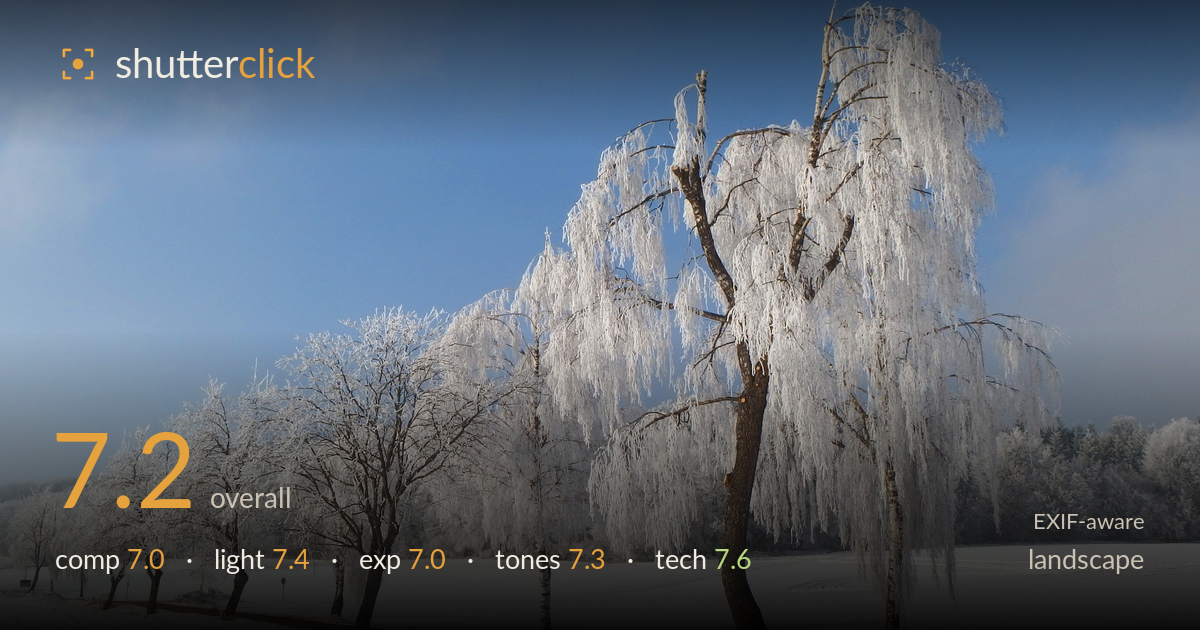
Frost-laden birches along a winter road
Photo by Kreuzschnabel

| Focal length | 8 mm |
| Aperture | f / 8.0 |
| Shutter | 1/800 s |
| ISO | ISO 100 |
| Exp. comp. | 0.0 EV |
| Shot at | 14:08 · Feb 19, 2015 |
A crisp, well-seen hoarfrost scene where a row of frost-laden birches recedes along a diagonal road into a clean winter field — the receding line of trees is the strongest element, giving genuine depth and scale. The frost detail against a deep blue sky is the real reward here. What most holds it back is the near tree's placement: the dominant right-hand birch crowds the frame edge and competes with the recession rather than anchoring it. The road, a natural leading line, sits underused in the lower corner. Tighter attention to where the strongest tree lands would lift this considerably.
The diminishing row of trees along the road builds a convincing sense of depth and distance, and the split between snowfield and blue sky is clean. The problem is the largest birch pressed against the right edge — it dominates but feels cut off, pulling weight out of the frame. The road, which could serve as a strong leading line, is relegated to a thin sliver in the lower-left corner. A composition that gave the road more presence, or set the big tree slightly more inboard, would balance the recession better.
Low, raking winter sun lights the frost beautifully, picking out the ice crystals on every twig and giving the branches a luminous edge against the sky. The side light also models the tree trunks and rakes across the snow, hinting at texture in the foreground. Shadows are long and cool, appropriate to the season and hour. The light on the distant treeline is a touch flat, and the sky gradient does much of the mood work, but overall the timing serves the frost well.
Exposure is handled sensibly for a bright snow scene — the whites hold detail in the frost rather than blowing out, and the blue sky retains tone. The road and darker trunks keep enough shadow information without blocking up. There is mild highlight compression in the brightest sunlit frost near the top-right tree, and the vast snow foreground reads slightly bright and empty. A touch more shadow presence in the snow's raking texture would have added dimension, but the histogram is well controlled overall.
A clean, cool winter palette: deep blue sky grading lighter toward the horizon, white frost, and the warm ochre of the exposed road and trunks providing welcome contrast. White balance reads accurate — the snow stays neutral without a blue cast. The tonal range is wide and handled well, from the dark trunks to the bright frost. The blue could feel slightly heavy at the top of the frame, and the distant haze mutes some separation, but the grading is faithful and pleasant.
The settings suit the conditions well. At f/8 on the XZ-10's small sensor with an 8mm focal length, depth of field is deep enough to hold the near trunk and distant treeline acceptably sharp — appropriate for a landscape. ISO 100 keeps noise negligible and preserves the fine frost detail, which is exactly what this subject demands. The 1/800s shutter is far faster than a static scene needs, but it costs nothing here given the bright conditions and does guarantee freedom from any camera shake. Focus appears accurate across the plane, with the frost crystals rendering crisply. The main limitation is the sensor and lens itself: fine twig detail in the distant trees softens slightly and the dynamic range is stretched by the bright snow against dark trunks. Nothing in the settings is at fault — this is close to optimal for the camera. A polariser could have deepened the sky and cut glare off the snow for extra bite.
What would elevate it
Tags
Shot something like this?
Expert photo critique, on demand — scored across six categories, EXIF-aware. Start with 3 free critiques, no credit card.
critique my photo — free