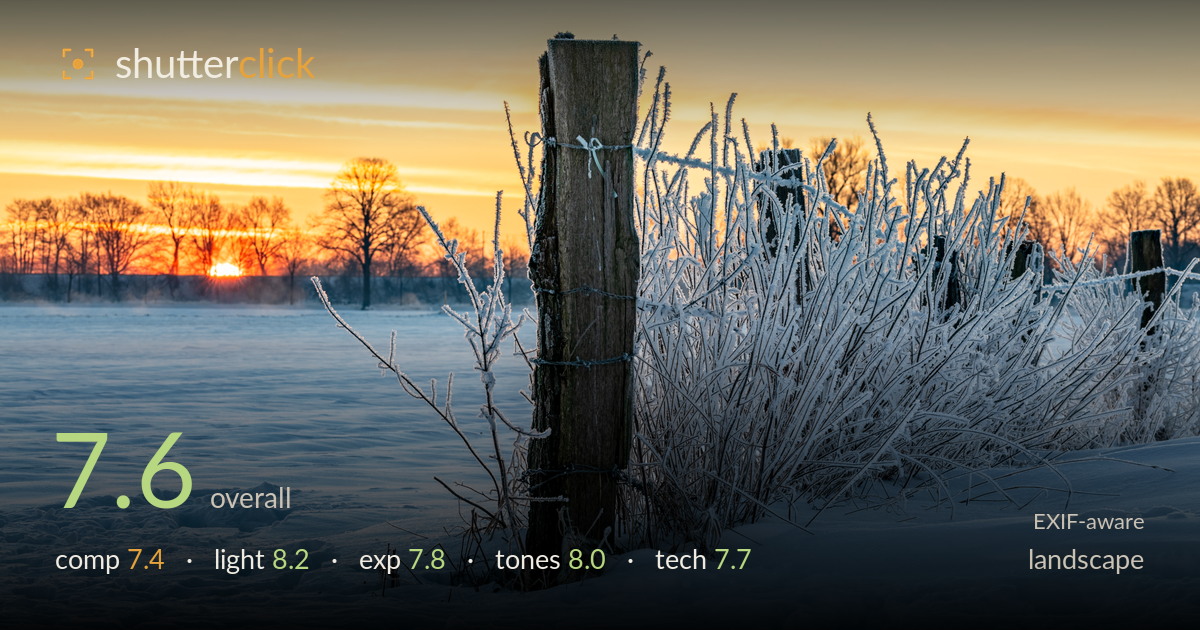
Frosted fence post at sunrise
Photo by Dietmar Rabich

| Focal length | 105 mm |
| Aperture | f / 14.0 |
| Shutter | 1/80 s |
| ISO | ISO 100 |
| Exp. comp. | -2.0 EV |
| Shot at | 06:52 · Feb 14, 2021 |
A well-timed hoar-frost sunrise where warm and cool tones do the heavy lifting. The frosted fence line leads the eye from the weathered post into the setting sun, and the temperature contrast between the golden sky and blue-shadowed snow gives the frame genuine atmosphere. The post anchors the composition, but its near-central placement fights the strong diagonal of the frost-laden grasses. The vast snow foreground is textured but under-utilised, contributing more empty space than depth cues. Sharpness on the near frost is convincing; the distant treeline sun holds without blowing out. Trimming that foreground would sharpen the whole statement.
The frosted post anchors the frame and the barbed-wire fence carries a clear diagonal toward the sun, a solid depth device. The problem is the post sits almost dead-centre horizontally while the real energy — the frost-laden grasses — sweeps off to the right, creating a slight tug-of-war. The lower third is a large expanse of scuffed snow that adds texture but little narrative. A tighter crop lifting the horizon and reducing that foreground would concentrate attention on the post-to-sun relationship. Horizon placement in the upper third works well.
The timing is the strongest element: low sun breaking through the treeline at the moment hoar frost rims every branch, so the light rakes across and catches the ice crystals. The warm band along the horizon reads naturally against the cool blue of the shaded snow, and the sun sits just below the trees without overwhelming the scene. The near frost sits mostly in shadow, so some of its sparkle is muted; a fraction more front light or a slightly different angle would have set the near grasses alight.
The -2 EV compensation was the right instinct — it protects the sky and the sun's core, which hold colour and just barely retain detail rather than clipping to white. The snow reads as a believable blue-white rather than blown paper, and shadow areas on the post keep enough texture to show grain and frost. The trade-off is the foreground snow leaning slightly dark and heavy in the lower left. A gentle shadow lift would recover a touch of foreground separation without threatening the well-guarded highlights.
The colour story is the picture's biggest asset: a graded warm horizon of amber and orange transitioning up to pale sky, set against the cool blue cast of shaded snow. White balance feels honest for a cold dawn — the snow reads cold without going artificially teal. Contrast is controlled, the frost stays bright without glare, and the treeline silhouettes give a clean tonal edge. Saturation in the sunset band is rich but not pushed. The overall tonal range is handled with restraint appropriate to the delicate frost subject.
The settings are well matched to the scene. f/14 delivers the deep front-to-back sharpness a foreground-heavy landscape needs, keeping both the near post and the distant treeline acceptably crisp, though at this focal length and aperture diffraction is beginning to nibble at ultimate resolution — f/11 would have given a touch more bite with negligible depth loss. ISO 100 keeps noise absent, ideal for the smooth sky gradient. 1/80s on a static frost scene is fine, and the frost detail suggests a tripod or steady hand held it. The 105mm choice compresses the treeline and sun pleasingly, pulling the distant sunset closer to the post. Focus appears placed on the near frost and post, which is the correct plane. The main technical note is that a small aperture at 105mm on this sensor sits right at the diffraction threshold; execution is otherwise clean and deliberate, with exposure decisions clearly considered rather than accidental.
What would elevate it
Tags
Shot something like this?
Expert photo critique, on demand — scored across six categories, EXIF-aware. Start with 3 free critiques, no credit card.
critique my photo — free