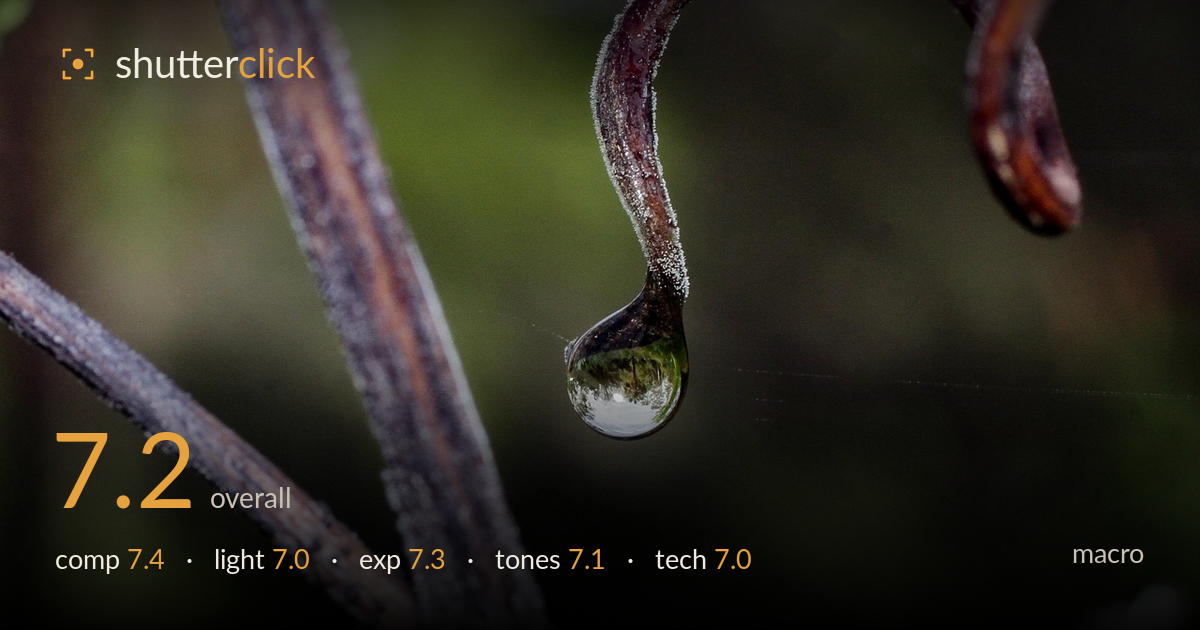
Frosted stem with a hanging dewdrop
Photo by alicemary

No EXIF metadata in this file
Technical analysis based on visual assessment only.
A well-observed dewdrop hanging from a curling, frost-dusted stem, with the refracted landscape inside the drop as the payoff. The strongest asset is the placement of the hanging tip and drop against clean, dark negative space, and the fine rime frost that catches light along the stem edges. What most holds it back is focus: the drop and its refraction — the natural focal point — sit slightly softer than the frost on the stem above, so the eye lands where the sharpness isn't. The busy diagonal branches in the lower left also compete for attention. Tighter focus discipline and a cleaner background would elevate this considerably.
The curling stem entering from top-right and terminating in the pendant drop makes a natural, elegant line, and the dark negative space through the centre isolates it well. The refractive drop as an end-point reward is a smart payoff. Less successful are the crossing diagonal branches in the lower-left third — they're prominent enough to pull attention and clutter an otherwise clean frame. A slightly tighter framing that reduced their weight, or a shooting angle that placed them fully out of focus, would give the drop cleaner dominance.
Soft directional light rakes across the stem enough to reveal the frost crystals along its edges, which is exactly what this subject needs — that rim of rime is the textural highlight. The background falls into shadow, helping the subject separate. However, the light on the drop itself is a touch flat, so the refracted image inside lacks the sparkle and internal contrast a slightly harder or more angled source would draw out. Backlighting through the drop would have lit the refraction more dramatically.
Exposure is well judged for a high-contrast scene. The frost highlights on the stem hold detail without clipping, and the dark background retains subtle tonal variation rather than blocking to pure black. The drop's interior — the critical element — keeps detail in both the bright sky refraction and the darker rim. Midtones on the stem read cleanly. If anything, the overall image sits slightly dark, and lifting the shadows a touch in post would reveal more of the background texture without harming the subject separation.
The muted, earthy palette — maroon and ochre stems against desaturated green shadow — suits the cold, damp mood. The frost reads convincingly neutral, suggesting accurate white balance. The tiny inverted landscape inside the drop introduces a welcome patch of green and light. Contrast is handled well between the lit frost and dark surround. The background greens are a little murky and undifferentiated, which flattens the depth slightly; a hair more separation or warmth in the midtones would give the backdrop more life without distracting.
Depth of field is extremely shallow, as expected at this magnification, and the plane of sharpest focus appears to sit on the frost of the stem above the drop rather than on the drop and its refraction. Since the refracted landscape is the conceptual heart of the image, that's the miss — the eye wants crispness where it isn't quite delivered, and the drop reads marginally soft. The frost detail on the upper stem is genuinely sharp and resolves individual crystals nicely, showing the lens and technique are capable. Handheld or wind-induced micro-movement is a plausible culprit given how narrow the focus band is. A focus point placed on the drop itself, a slightly smaller aperture to extend the plane through both stem and drop, or a focus-stack blending the frost and the refraction would resolve it. A tripod and remote release would remove the small-motion risk that this magnification punishes so heavily.
What would elevate it
Tags
Shot something like this?
Expert photo critique, on demand — scored across six categories, EXIF-aware. Start with 3 free critiques, no credit card.
critique my photo — free