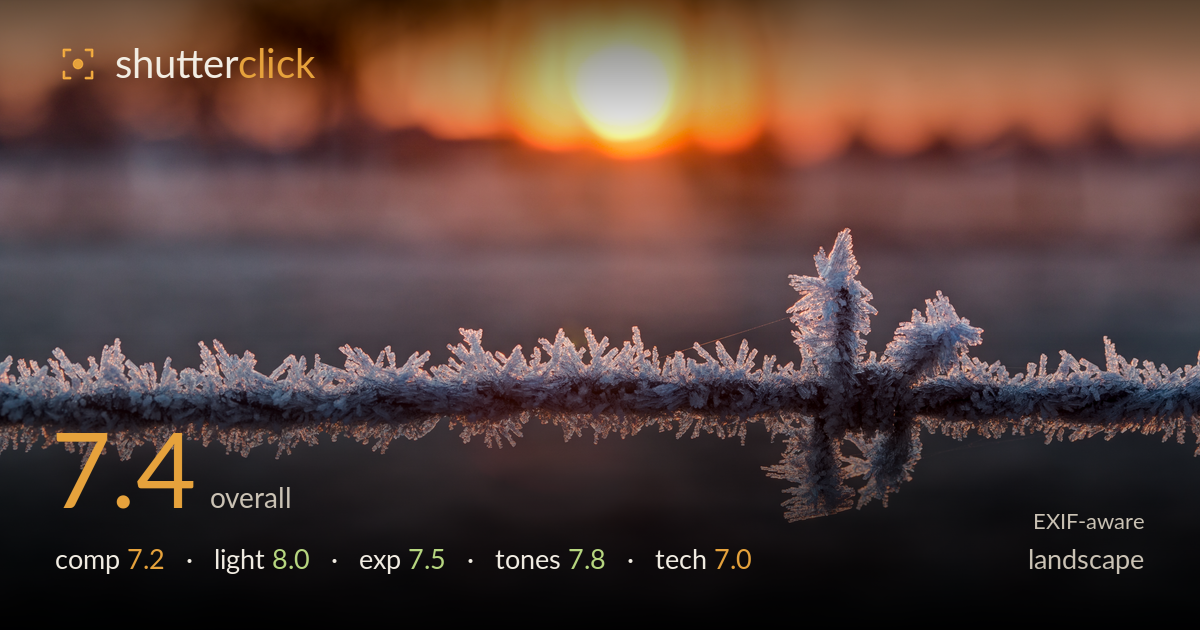
Frosted wire against the setting sun
Photo by Dietmar Rabich

| Focal length | 60 mm |
| Aperture | f / 9.0 |
| Shutter | 1/320 s |
| ISO | ISO 100 |
| Exp. comp. | 0.0 EV |
| Shot at | 08:32 · Dec 4, 2016 |
A frost-encrusted barbed wire read against a low winter sun makes a genuinely evocative image, carried by warm backlight that fires through every ice crystal. The hoarfrost detail on the wire barb is the real reward, and the tree silhouette anchors the soft background. What holds it back is the depth-of-field balance: at f/9 the wire is largely sharp but the barb and its icy crown sit at the near edge of the focus plane and soften slightly, while much of the frame dissolves into bokeh. The wire also runs nearly through the middle, and the empty right end leaves the composition slightly unresolved.
The horizontal wire as a strong graphic line works, and placing the frosted barb cluster right of centre gives the eye a clear anchor against the setting sun. The sun sits close to a third, which helps. But the wire crosses almost dead-centre vertically, splitting the frame into two near-equal bands, and the long stretch of bare wire running off the left and right edges feels underused. A slightly lower wire placement, and letting the barb sit nearer a power point, would give the frost more room to breathe and resolve the empty ends.
The timing is the strongest asset here. Shooting straight into a low sun backlights the ice crystals so each spike glows and rims with warm light, exactly what frost photography needs. The sun's position just above the horizon gives long, soft directional light and a gentle glow across the background. The tree and horizon fall to silhouette, which keeps attention on the lit frost. Only minor point: the wire's lower edge falls into cool shadow, so the crystals there read flatter than the backlit upper edge.
Exposure is well judged for a into-the-sun frame. The sun's core clips, as expected and largely acceptable here, and the surrounding glow holds graduated colour rather than blowing to a white blob. Shadow areas in the foreground and lower wire retain enough information without muddiness. The frost highlights sit bright but mostly under control, preserving crystal texture. A touch more highlight recovery around the sun would tame the hottest halo, and a hair more shadow lift on the wire's underside would balance the strongly lit top edge.
The warm-to-cool split is the image's tonal signature: amber sky and sunlit frost against the cool blue foreground band. That temperature contrast reads deliberate and gives the frost a jewel-like quality where the light passes through it. White balance leans warm, appropriate for the hour. The orange gradient around the sun is smooth. The lower foreground drifts a little flat and grey, and the transition from warm upper frost to cool lower wire could feel less abrupt with a gentler local warmth lift, but overall the palette is coherent and atmospheric.
The 60mm macro is a sensible choice for this frost study, and f/9 was a reasonable attempt to hold the wire's depth against a shallow near-subject. In practice the focus plane favours the mid-wire: the frosted barb cluster and its crown sit slightly forward and read a touch soft where they should be the sharpest point. Stopping to f/11–f/13, or focusing marginally further forward onto the barb, would put the crystalline detail exactly where the eye lands. ISO 100 keeps the file clean with no visible noise, and 1/320s easily froze any breeze on the frost. Diffraction is not yet a concern at f/9, so there was headroom to close down. The wire is level and the background bokeh is smooth and pleasing, so lens and settings largely served the scene. The main gain available is precise focus placement on the standout ice formation rather than the plain wire.
What would elevate it
Tags
Shot something like this?
Expert photo critique, on demand — scored across six categories, EXIF-aware. Start with 3 free critiques, no credit card.
critique my photo — free