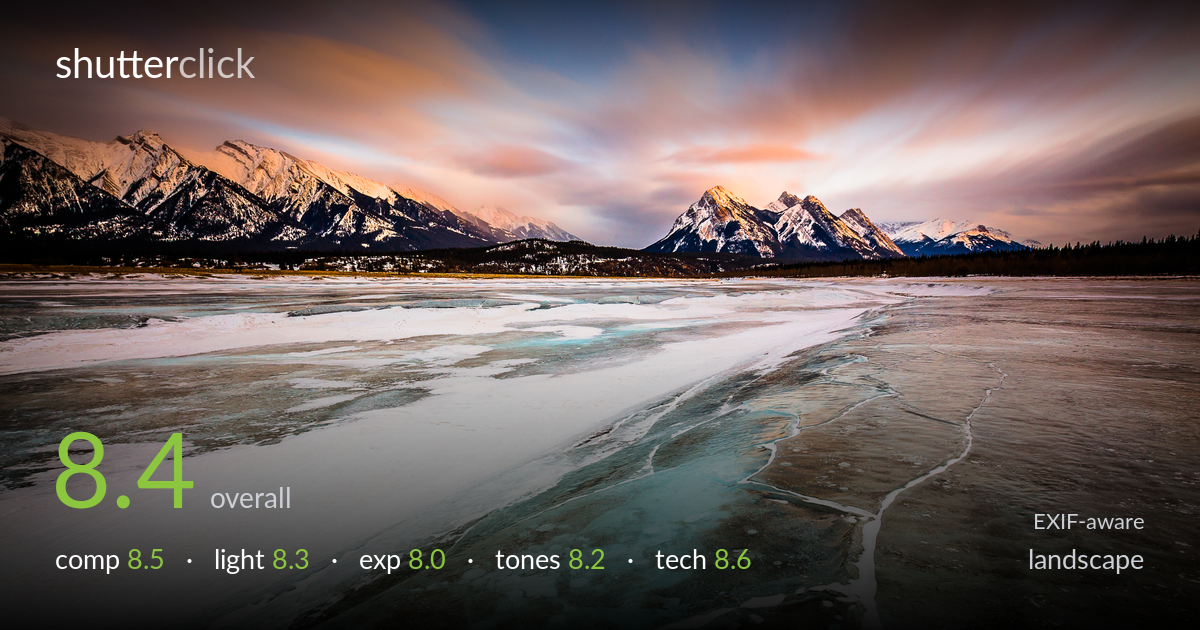
Frozen lake beneath glowing peaks
Photo by Martin Sojka

| Focal length | 16 mm |
| Aperture | f / 16.0 |
| Shutter | 553.0 s |
| ISO | ISO 50 |
| Exp. comp. | 0.0 EV |
| Shot at | 18:10 · Jan 31, 2014 |
A textbook frozen-lake composition executed with real command of foreground interest. The turquoise ice with trapped methane bubbles and the diagonal pressure ridge lead the eye powerfully toward the alpenglow-lit peaks, and the long exposure has smeared the sky into expressive motion. The strongest element is the depth — near-to-far layering rarely reads this cleanly. What holds it back slightly is a sky that runs warm to the point of looking pushed in places, and a foreground that competes for attention with several strong leading lines rather than committing to one. Still, a confident and resolved frame.
The diagonal pressure ridge and the band of clear blue ice work as a strong leading line from the bottom-right corner up to the peaks, and the bubble field anchors the foreground with genuine texture. Horizon placement in the upper third is well judged, giving the ice room to dominate. The two mountain massifs left and right balance the frame nicely. The one weakness is that several competing lines cross the lower frame, so the eye scatters slightly before settling on the peaks.
The timing captures alpenglow catching the right-hand peaks while the left massif holds cooler shadow, creating depth through light separation. The warm sunset glow against the cold ice is the emotional core of the image. The low-angle light skims the snow on the slopes, revealing form. The foreground, however, sits in flatter ambient light with little directional modeling, so the ice texture relies more on the inherent pattern than on raking light. A touch more warmth reaching the near ice would have unified the scene.
Exposure is well controlled across a difficult dynamic range. The lit peaks retain detail without clipping and the shadowed left mountain holds form. The bright snow band mid-frame is close to blowing but stays just within range. ISO 50 and the long exposure keep the file clean. The brightest warm clouds at upper centre push toward the highlight ceiling and lose some subtlety. A graduated approach or slight pull on those clouds would preserve more tonal information in the sky's hottest zone.
The turquoise-to-orange complementary palette is the image's signature, and it largely works — cold foreground against warm sky reads as intentional. White balance is well placed on the ice. The concern is the sky's saturation: the oranges and magentas verge on oversaturated and slightly artificial in the most intense areas, which can undermine the otherwise natural feel. The mid-tones in the mountains hold good gradation. Dialing back vibrance in the warmest clouds would let the genuine alpenglow carry the colour story more credibly.
The settings are well matched to the scene. At 16mm on the EF16-35mm f/2.8L, f/16 delivers the deep front-to-back sharpness this near-foreground-to-distant-peak composition demands, and focus appears well placed to keep both the bubble field and the mountains acceptably crisp. ISO 50 maximizes dynamic range and keeps noise negligible in the smooth ice and sky. The 553-second exposure is the bold choice that pays off: it renders the moving clouds as sweeping streaks, adding energy to the upper frame. One caution at f/16 on full frame is diffraction softening fine detail slightly — f/11 might have held marginally more bite in the bubbles while still covering the depth. A long exposure of this length also implies a sturdy tripod and likely an ND filter, both executed cleanly with no visible shake or banding. Overall a technically assured capture where every setting serves the image's intent.
What would elevate it
Tags
Shot something like this?
Expert photo critique, on demand — scored across six categories, EXIF-aware. Start with 3 free critiques, no credit card.
critique my photo — free