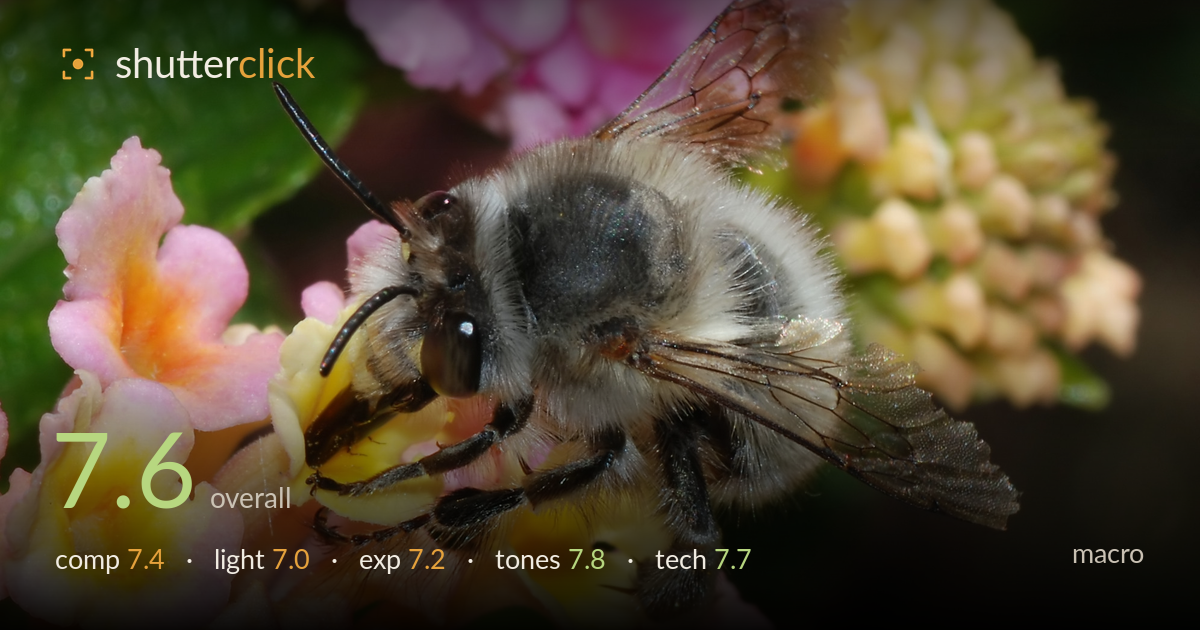
Fuzzy bee on lantana blooms
Photo by Alvesgaspar

No EXIF metadata in this file
Technical analysis based on visual assessment only.
A well-timed capture of a fuzzy solitary bee on lantana, with the eye and antenna rendered sharp and the fur texture holding fine detail. The compact colour palette of pink, yellow and green frames the subject pleasingly. What most holds it back is the busy background: the yellow lantana cluster on the right competes with the subject, and the harsh midday sun creates specular hotspots on the fur and hard shadows. A softer light and cleaner separation would lift this from a strong record shot to a standout macro.
The bee is placed left of centre facing into the frame, which gives its gaze room and reads naturally. The surrounding lantana clusters supply context without overwhelming, and the diagonal of the body creates energy. The bright yellow flower head at right, however, pulls attention away from the subject and slightly crowds the composition. The wing runs close to the right edge. A framing that pushed the competing cluster further out of focus, or a touch more breathing room around the abdomen, would strengthen the balance.
Direct midday sun lights the subject from the upper left, which brings out the silver fur but at a cost. Specular highlights flare on the thorax hairs and the wing membrane, and the light is hard enough to drop the underside legs into dense shadow. The catchlight on the eye is a genuine plus, adding life. A diffuser or shooting under lighter overcast would soften those hotspots and reveal fur texture more evenly across the body without losing the modelling.
Exposure is handled reasonably for a high-contrast scene. The pale fur retains texture rather than blowing out entirely, and the eye holds detail. Some of the brightest thorax hairs and the sunlit yellow petals nudge toward clipping, and the shadowed legs and belly sit quite dark with limited recoverable detail. Overall the midtones on the bee are well placed. A slight reduction in exposure to protect the fur highlights, with shadows lifted in post, would balance the range better.
The colour rendering is the standout strength here. The muted pinks, warm yellows and deep greens form a cohesive, appealing palette that flatters the silvery-grey bee. White balance looks accurate under the daylight, and saturation is natural rather than pushed. Contrast is a touch high courtesy of the hard sun, deepening the shadows more than ideal. The subtle iridescence caught on the thorax adds interest. Gentle contrast easing would recover a little more gradation in the darkest fur and legs.
Focus is placed well on the eye and the front of the face, and the antenna and facial hairs are crisp, which is what matters most in a macro insect shot. Depth of field is shallow, as expected at this magnification, and falls off across the abdomen and wings so the rear of the body softens noticeably. That is a defensible single-frame compromise given a live, moving subject, though a focus stack would have carried sharpness through the whole thorax and abdomen. The handheld capture froze the bee cleanly with no motion blur, suggesting an adequately fast shutter. Noise is well controlled and fine hair detail resolves nicely, indicating a sensible ISO and good glass. The main technical opportunity is depth: a slightly smaller aperture, or stacking several frames, would keep the wing and abdomen within the sharp zone. Getting the sensor plane more parallel to the bee's body would also spread the available depth of field more efficiently across the subject.
What would elevate it
Tags
Shot something like this?
Expert photo critique, on demand — scored across six categories, EXIF-aware. Start with 3 free critiques, no credit card.
critique my photo — free