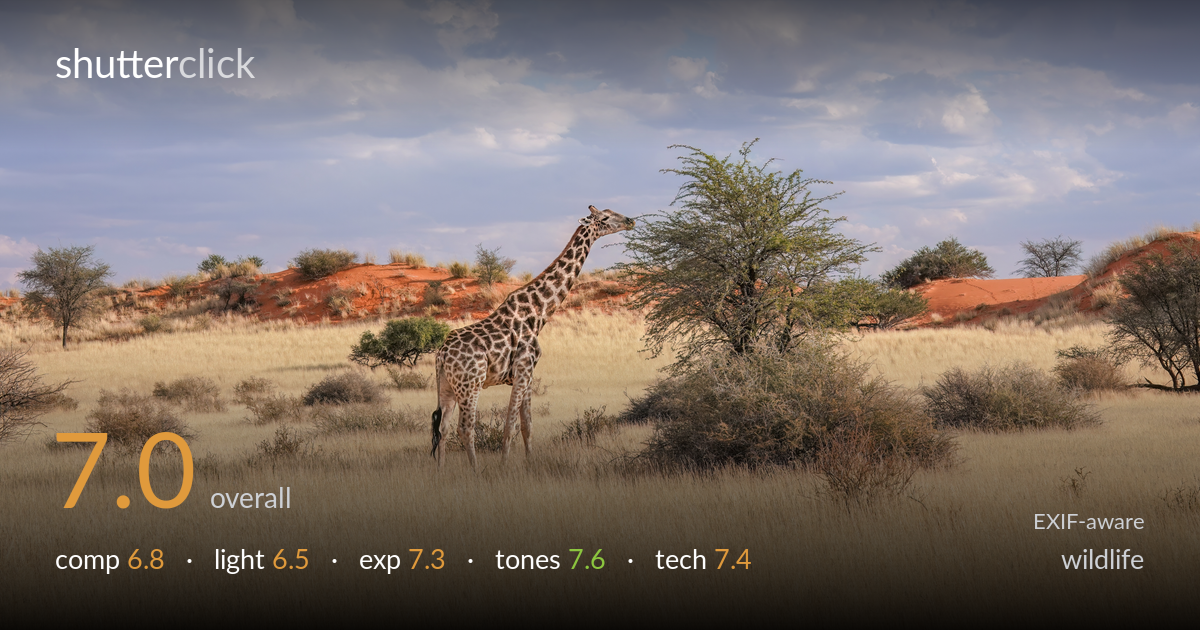
Giraffe in the kalahari grass
Photo by Giles Laurent

| Focal length | 70 mm |
| Aperture | f / 8.0 |
| Shutter | 1/1000 s |
| ISO | ISO 400 |
| Exp. comp. | 0.0 EV |
| Shot at | 13:49 · Jul 21, 2025 |
This reads more as an environmental portrait than a tight wildlife shot, and that's its strength — the giraffe sits in a richly layered Kalahari scene of golden grass, red dunes, and an acacia. The animal-in-habitat approach works, but the head is partly merged with the acacia foliage behind it, weakening the most important element. The light is flat and overhead rather than the warm raking light this landscape rewards, and the giraffe's facing direction crowds the frame edge. Solid execution overall, with the framing and timing of light as the main levers for improvement.
The giraffe is placed left of centre with the acacia balancing it on the right — a reasonable two-element arrangement, and the red dune band gives the middle ground welcome structure. The problem is the head merging into the dark acacia canopy, costing the most important part of the animal its separation. The giraffe also faces into a tight margin of space rather than open frame, which feels slightly cramped. The expansive foreground grass adds context but occupies a lot of real estate that does little compositional work.
The light is soft and broadly diffused under a partly clouded sky, which keeps shadows gentle and avoids harsh contrast on the animal, but it's also flat and directionless. There's no modelling to give the giraffe form or to rake texture across the grass and dunes. The red sand in the background, which could glow under low warm light, reads muted here. A lower sun angle near golden hour would have shaped the scene and lifted the colour of that dune band considerably.
Exposure is well controlled across a wide tonal range. The bright sky retains cloud detail without blowing out, the golden grass holds its midtones, and the giraffe's coat keeps shadow detail in the spots and underside. Nothing is clipped to distraction and the histogram appears used end to end. The animal sits slightly dark against the busy background, so a touch of local lift on the giraffe would help it read, but the global exposure decision is sound and clearly deliberate.
The colour palette is the image's quiet strength — warm ochre grass, terracotta dunes, and the cool blue-grey sky create a pleasing complementary balance. White balance is natural and the grass isn't oversaturated into garishness. Contrast is moderate, suiting the soft light. The acacia greens are a little muddy and dark, which is partly why the giraffe's head disappears into them. Overall the tonal rendering is faithful and attractive, capturing the dry-season Kalahari look without heavy-handed grading.
The settings are well chosen for the situation. At 70mm on the 24-70 GM II, f/8 delivers front-to-back sharpness appropriate for an animal-in-landscape frame, and 1/1000s at ISO 400 freezes the giraffe cleanly with noise kept negligible — sensible given the bright conditions. Focus appears accurate on the body, and detail in the spots and grass texture is crisp. The main technical limitation is reach: 70mm forced a wide environmental framing, so the giraffe occupies a modest portion of the frame and its head competes with the acacia. A longer lens, even 200mm or more, would have allowed cleaner subject isolation while still including habitat context, and would have let a wider aperture throw the background out of focus to lift the animal off the foliage. The choices made are technically tidy; the gear simply wasn't long enough to deliver the separation a wildlife frame usually wants.
What would elevate it
Tags
Shot something like this?
Expert photo critique, on demand — scored across six categories, EXIF-aware. Start with 3 free critiques, no credit card.
critique my photo — free