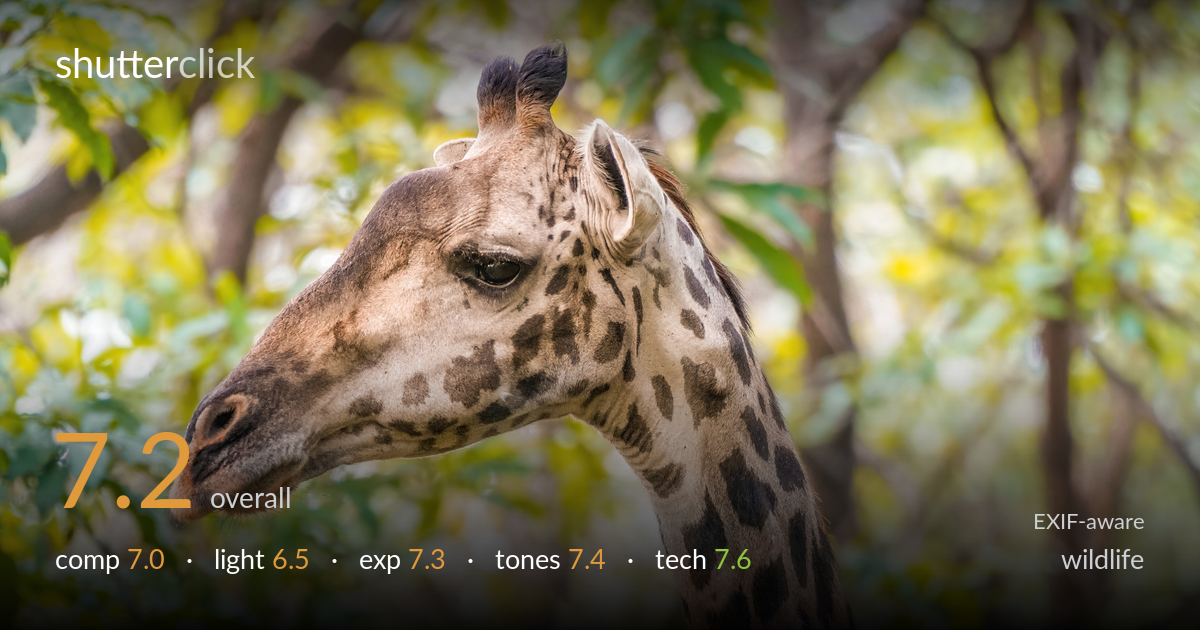
Giraffe profile among the trees
Photo by Giles Laurent

| Focal length | 400 mm |
| Aperture | f / 5.6 |
| Shutter | 1/250 s |
| ISO | ISO 2500 |
| Exp. comp. | 0.7 EV |
| Shot at | 06:47 · Jul 7, 2020 |
A clean, well-isolated giraffe profile against an attractive green canopy, let down mainly by flat, diffuse light that leaves the head modelling soft. The S-curve of the neck reading from bottom-right to the head is the strongest compositional element, and the shallow depth of field separates the subject crisply from the busy background. The eye carries reasonable detail but lacks a catchlight, and the head is partly framed against the brightest, most cluttered patch of foliage. The portrait-orientation crop suits the vertical neck. Stronger directional light and a touch more breathing room in front of the muzzle would lift this from competent to memorable.
The vertical framing follows the neck's curve naturally, and placing the head in the upper-left third works for a profile facing into the frame. Background separation is excellent. The muzzle, however, sits very close to the left edge — a little more space ahead of the gaze would ease the cramped feeling and respect the direction of the look. The lower neck running off the bottom-right corner is fine for this composition, but the brightest, busiest foliage cluster directly behind the head competes with the face for attention.
Light is soft, overcast or open-shade, which is flattering on coat texture but leaves the head and face flat with little modelling. There's no catchlight in the eye, so the gaze reads slightly lifeless — a key concern for a wildlife portrait. The even illumination keeps the spotted pattern readable across the neck without harsh shadows, which is a genuine plus, but a hint of directional or low-angle light would carve dimension into the jaw and brow and give the eye sparkle.
Exposure is well judged, helped by the +0.7 EV compensation lifting the coat against the bright background. Highlights in the brightest leaf gaps brush against clipping but stay largely controlled, and shadow detail in the darker spots and under the jaw is retained. The midtones of the tan coat sit cleanly with good separation from the pattern. The histogram looks balanced for a high-key woodland setting, with no signs of accidental under- or over-exposure. A slightly darker rendering of the brightest background patches would reduce distraction.
Pleasing colour throughout — the warm tans and chocolate spots of the coat sit nicely against the cool-to-warm greens and yellows of the canopy, a complementary relationship that aids separation. White balance looks accurate and natural. Contrast is moderate, fitting the soft light, though the face could take a touch more local contrast to gain presence. The green background tones vary from fresh lime to muted sage, giving depth. Saturation is restrained and believable rather than pushed, which keeps the rendering realistic.
Solid execution given a demanding setup. At 400mm on a 70-200 f/2.8 with a 2x teleconverter, f/5.6 is effectively wide open and a sensible choice for separation; the resulting depth of field keeps the head and most of the neck acceptably sharp while melting the background. Focus appears placed near the eye and head, which is correct, though critical sharpness on the eye itself looks just slightly soft — likely a combination of teleconverter resolution loss and the 1/250s shutter at this long reach. For a static subject 1/250s is workable, but at 400mm it's near the edge of safe handholding; 1/500s or faster would buy more reliable bite. ISO 2500 is well within the A7R III's capability and noise is well managed, with clean shadows and no objectionable luminance grain. The teleconverter costs some micro-contrast and edge acuity, which shows in the slightly muddy fine hair detail, but overall the gear handled the situation competently.
What would elevate it
Tags
Shot something like this?
Expert photo critique, on demand — scored across six categories, EXIF-aware. Start with 3 free critiques, no credit card.
critique my photo — free