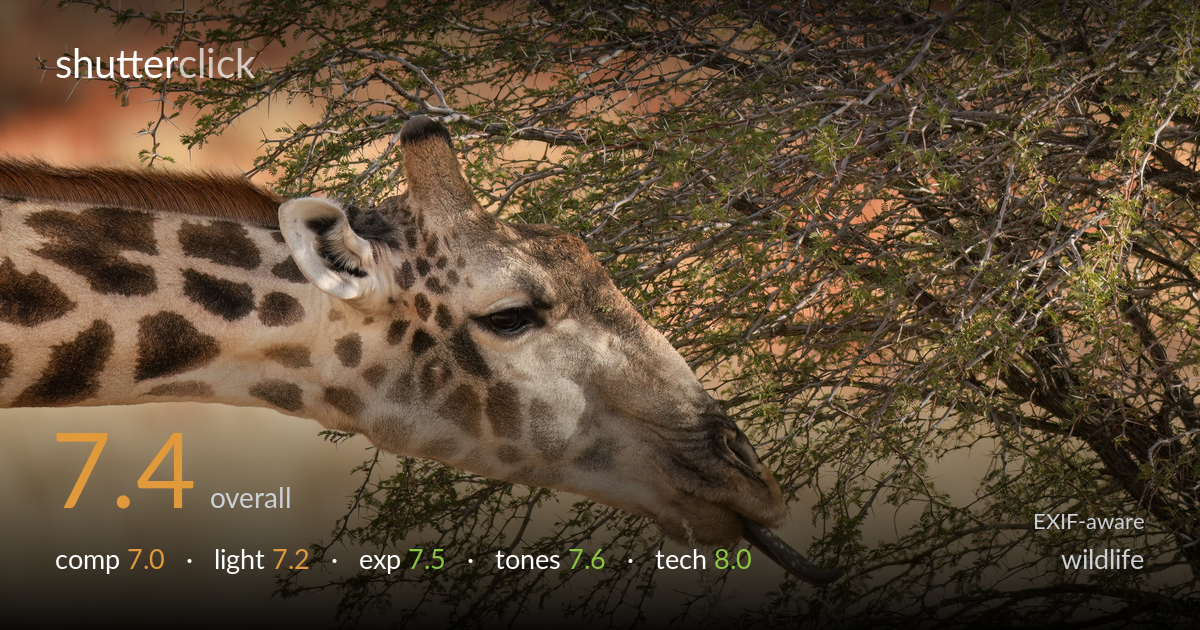
Giraffe reaching for acacia thorns
Photo by Giles Laurent

| Focal length | 405 mm |
| Aperture | f / 6.3 |
| Shutter | 1/800 s |
| ISO | ISO 320 |
| Exp. comp. | 0.0 EV |
| Shot at | 14:33 · Jul 21, 2025 |
A behaviour-rich giraffe portrait that captures the feeding moment — the extended tongue reaching for thorny acacia tells a story most static portraits miss. The eye is sharp and the coat detail is excellent. What holds it back is the busy intersection of head and branches: the muzzle and tongue tangle into the foliage, weakening separation at the exact point the eye should land. The reddish dune background is pleasant but competes for attention through the thorn screen. Strong subject, strong moment, but a cleaner sightline to the feeding action would lift it considerably.
The profile orientation gives the long neck room to sweep in from the left, and placing the head toward centre-right works for a feeding subject reaching into frame. The tongue extending toward the thorns is the narrative payoff. The problem is clutter: branches cross the muzzle and the tongue disappears into a thicket, muddying the key gesture. The head sits against the busiest part of the foliage rather than clean negative space. A slightly different angle separating the muzzle from the densest branches would let the feeding action read instantly.
Soft, slightly diffused daylight wraps the head gently and keeps shadows on the coat manageable, preserving the spot patterning without harsh contrast. Direction is roughly frontal-side, which models the muzzle and brow adequately and lights the eye. There is a small catchlight, though it is faint. The flat quality suits documenting texture but lacks the directional punch that would carve the head from the background. Earlier or later light raking across the muzzle would add dimension and stronger eye sparkle.
Exposure is well controlled. The pale coat and lit dune background hold detail without blowing out, and the darker shadow under the jaw retains structure. The histogram looks balanced for a high-key scene — no meaningful clipping in the bright sand tones. The eye and surrounding fur sit at a good brightness. If anything, the overall scene reads slightly bright, and a touch of negative compensation would have deepened the spots and added bite. As shot, exposure decisions appear deliberate and the dynamic range is handled cleanly.
Warm, harmonious palette — the tawny coat sits naturally against the ochre and rust dune backdrop, giving a cohesive desert feel. White balance reads accurate with believable neutrals in the lighter fur. The spot contrast is rendered well, with good separation between the brown patches and cream ground colour. Saturation is restrained and natural. The green foliage adds welcome relief without going garish. The only limitation is the overall softness of contrast, which keeps the image feeling slightly low-energy rather than punchy.
The FE 400-800mm at 405mm and f/6.3 is well matched to this subject, and the choices are sound. The eye is sharp and the coat texture resolves beautifully, confirming accurate focus on the critical plane. At 1/800s the giraffe's slow feeding motion is cleanly frozen, with no visible blur on the tongue or head. ISO 320 keeps noise negligible and tonal smoothness high — exactly where it should be in good light. f/6.3 wide open on this lens delivers acceptable sharpness on the subject, though the depth of field is shallow enough that the near branches and tongue tip drift slightly soft. The main technical limitation is not the camera but the line of sight: the foliage between lens and subject competes for the autofocus and the eye's attention. Stopping down marginally would not help separation here; a cleaner shooting angle would. Overall the execution is clean, sharp where it counts, and noise-free.
What would elevate it
Tags
Shot something like this?
Expert photo critique, on demand — scored across six categories, EXIF-aware. Start with 3 free critiques, no credit card.
critique my photo — free