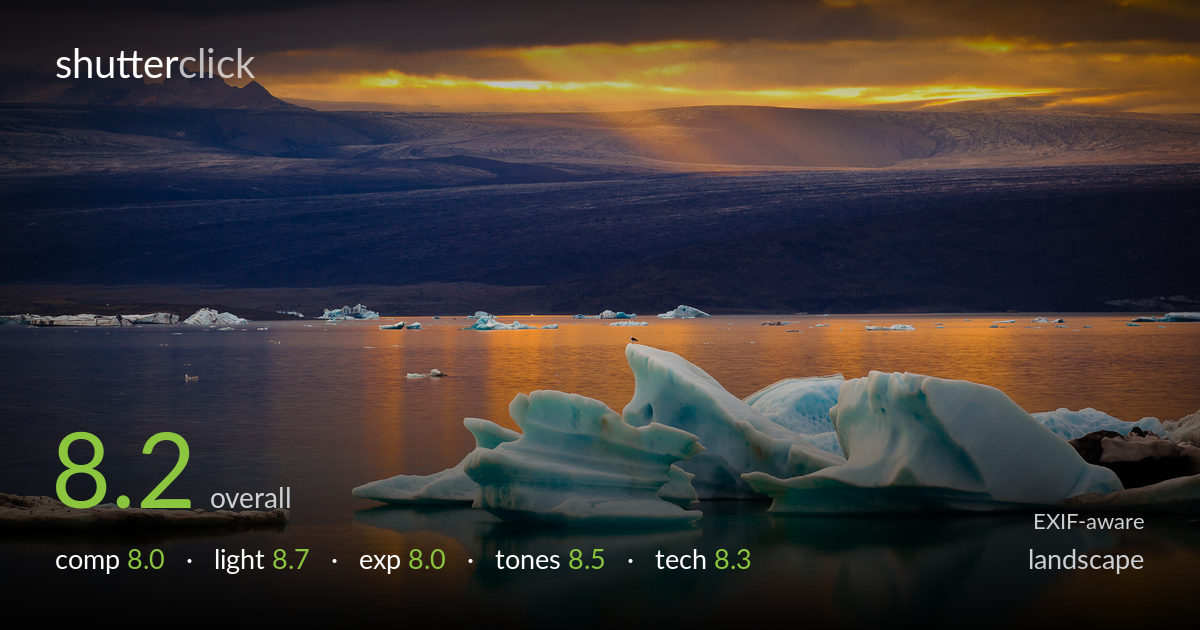
Glowing glacier lagoon sunset
Photo by Martin Sojka
.jpg)
| Focal length | 145 mm |
| Aperture | f / 11.0 |
| Shutter | 2.5 s |
| ISO | ISO 50 |
| Exp. comp. | 0.0 EV |
| Shot at | 19:11 · Jul 23, 2011 |
A glacier lagoon at sunset rendered with genuine atmospheric payoff — the foreground icebergs glow cyan against the warm light, and the long exposure smooths the water into a mirror that carries the colour down through the frame. The strongest element is the marriage of cool ice and warm sky, a colour contrast that does most of the heavy lifting. What holds it back is a slightly cluttered iceberg cluster on the right that crowds the edge, and a middle band of dark hillside that reads a touch heavy and flat. The break of light through the clouds is well caught and worth the timing.
The foreground icebergs anchor the lower third well and their reflection extends the subject downward, giving the frame real depth. The diagonal ridge of distant mountains leads the eye toward the break of light at upper right, a natural focal point. The horizon sits roughly on the upper third, a sound choice. The iceberg mass crowding the right edge feels slightly cramped, and the scattered smaller bergs across the midground compete a little. A touch more breathing room on the right would let the main cluster sit more comfortably.
This is the photograph's strongest asset. The low sun punching through a heavy cloud bank creates dramatic crepuscular rays raking across the snow-dusted hills, and that warm light pools beautifully on the water's surface. The cool ice catching ambient sky light against the warm reflection sets up a satisfying temperature contrast. Timing is well judged — a few minutes earlier or later and the light break would have been lost. The directional glow gives the distant terrain modelling it would otherwise lack.
Exposure is well balanced across a demanding dynamic range. The bright sun break retains some structure rather than blowing entirely to white, and shadow detail survives in the dark midground hills, though that band sits heavy and could lift slightly. The ice holds highlight detail without clipping its delicate blues. The 2.5s exposure at ISO 50 keeps noise negligible. The darkest foreground water loses some separation, but overall the histogram appears used intentionally with no careless blacks or whites.
The warm-cool palette is the defining strength — molten orange in the sky and water reflection set against the glacial cyan and teal of the ice. White balance leans warm appropriately for the golden hour without tipping into garishness. Contrast holds the dramatic mood without crushing detail. The dark hillside band reads slightly muddy and could use a touch of separation in the midtones. The transition from warm sky into cool foreground water is handled with restraint rather than oversaturation.
Settings are well matched to the scene. The 70-200 f/4L at 145mm compresses the distant mountains and light break, pulling them closer and stacking the layers effectively — a smart focal choice for this kind of distant subject. f/11 is the lens's sweet spot for edge-to-edge sharpness and keeps both foreground ice and far hills acceptably sharp. ISO 50 delivers clean, noise-free files with maximum dynamic range, important for holding the bright sun against dark terrain. The 2.5s exposure smooths the water into the glassy reflection that makes the foreground work, and at this length a tripod was clearly used since the ice renders crisp. Focus appears placed on the main iceberg cluster and holds well. The only consideration is that at 145mm and 2.5s, any iceberg drift could soften edges, but the ice reads sharp here. Solid, deliberate technical execution throughout with no obvious missteps.
What would elevate it
Tags
Shot something like this?
Expert photo critique, on demand — scored across six categories, EXIF-aware. Start with 3 free critiques, no credit card.
critique my photo — free