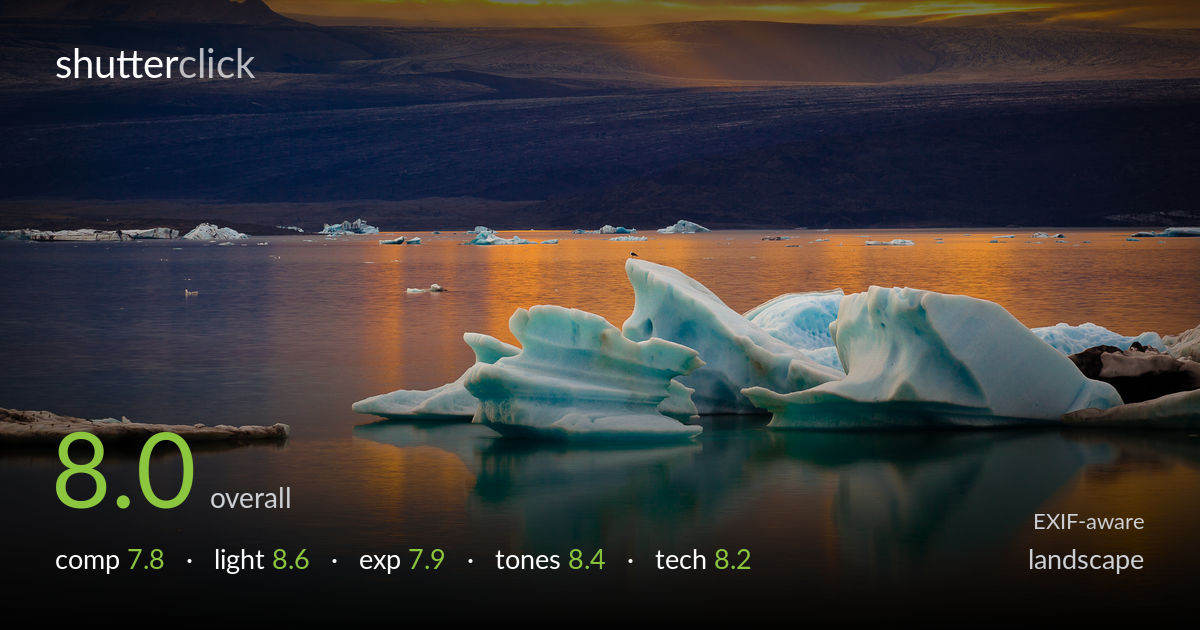
Glacial lagoon at sunset
Photo by Martin Sojka
.jpg)
| Focal length | 145 mm |
| Aperture | f / 11.0 |
| Shutter | 2.5 s |
| ISO | ISO 50 |
| Exp. comp. | 0.0 EV |
| Shot at | 19:11 · Jul 23, 2011 |
A glacial lagoon at sunset that earns its colour — the warm break in a heavy sky pours light across the water and sets the cool blue ice against an orange reflection beautifully. The foreground icebergs are the anchor, and the small bird perched on one adds a quiet focal accent. What holds it back is the cluttered mid-distance: the scattered smaller bergs read as visual noise rather than layering, and the dark central landmass eats a wide band with little detail. A cleaner separation between foreground ice and background, or a slightly higher viewpoint, would let the composition breathe.
The main iceberg cluster sits low and right, balanced against the open water and the glowing sky band — a workable arrangement that uses the reflection well. The bird on the ice is a lucky, telling detail. Less successful is the dark central band of land, which occupies a wide swath with little tonal interest, and the scattered small bergs in the mid-distance that fragment attention rather than building depth. A composition weighting more water or sky over that flat dark zone would tighten the eye's path from foreground ice to the light.
The light is the photograph's strongest asset: a narrow break in dense cloud floods warm directional light across the lagoon, with visible god-rays raking the far slope. That warmth playing against the cool blue ice is the whole point, and it works. The reflected gold on the water adds a second layer of glow. The heavy upper cloud keeps the sky from blowing out and gives the scene weight. Timing this window of broken light at sunset was the decisive call, and it paid off.
Exposure is well managed for a high-contrast scene. The brightest patch of sky holds colour and detail rather than clipping to white, and the ice retains texture in its highlights. The dark land band sits deep but isn't a total void. The trade-off is that the midground shadow detail is thin, and the overall image leans dark, which suits the mood but loses some information in that central mass. A graduated approach or gentle shadow lift would recover a touch of the slope's texture without flattening the drama.
The colour story is the standout — molten orange in the sky and its reflection set against the glacial blue-green of the ice, a complementary pairing that gives the frame its punch. White balance holds the warmth without tipping into garish. The cool ice tones stay convincing rather than oversaturated. Contrast between the bright break and the surrounding dark cloud is well judged for the mood. The only caution is the muddy brown of the central land, which sits awkwardly between the two strong colour zones and slightly dilutes the palette.
Settings are sound for the conditions. f/11 on the 70-200 at 145mm delivers ample depth of field, keeping foreground ice and distant slope acceptably sharp, and the choice suits a static landscape. ISO 50 maximises dynamic range and keeps noise invisible even in the deep shadows — exactly right when the light allows it. The 2.5-second exposure smooths the lagoon surface, lending the reflection its glassy calm, and a tripod was clearly used since the ice and shoreline render crisp. Focus appears placed on the main berg cluster and holds well. The telephoto compression flattens the mountain layers pleasantly, pulling the distant glacier closer. One consideration: at 2.5 seconds any drift in the floating ice could soften fine edges, though here the bergs read sharp enough. Overall a well-executed technical package — the gear and settings serve the scene rather than fight it, and nothing about the execution undercuts the image.
What would elevate it
Tags
Shot something like this?
Expert photo critique, on demand — scored across six categories, EXIF-aware. Start with 3 free critiques, no credit card.
critique my photo — free