Glowing aerial city night
Photo by enjoytheworld

No EXIF metadata in this file
Technical analysis based on visual assessment only.
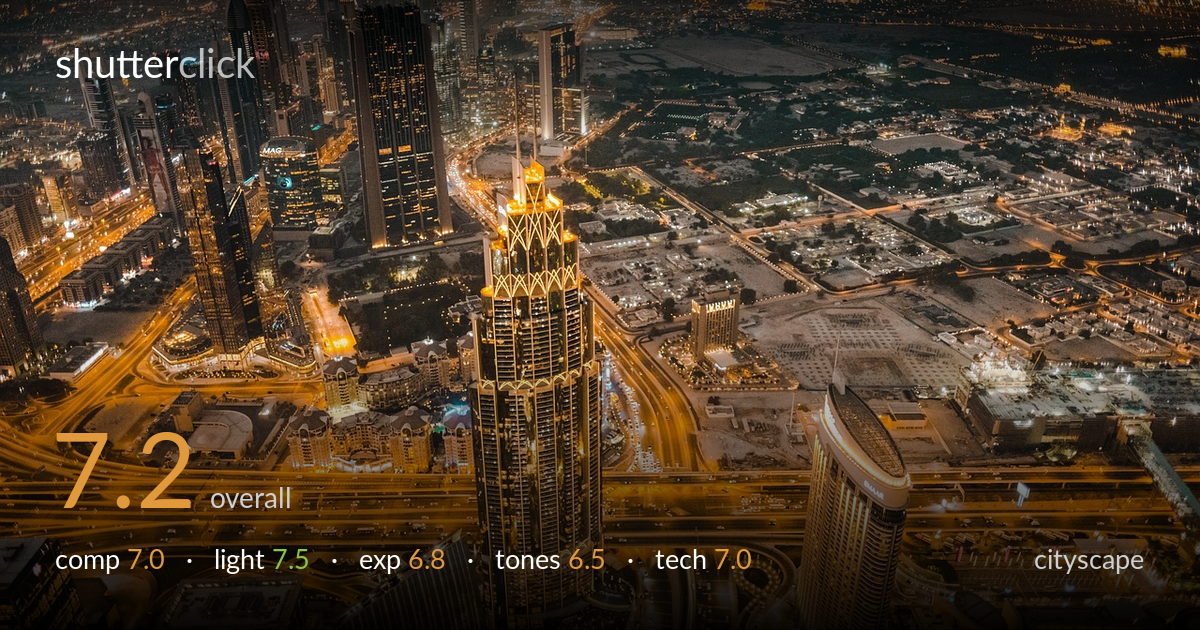
An aerial cityscape that delivers genuine scale and density, with the lit road interchanges acting as natural leading lines through the frame. The high vantage point gives a sweeping sense of a sprawling metropolis at night. What most holds it back is the overwhelming dominance of warm sodium tones, which flatten colour separation and lend a monochrome-orange cast across the whole scene. The central tower commands attention but sits in a slightly cramped lower-centre position, and the distant city dissolves into atmospheric haze. A tighter white balance and more dynamic-range recovery in the deep shadows would lift this from impressive to striking.
The sweeping aerial perspective conveys real scale, and the curving road interchanges form strong leading lines that draw the eye through the lower portion of the frame. The brightly lit central tower anchors the composition, though it sits low and slightly left of centre, leaving the upper third to dissolve into hazy, lower-interest cityscape. The diagonal of the highways adds energy. A slightly higher placement of the main tower or a crop that emphasised the road junction would tighten the balance and reduce the dead weight of distant haze up top.
Shot at blue hour with the city fully illuminated, the timing captures that ideal window where artificial light dominates but the sky retains faint tone. The road networks glow with continuous warm light, shaping the urban geometry well. The illuminated central tower provides a clear focal highlight against darker surrounding structures. The light is, however, almost entirely single-temperature sodium orange, which limits contrast between districts. A touch more residual sky colour or cooler accents from other light sources would have added depth and separation across the sprawl.
Exposure is largely well judged for a difficult night aerial. The bright road lighting holds without major blown clipping, and the darker building masses retain reasonable form. Deep shadow areas in the unlit zones go murky and lose detail, while a few of the brightest highway stretches push toward clipping. The overall midtone placement leans dark, which suits the mood but buries some of the city texture. Recovering shadow detail and pulling back the hottest highlights would broaden the tonal range and reveal more structure throughout.
The palette is dominated by warm sodium-vapour orange to the point of near-monochrome, which unifies the scene but suppresses tonal variety and any cooler counterpoint. White balance leans heavily warm, leaving little separation between the road grid and surrounding land. The sky carries a muddy greenish-brown haze rather than clean blue-hour tone. Introducing a cooler balance, or selectively cooling the sky and shadows, would create the warm-cool tension that makes night cityscapes sing. As is, the contrast between lit and unlit areas does most of the visual work.
From visual evidence this appears to be a handheld or stabilised aerial frame, likely from an aircraft or high tower, holding acceptable sharpness across the central structures. The lit roads show crisp edges without obvious motion smear, suggesting a shutter fast enough to counter platform vibration, though fine detail in the far distance softens into atmospheric haze rather than focus error. Noise is controlled reasonably for a night scene, with only mild grain in the darker patches, implying a sensible ISO balance. Depth of field is effectively deep, appropriate for the subject, keeping near and far buildings rendered. The main limitation is the haze and the slight overall softness in the upper portion, which is largely atmospheric rather than technical. A faster shutter combined with the steadiest possible platform, plus shooting through the cleanest available glass or open window, would sharpen the result. Capturing in raw would also give far more latitude to recover the crushed shadow detail and rein in the hottest highway highlights.
What would elevate it
Tags
Shot something like this?
Expert photo critique, on demand — scored across six categories, EXIF-aware. Start with 3 free critiques, no credit card.
critique my photo — free