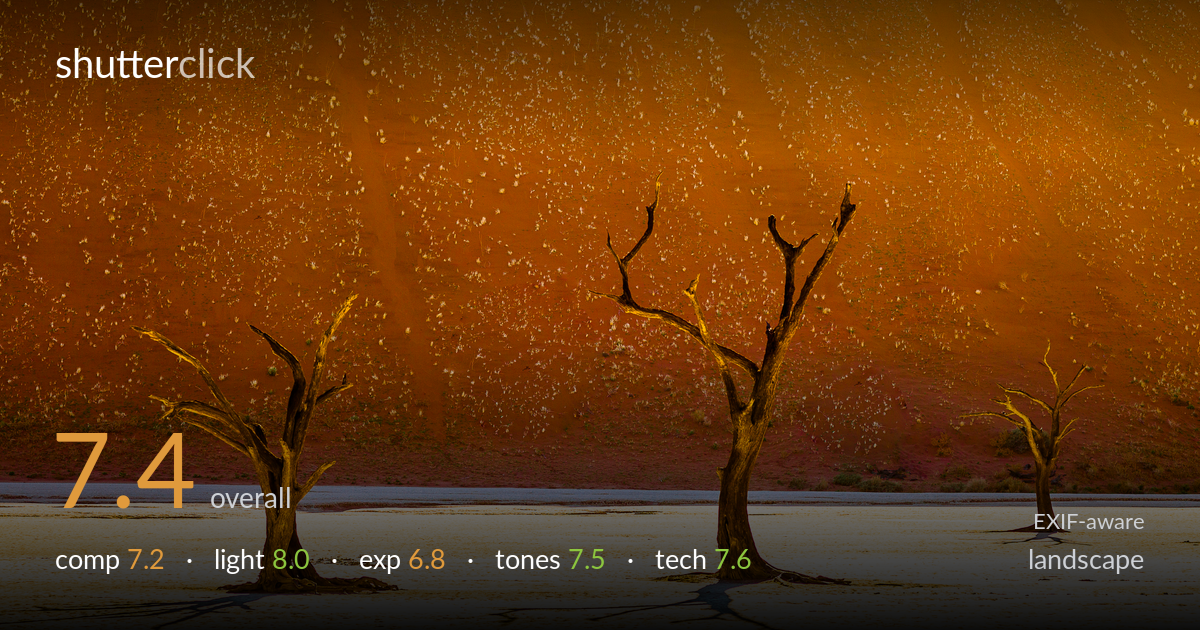
Glowing desert dead trees
Photo by Martin Sojka

| Focal length | 100 mm |
| Aperture | f / 5.6 |
| Shutter | 1/400 s |
| ISO | ISO 100 |
| Exp. comp. | -1.0 EV |
| Shot at | 06:57 · Apr 17, 2012 |
A striking interpretation of Deadvlei's dead camelthorns set against a sunlit dune wall, carried by the warm light and the graphic shadows raking across the pan. The three trees are placed with thought, the largest anchoring the right-center while the small distant tree adds depth. What most holds the image back is the heavy haze and lens flare washing through the upper frame — the streaking and atmospheric veiling flatten contrast and bury detail in the dune face. A cleaner light direction and a tighter handle on flare would let the silhouettes and the rust-and-cream palette read with more punch and separation.
The placement of the three trees works — the large central-right tree dominates while the smaller left and distant right trees build rhythm and scale. The cracked, shadow-streaked pan in the foreground anchors the frame and the dune wall fills the backdrop cleanly. The weakness is balance: the two foreground trees crowd the lower-left while the right third feels comparatively empty save the small distant tree. A slightly wider gap or repositioning would relieve that tension and let the negative space of the dune breathe more deliberately.
The low backlight is the image's engine — it rims the bare branches, ignites the pale pan into a glowing gold, and throws long shadows that give the foreground real structure. The warmth is genuinely evocative of Sossusvlei at the right hour. The cost is the diffuse veiling flare streaking down from the top — it softens the entire dune face and saps local contrast. Shooting a touch earlier, or shielding the lens, would preserve the glow while keeping the highlights cleaner and more defined.
The -1 EV pull was a sound instinct to protect the bright pan, and the histogram largely holds — the cream foreground retains texture rather than blowing out. But the upper frame, where flare and haze concentrate, drifts toward washed highlights with little recoverable detail in the brightest dune areas. The tree silhouettes sit dark and read as intentional, which works. Bracketing or a slightly stronger pull on the highlight zone would have held more of the dune's gradation against the sun.
The rust-orange dune against the luminous gold pan is a handsome, coherent palette and the warm white balance suits the hour. Tonal separation between the cream foreground and the deep tree silhouettes is strong. Where it falters is the upper third: haze compresses the reds into a flatter, muddier band and the saturation there feels slightly pushed against thinning contrast. Recovering some midtone contrast in the dune and easing global warmth a touch would give the whole frame more dimensional richness.
The Makro-Planar 100mm at f/5.6 is a sensible choice for compressing the trees against the dune, and the focal length flattens the scene attractively. Focus appears placed on the central tree, which is acceptably sharp, though the foreground branches on the left tree look slightly softer than ideal — at this distance f/8 would have held both planes more comfortably without meaningful diffraction penalty. ISO 100 keeps noise non-existent and 1/400s easily freezes any motion, perhaps faster than needed for a static scene; that shutter latitude could have funded a smaller aperture. The biggest technical compromise is flare control: shooting almost into the sun without effective shielding has introduced the veiling streaks across the upper frame, the main thing degrading micro-contrast. A lens hood, a hand shielding the front element, or a marginal angle change would have curbed it. Overall the gear was capably handled; the execution is let down mainly by the uncontrolled flare and a slightly shallow aperture for the depth on offer.
What would elevate it
Tags
Shot something like this?
Expert photo critique, on demand — scored across six categories, EXIF-aware. Start with 3 free critiques, no credit card.
critique my photo — free