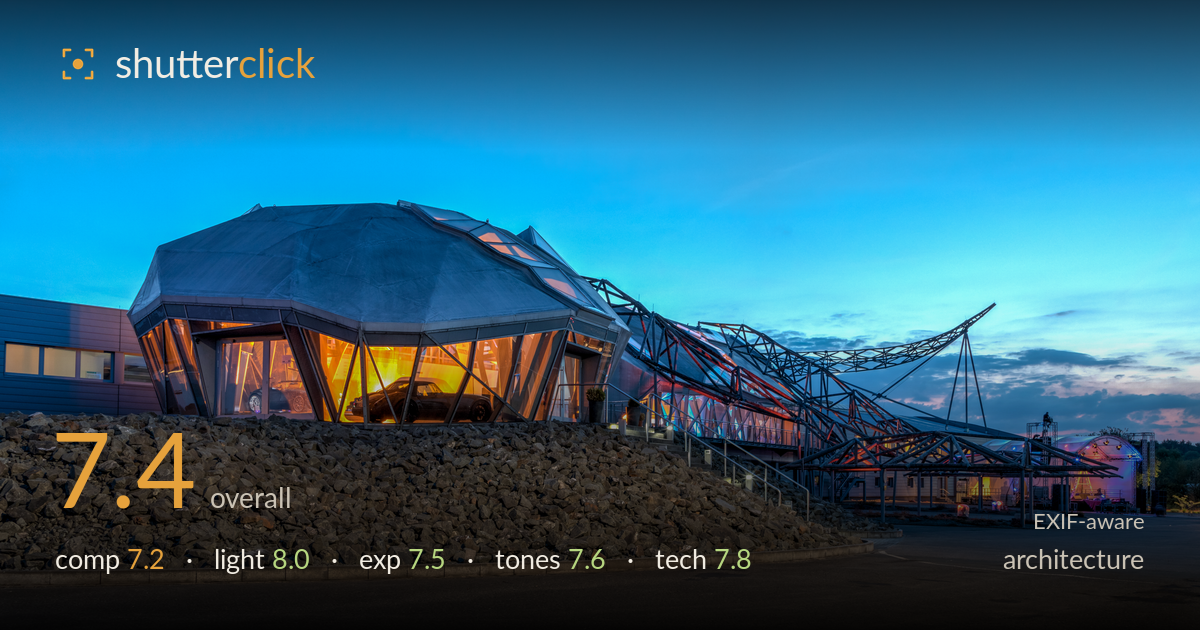
Glowing dome at blue hour
Photo by Dietmar Rabich

| Focal length | 27 mm |
| Aperture | f / 10.0 |
| Shutter | 3.2 s |
| ISO | ISO 400 |
The blue-hour timing is the strongest asset here — the deep gradient sky against the warm glowing interior of the domed structure creates exactly the tension architectural photography thrives on. The organic, faceted dome makes a compelling centrepiece, and the illuminated car inside is a natural focal point. What holds the shot back is the imbalance of the frame: the sky occupies well over half the image with little happening in it, while the rock berm in the foreground reads as grey dead weight. The trailing steel structure to the right thins out and becomes visually noisy rather than resolving. Tighter framing and cleaner foreground handling would sharpen the impact.
The faceted dome anchors the frame well and its off-centre placement follows the thirds sensibly, with the descending steel structure creating a rightward diagonal that carries the eye. But the sky dominates far too much of the upper frame — it's a large empty expanse with only faint cloud interest on the right. The rock berm across the lower third is a large, texturally busy but tonally flat foreground that adds bulk without leading anywhere. The steel skeleton on the right dissolves into visual clutter rather than a clean terminus.
The blue-hour timing is judged well — the ambient sky retains rich colour while the artificial interior lighting reads at full effect, the ideal window for this kind of illuminated structure. The warm orange glow of the dome interior against the cool sky gives strong colour contrast and draws the eye immediately to the car. The blue and magenta accents in the trailing structure add variety. The balance between remaining daylight and building illumination is close to optimal, exactly what makes the shot work.
The 3.2-second exposure balances the darkening sky against the bright interior competently. The warm dome interior holds together without the glowing highlights blowing out, and the sky gradient is smooth and clean. Shadow areas in the rock berm and lower structure retain reasonable detail. There are hints of HDR blending in the tonal handling, which keeps dynamic range under control. The darker asphalt foreground and distant right-side structures sit a touch murky, but nothing is crushed to pure black without recovery.
The warm-cool colour relationship is the tonal backbone — orange interior versus graduated blue sky, a classic and effective pairing. The blue gradient is rendered smoothly from deep upper tones down to cyan near the horizon. Some processing pushes saturation and local contrast into a slightly HDR-tinged, artificial register, particularly where the sky meets the structure. The rock berm reads as a flat, desaturated grey mass that could use warmth or contrast to integrate it. White balance overall is convincing for the hour.
The settings are well matched to the task. f/10 delivers the front-to-back sharpness architecture demands, keeping both the near berm and the distant structure resolved, while staying clear of diffraction softening on the 5D Mark IV's sensor. The 3.2-second shutter at ISO 400 is a sensible tripod-based choice that keeps noise negligible across the deep blue sky, where noise would be most visible. The 27mm focal length on the 24-105 gives a wide but not distorted field, and verticals appear largely controlled with no obvious keystoning — good discipline for the genre. Focus is accurate across the plane. The main technical limitation is not in capture but in the evident HDR or heavy tonal processing, which introduces a slightly synthetic edge to the sky-structure transitions and flattens local contrast in places. A lighter processing hand would preserve the clean capture quality the settings achieved. Overall this is solid, deliberate execution.
What would elevate it
Tags
Shot something like this?
Expert photo critique, on demand — scored across six categories, EXIF-aware. Start with 3 free critiques, no credit card.
critique my photo — free