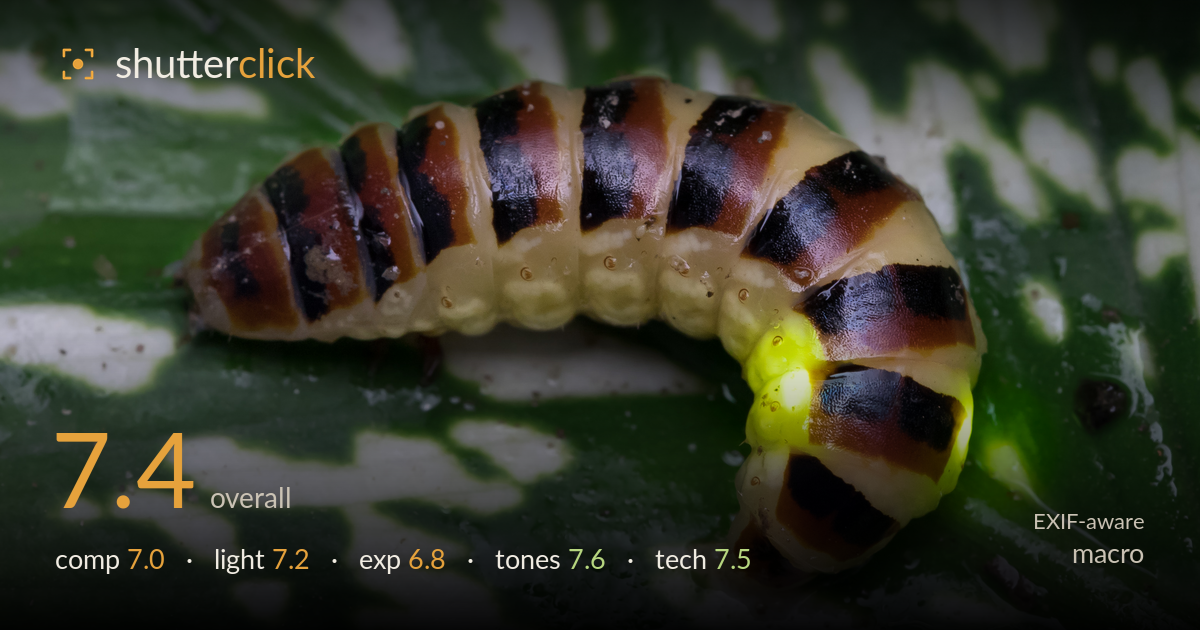
Glowing larva on a leaf
Photo by Basile Morin

| Focal length | 100 mm |
| Aperture | f / 10.0 |
| Shutter | 1.3 s |
| ISO | ISO 1000 |
| Exp. comp. | 0.0 EV |
| Shot at | 01:54 · Sep 2, 2019 |
A bioluminescent glow-worm larva mid-crawl, its neon-yellow light organs the clear payoff of the frame. The variegated leaf gives strong colour contrast and the striped segmentation reads with real texture and dimension. What holds it back is depth of field: at f/10 and this magnification only a thin band along the body's crest is critically sharp, and the leading segments and glowing organs soften. The dappled leaf pattern, while pretty, also competes for attention and clutters the negative space. The subject is well placed on the curve of the frame, but a touch more separation and sharper delivery of the glow would lift this from good to memorable.
The C-curve of the larva sits well across the frame and leads the eye toward the glowing tail organs in the lower right, which is the natural focal point. The variegated leaf offers colour and texture, but its high-contrast white blotches pull attention and clutter the background, breaking the sense of negative space. The subject occupies a strong diagonal, though the head end is cramped against the left edge. A slightly wider berth on the left and a cleaner backdrop behind the glow would let the subject breathe more.
The mix of soft ambient light on the body and the self-emitted glow from the larva's light organs is the standout here — the neon-yellow bioluminescence reads convincingly against the muted body tones and even spills onto the wet leaf. The overall illumination is soft and directionless, which flatters the glossy segments without harsh specular hotspots. A hint of raking side light would have carved out more of the segment ridges, but the restraint keeps the glow as the emotional anchor, which is the right call for this subject.
Exposure is largely controlled — shadows in the dark bands retain detail and the leaf's whites stay just shy of clipping. The glowing organs are pushed near saturation, which suits their nature, though a touch of highlight recovery there would preserve more structure in the brightest yellow. The long 1.3s exposure gathered enough ambient light to keep midtones open. Overall it reads deliberate, but the brightest leaf patches sit close to the top of the histogram and edge toward losing texture.
The colour palette is a real strength: the warm caramel and rust body bands play against the cool blue-black iridescent segments and the acid-green leaf, with the yellow glow as an accent that ties it together. White balance is neutral and believable, and saturation stays natural rather than pushed. Contrast is well judged, holding the dark bands rich without crushing them. The tonal range from the deep segment shadows through the pale body to the bright leaf is broad and handled with control.
The 100mm f/2.8L macro is the right tool, and at f/10 the aperture is a sensible compromise for this magnification — yet the depth of field still can't span the full curve of the larva. Focus lands crisply along the mid-body crest, but the head segments at left and the glowing organs at lower right drift soft, and the glow being off the focal plane is the most costly miss since it's the subject's whole appeal. The 1.3s shutter demands a tripod and a stationary subject; any twitch would smear detail, so the sharp core suggests good discipline there. ISO 1000 is modest and noise is well controlled. The clear path forward is focus stacking — several frames shifting the plane across the body would render the entire larva and its light organs sharp. Alternatively, timing the single frame to nail focus precisely on the glowing tail would salvage the most important detail. Execution is competent; the depth limitation is what caps it.
What would elevate it
Tags
Shot something like this?
Expert photo critique, on demand — scored across six categories, EXIF-aware. Start with 3 free critiques, no credit card.
critique my photo — free