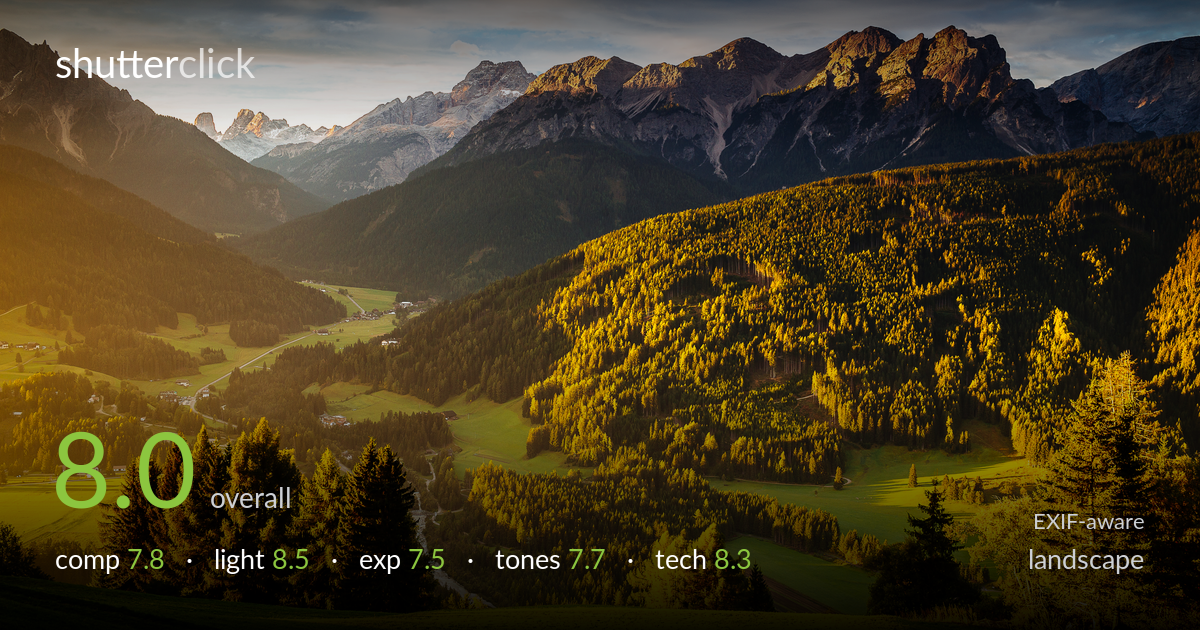
Golden alpine valley
Photo by Martin Sojka
.jpg)
| Focal length | 35 mm |
| Aperture | f / 8.0 |
| Shutter | 1.0 s |
| ISO | ISO 100 |
| Exp. comp. | 0.0 EV |
| Shot at | 07:36 · Sep 27, 2013 |
A classic alpine valley scene carried by superb low-angle light that rakes across the forested slopes and isolates the ridgeline. The depth is genuine — foreground meadow, layered valley, distant peaks — and the warm-to-cool gradient gives the frame real atmosphere. What holds it back most is the foreground: the lower-left meadow reads as empty and slightly dim, and the eye reaches the village and river before it finds a clear anchor. The sky's flat grey band also competes with the drama below. Tightening the foreground role and balancing the upper tones would lift a strong frame to an excellent one.
The layering works well — meadow, descending valley, ridgeline, and sky stack into convincing depth, and the river and road thread the eye into the scene. The diagonal of the foreground slope leads in nicely. However, the lower-left meadow is a large, low-detail area that contributes little and feels weighty against the dense, golden right side. The frame leans right. The horizon sits high, which suits the valley emphasis, but the sky band is somewhat undifferentiated. A foreground element with more shape would anchor the bottom edge.
This is the photograph's strongest asset. Low golden light skims the right-hand forest, picking out individual trees and giving the slope dimensional texture, while the opposite valley wall falls into cool shadow — a beautiful contrast that builds depth. The ridgeline catches warm rim light along its crest with shadowed faces below, sculpting the rock. Timing near sunset was judged well. The only soft spot is the flat, overcast sky, which lacks the warmth and drama present in the land and doesn't fully reward the moment.
A well-controlled exposure for a high-dynamic-range scene. Highlights on the sunlit grass and ridge crest hold detail without clipping, and the shadowed valley walls retain information rather than blocking up. The midtones across the lit forest are nicely placed. The deepest shadows on the left valley flank verge on murky and could use a touch more lift, and the brightest gold patches sit close to the upper limit. Overall the bracketing or single-frame latitude was handled deliberately and competently.
The warm-cool split — golden lit slopes against blue-shadowed valley — is appealing and reads naturally. Greens are saturated without going synthetic, and the rock takes warm tones convincingly. The white balance leans warm, which suits sunset but pushes some of the gold toward an overcooked yellow in the brightest grass. The grey sky sits tonally apart from the rich land, creating a slight disconnect. Pulling the most saturated yellows back and warming the sky subtly would unify the palette.
The settings are well chosen for the genre. f/8 on the Zeiss 35mm sits in the lens's sharpness sweet spot and delivers front-to-back depth of field appropriate for a deep landscape, with the distant ridgeline and foreground meadow both rendered cleanly. ISO 100 keeps the file noise-free, giving room for the shadow lifting the scene requires. The 1-second shutter at this hour was a sensible choice — it suggests a tripod was used, and there is no visible motion blur in the trees, so wind was minimal. Focus appears accurately placed for hyperfocal coverage; detail holds across the frame. The 35mm focal length suits the expansive valley without distorting the layered depth. The Distagon's resolving power shows in the fine separation of individual trees on the lit slope. Nothing technical undermines the image — execution here is assured and matches the conditions, which is exactly what a deep evening landscape demands.
What would elevate it
Tags
Shot something like this?
Expert photo critique, on demand — scored across six categories, EXIF-aware. Start with 3 free critiques, no credit card.
critique my photo — free