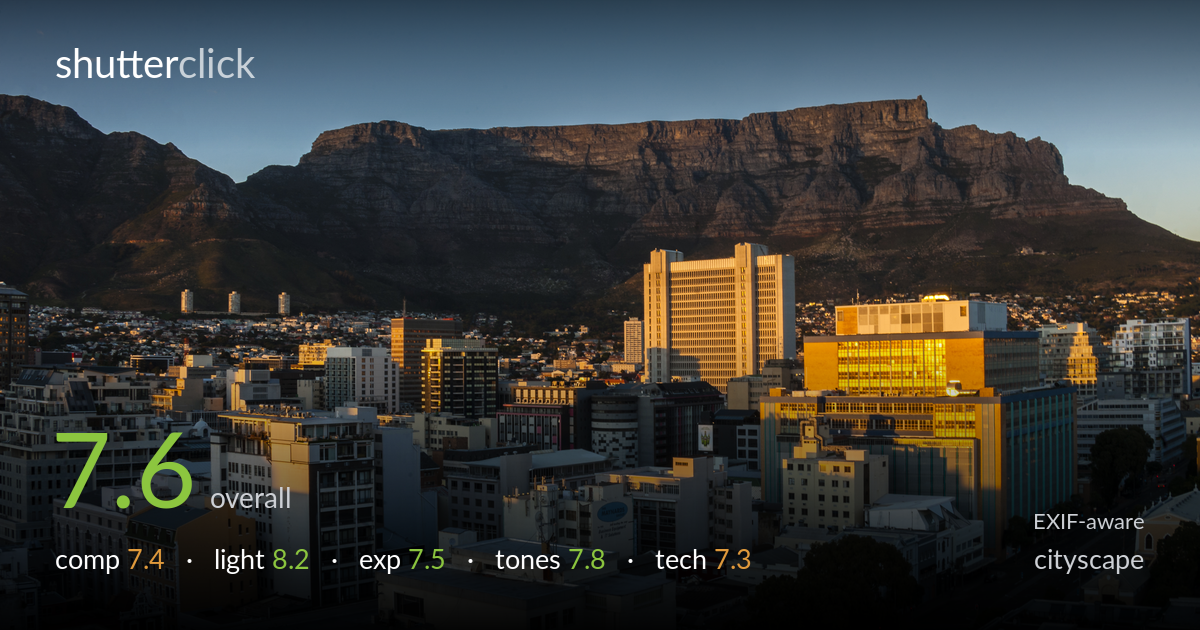
Golden hour city skyline
Photo by Daniel Case

| Focal length | 28 mm |
| Aperture | f / 16.0 |
| Shutter | 1/10 s |
| ISO | ISO 125 |
| Exp. comp. | 0.0 EV |
| Shot at | 00:56 · Jul 22, 2018 |
Table Mountain anchoring a warm-lit downtown skyline is the photo's biggest asset — that low golden light raking across the right-hand towers, especially the glowing glass facade, gives the frame real depth and a sense of place. The massif provides a commanding backdrop and clean horizon. What holds it back most is the foreground city, which sits in flat shadow and feels visually busy without a clear lead-in. The layering between bright buildings and shadowed slope is the strongest relationship here; tightening the foreground clutter and balancing the shadow density would lift an already accomplished cityscape.
The mountain reads as a strong, stable backdrop, and placing the skyline along the lower third gives the massif room to dominate. The glowing tower cluster on the right anchors the eye effectively. The left and lower foreground, however, dissolve into a uniform jumble of rooftops with no clear entry point or leading line, so the eye wanders. The horizon sits a touch high, compressing sky. A slightly higher vantage or a frame that includes a road or river as a lead-in would organise that busy lower zone.
The late-day light is the standout. Low sun rakes the right side of the frame, igniting the glass facade and warming the white towers against the cool, shadowed mountain — a genuine warm-cool interplay that gives depth and mood. The contrast between sunlit buildings and the slope already falling into shade reads convincingly as golden hour. The trade-off is the left and central foreground sitting in flat shade, which feels underserved by the same light. Shooting a few minutes earlier might have spread the glow further across the city.
Exposure is well judged for the sky and the highlight buildings — the glowing glass tower holds colour without blowing out, and the blue sky retains gradation. The shadowed foreground and mountain base, though, sit dark and lose separation, with detail compressed in the lower-left rooftops. The histogram likely leans toward the shadows. A half-stop lift or shadow recovery in post would open those areas without threatening the bright facades. The dynamic range of the scene is wide, and the capture handles the bright end better than the dark.
The warm-cool split is the tonal strength here: amber sunlight on the towers against the cool blue mountain and sky. White balance reads natural for golden hour, and the saturated glass facade is a believable focal accent. Contrast is healthy. The shadowed foreground, however, skews slightly muddy and cool, lacking the tonal life of the lit areas. Mid-tone separation in the darker buildings is weak. Gentle dodging of the foreground and a touch of warmth there would unify the palette across the frame.
At 28mm and f/16 the deep depth of field is appropriate for a cityscape, keeping foreground buildings and the distant mountain acceptably sharp, though f/16 on this lens invites diffraction softening — f/8 to f/11 would likely have been crisper across the frame with the same effective depth at this distance. ISO 125 keeps noise negligible, ideal here. The 1/10s shutter is slow for handheld work; on a tripod it is fine, but any slight movement at this speed risks softness, and the fine architectural detail looks a touch soft, consistent with either diffraction or minor shake. The 28-300mm superzoom is a convenient travel choice but not the sharpest optic wide open or stopped fully down. Focus appears placed correctly across the scene. Overall the settings are sensible for a static evening cityscape, but a wider aperture and confirmed tripod stability would have maximised the resolution this 24MP sensor can deliver.
What would elevate it
Tags
Shot something like this?
Expert photo critique, on demand — scored across six categories, EXIF-aware. Start with 3 free critiques, no credit card.
critique my photo — free