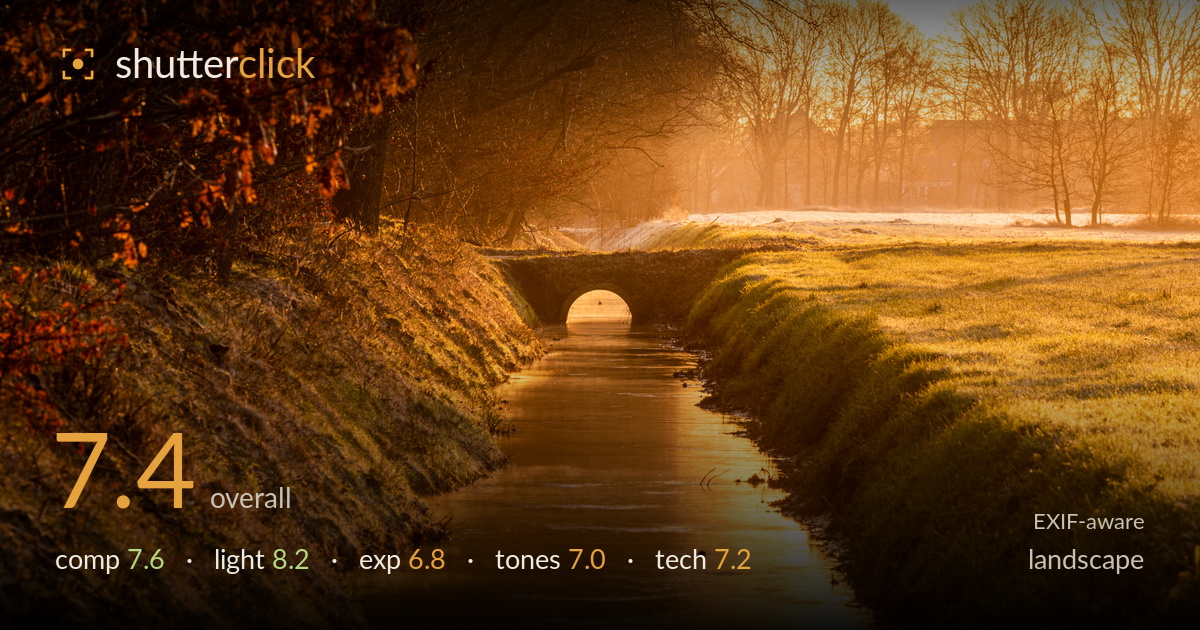
Golden light down the ditch
Photo by Dietmar Rabich

| Focal length | 300 mm |
| Aperture | f / 16.0 |
| Shutter | 1/10 s |
| ISO | ISO 100 |
| Exp. comp. | 0.0 EV |
| Shot at | 07:11 · Feb 12, 2022 |
A warm, atmospheric backlit scene where a ditch of golden water leads the eye toward a small culvert arch beneath a low sun. The leading line of the waterway is the strongest structural asset, and the golden-hour light carries genuine mood. What most holds it back is the dominance of a single amber hue — the whole frame collapses into orange, and the shadows on the left bank go muddy. The near foreground water is dark and detail-poor, and the sky washes to near-white. A touch of tonal separation and white-balance restraint would let the light breathe rather than saturate.
The ditch functions as a strong central leading line, drawing the eye cleanly to the culvert arch as an anchor point. Placing that arch near the upper third works well, and the diagonal banks add convergence. The right-side field opens the frame and balances the dense left treeline. The weakness is the heavy, near-black foreground water occupying the lower third with little to hold interest — a shade more brightness or a slightly higher vantage would give that expanse purpose rather than dead weight.
Low backlight at golden hour is used to real effect — the sun rakes across the grass banks, rim-lighting the blades and setting the water surface ablaze with reflected gold. The bare trees read as delicate silhouettes against the glow. Direction and timing are the photograph's clearest strengths. The tradeoff is that shooting almost straight into the sun flattens the left bank into a haze of amber with little shadow modelling, and the blown sky offers no gradation. Slightly off-axis framing would preserve more shape.
Exposure is a compromise the scene forced. The upper sky and brightest water reflections push to near-white with little recoverable highlight detail, while the foreground water and left bank sink into dense shadow. The midtone grass holds up best. The dynamic range of a direct backlit sunrise is punishing, and the result leans bright overall. Bracketing and blending, or protecting the highlights by a stop and lifting shadows in post, would retain both the sky's glow and the foreground's texture.
The colour is unapologetically warm, and while the golden cast suits the hour, it has been allowed to swallow the entire palette — nearly every pixel sits in the same orange-amber band, leaving little tonal contrast or separation. The greens of the field barely survive. A slightly cooler white balance would restore some of that grass colour and give the gold something to play against. Contrast in the shadows is muddy rather than deep. As it stands the grade is atmospheric but monochromatic.
At 300mm the long lens compresses the ditch and treeline handsomely, and the culvert holds acceptable sharpness where it matters. f/16 was chosen for depth but on a telephoto at this distance it invites diffraction softening, and the extreme aperture wasn't strictly necessary — f/8 to f/11 would have kept the arch-to-foreground range sharp while preserving crisper detail. ISO 100 is ideal and keeps noise absent. The 1/10s shutter is the concern: on a 300mm frame that is well below the reciprocal guideline, so a tripod or solid support was essential, and any water movement or breeze in the grass would smear. The reflections do look slightly soft, hinting at either subtle shake or diffraction. Focus placement on the mid-distance banks is sound. Overall the gear is well suited to the compression effect, but the aperture-and-shutter pairing works against ultimate sharpness — a wider aperture and faster shutter would have been the safer combination here.
What would elevate it
Tags
Shot something like this?
Expert photo critique, on demand — scored across six categories, EXIF-aware. Start with 3 free critiques, no credit card.
critique my photo — free