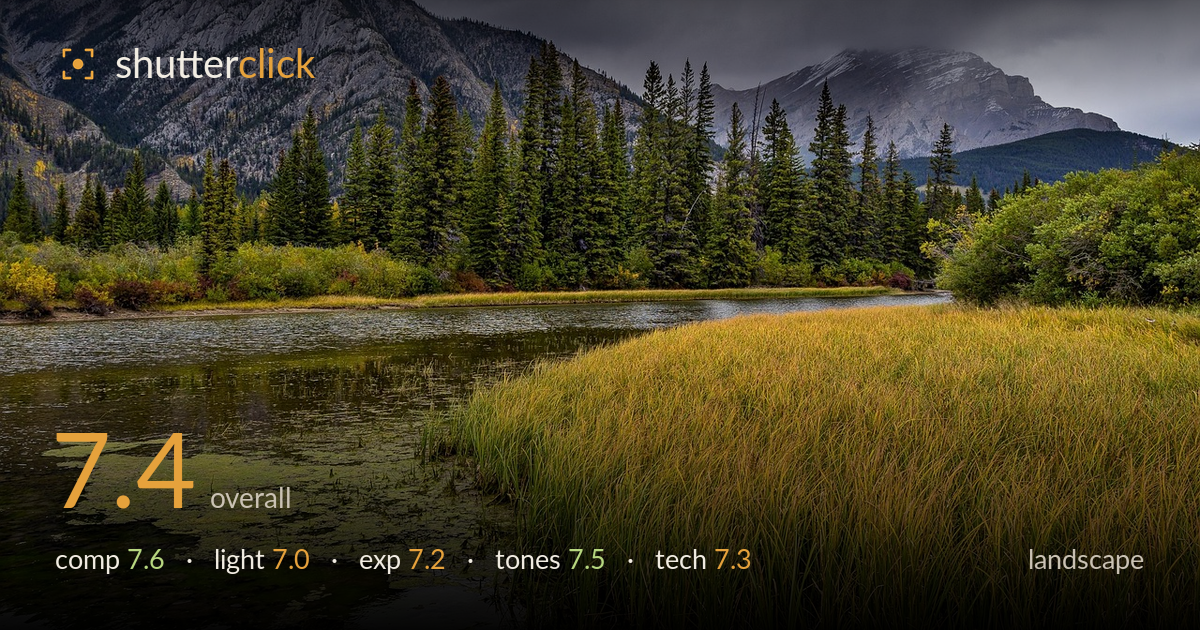
Golden marsh below moody peaks
Photo by Sonyuser

No EXIF metadata in this file
Technical analysis based on visual assessment only.
A well-layered Rockies scene that reads front to back — golden marsh grass in the foreground, a dark treeline mid-frame, and layered peaks under a heavy sky. The autumn grass sweeping in from the right is the strongest element, giving weight and colour. What holds it back is the flat, overcast light on the mountains, which mutes the range's texture and leaves the distant peak hazy and low in contrast. The horizon sits reasonably placed, but the busy foreground water with algae competes for attention. A moment of directional light on the peaks would lift this considerably.
The layering is the real strength: golden foreground grass, the diagonal shoreline pulling the eye left to right, a solid treeline, and mountains stacking into depth. The curve of the grass bank works as a lead-in. The horizon sits high enough to give the water and grass room. The algae-covered water on the left is a weaker patch — visually busy without adding much — and pulls attention from the peaks. A slightly lower angle emphasising the grass, or a step right to clean up the water, would tighten the read.
Overcast, diffuse light dominates. It suits the moody, brooding character of the sky and keeps the foreground grass evenly lit without harsh shadow, which flatters the colour. But the same flat light robs the mountains of modelling — the near range holds some texture, while the distant peak dissolves into low-contrast haze. There's no directional light to carve the ridgelines. A break in the cloud throwing a shaft onto the peaks, or shooting as weather clears, would give the range the dimensionality the foreground already has.
Exposure is handled well for a high-dynamic-range scene. The bright grass retains detail without blowing out, and the dark treeline and water hold shadow information. The heavy sky is rendered with texture rather than clipped to white, which preserves the mood. The distant peak is a touch flat, partly atmospheric haze rather than exposure error. Overall the histogram appears balanced with no major loss at either end. A subtle graduated adjustment to deepen the sky further would add drama without sacrificing the well-judged midtones.
The autumn palette carries the frame — warm ochres and golds in the grass play against the cool grey-green of the pines and the slate sky. White balance sits neutral to slightly cool, appropriate for the overcast conditions. Contrast is moderate; the mountains would benefit from a touch more separation. The green algae patch introduces a slightly murky tone that clashes with the warmer grass. Saturation is restrained and believable. Selectively lifting contrast on the peaks and gently warming the grass would strengthen the seasonal mood.
Sharpness holds well across the foreground grass, where fine blade detail is crisp, suggesting a well-chosen aperture for deep depth of field — front-to-back focus is largely maintained. The treeline is clean, and the near mountain retains rock texture. Softness in the distant peak reads as atmospheric haze rather than focus error, which is expected at that distance under these conditions. Noise is well controlled, consistent with good light and a low ISO. No motion issues are evident in the still water or grass. The lens appears to render straight verticals without obvious distortion, and the wide framing suits the scene. The main technical opportunity is in post: a dehaze or clarity adjustment on the far range would recover some of the definition the atmosphere has softened, and careful sharpening on the mid-ground trees would add bite. Focus placement on the foreground is sound and prioritises the strongest element.
What would elevate it
Tags
Shot something like this?
Expert photo critique, on demand — scored across six categories, EXIF-aware. Start with 3 free critiques, no credit card.
critique my photo — free