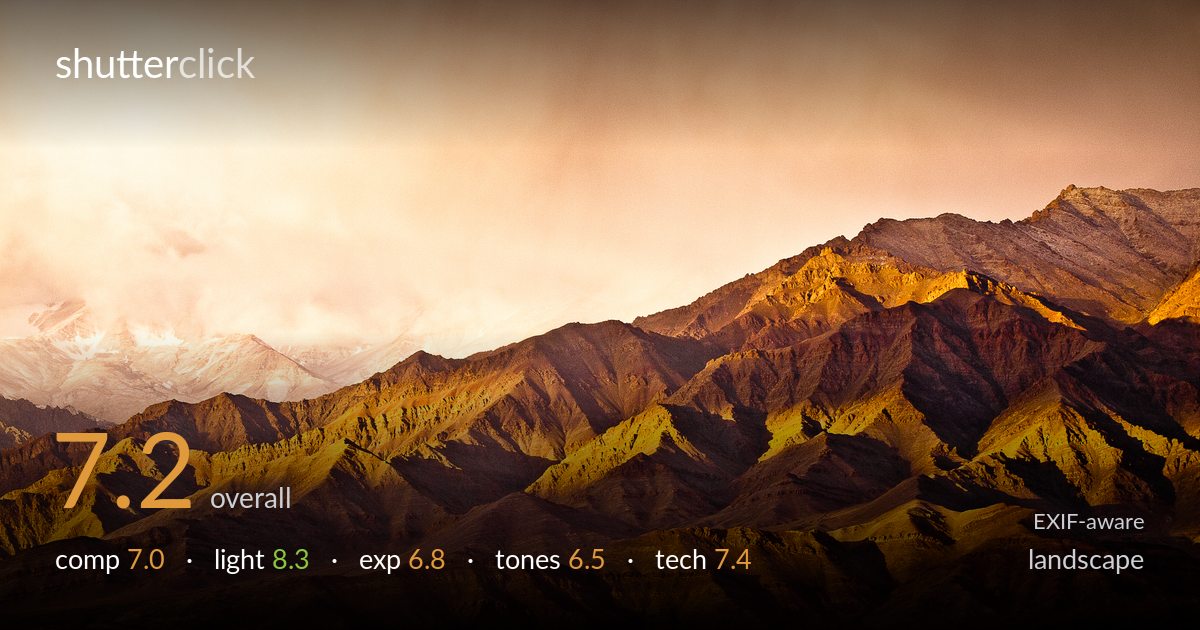
Golden raking mountain light
Photo by Martin Sojka
.jpg)
| Focal length | 50 mm |
| Aperture | f / 5.6 |
| Shutter | 1/320 s |
| ISO | ISO 200 |
| Exp. comp. | 0.0 EV |
| Shot at | 04:31 · Sep 16, 2010 |
Raking low sun across textured ridgelines is the real strength here — the warm light carves the folds of these mountains beautifully, separating sunlit spurs from shadowed gullies. The faint snow peaks behind, half-dissolved in haze, add welcome depth. What holds the frame back is the tonal treatment: a heavy orange cast saturates the entire image, sky included, flattening the white balance and burying subtlety. The sky also occupies the upper half with little event beyond gradient. A more layered horizon line and restrained grading would let the genuinely lovely light do its own work rather than competing with the colour.
The diagonal ridgeline sweeping from lower left to upper right gives the frame energy and leads the eye across the range. Receding layers — foreground ridges, mid-range spurs, hazy snow peaks at left — build real depth. The weakness is the sky: it fills roughly half the frame as a near-featureless gradient, giving the eye little to do up top. A lower horizon weighting toward the mountains, or a sky with more defined cloud structure, would concentrate interest where the texture and light actually live.
This is the photograph's anchor. Low, warm side light rakes across the ridges at a shallow angle, modelling every spur and gully into three dimensions. The interplay of golden sunlit faces against deep shadowed valleys reads as genuine relief, not flatness. The hazy backlight on the distant snow peaks adds atmospheric layering. The light is doing the heavy lifting and the timing was judged well — this is the kind of fleeting raking light that makes mountain terrain come alive.
Midtones across the lit slopes are well placed and the shadowed valleys retain detail rather than blocking up. The upper sky, however, drifts toward the highlight end and risks washing out where it meets the brightest haze on the left — detail there is thin. The overall exposure leans warm and slightly bright, which compresses contrast in the sky. Pulling highlights back and protecting the upper-left brightness would recover more atmosphere in that hazy transition zone.
The dominant orange cast is the chief tonal issue. While golden-hour warmth suits the subject, here it has spread uniformly across sky and land, leaving little colour separation — the sky reads the same amber as the slopes. White balance appears pushed warm beyond the natural light. A cooler, more neutral sky would let the genuinely warm mountain faces stand out by contrast. Mid-tone gradation in the rock is good; the grading just needs restraint to recover tonal variety.
At 50mm, f/5.6, 1/320s and ISO 200, the settings are well matched to a distant landscape. The aperture sits in the lens's sweet spot and, with everything at near-infinity, delivers front-to-back sharpness without needing to stop down further. ISO 200 keeps noise negligible and the 1/320 shutter easily freezes any handheld shake at this focal length. Focus appears accurate on the mid-range ridges where it matters. The 50mm (100mm equivalent on the Four Thirds sensor) is a sensible choice for compressing the layers of terrain into stacked planes, and it does so effectively. The main technical observation is not about capture but about the latitude available: shooting raw at this ISO leaves ample room to recover the warm-shifted sky and rebalance white balance in post. A graduated approach to the bright upper-left haze, whether in-camera with a filter or in processing, would have protected those highlights. Solid, unfussy technique that serves the scene.
What would elevate it
Tags
Shot something like this?
Expert photo critique, on demand — scored across six categories, EXIF-aware. Start with 3 free critiques, no credit card.
critique my photo — free