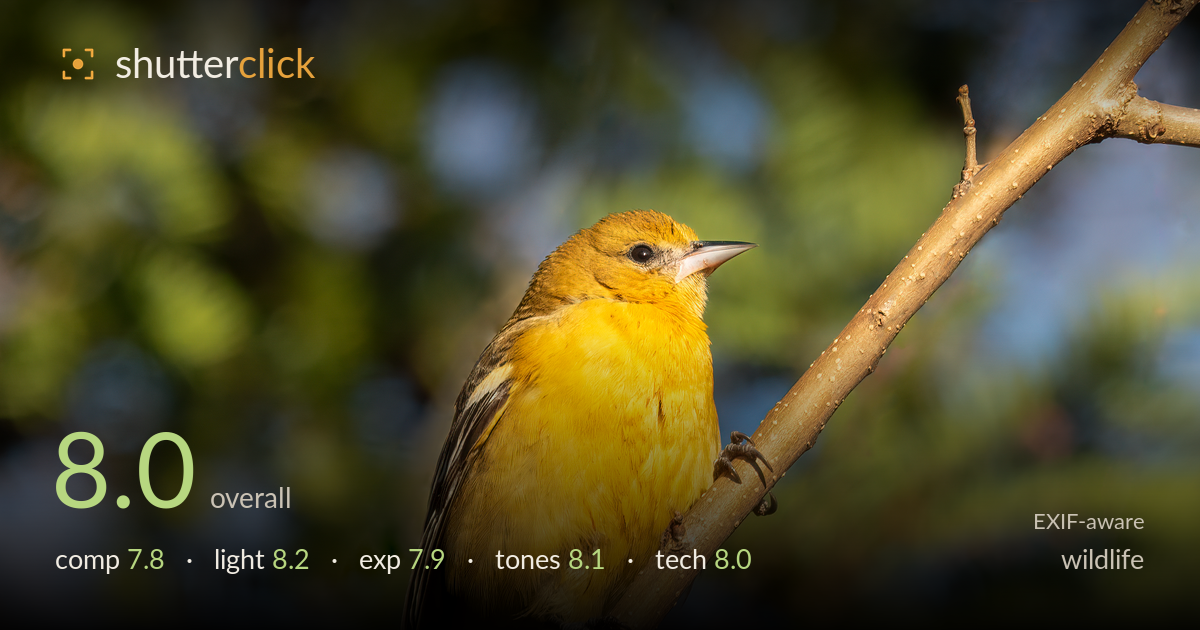
Golden oriole on a sunlit branch
Photo by Rhododendrites

| Focal length | 300 mm |
| Aperture | f / 7.1 |
| Shutter | 1/500 s |
| ISO | ISO 640 |
| Exp. comp. | 0.0 EV |
| Shot at | 16:59 · Jan 12, 2022 |
A clean, well-lit oriole portrait with warm low light shaping the plumage and a diagonal perch that adds energy. The eye is sharp with a catchlight, and the golden feathers separate cleanly from a soft mottled background. What most holds the shot back is the perch geometry: the strong diagonal branch runs from lower-left corner to upper-right, and the bird sits fairly centred, leaving the head close to the frame edge with limited room in its gaze direction. The tail also brushes the lower-left area. A little more breathing space ahead of the beak would lift this from very good to excellent.
The diagonal branch gives the frame movement and a natural anchor, and the bird's profile pose reads clearly. Placement is solid, though the head sits high and slightly close to the top edge while the bird faces right with only moderate room ahead of the beak — the gaze feels a touch boxed in. The tail extends toward the lower-left corner, competing mildly with the perch that exits there. A crop or reframe giving more space in the looking direction would balance the tension the diagonal creates.
Low, warm directional light rakes across the bird from the front-right, lighting the face and breast beautifully and giving the yellow real luminosity. A clean catchlight sits in the eye, essential for a bird portrait. Shadows on the flank and folded wing add form without going murky. The background greens and blues stay soft and cool, letting the warm subject pop. Timing near golden hour was well judged; the only minor cost is slight highlight brightness on the sunlit breast.
Exposure is well controlled for a high-contrast subject. The bright yellow breast retains feather detail rather than blowing out, and the darker wing and tail hold gradation without crushing to black. The eye and beak are cleanly rendered. The sunlit chest edges toward the upper end of the histogram but stays within recoverable range. Background exposure sits comfortably lower, aiding subject separation. A tiny reduction in the brightest breast tones would add a touch more safety margin, but this reads as deliberate and accurate.
The colour palette works well: saturated but believable yellows on the bird against muted green and blue bokeh creates pleasing complementary contrast. White balance leans warm, appropriate to the golden light, and skin-of-feather texture carries subtle tonal shifts. The blacks in the wing feathers stay rich without blocking up. The background retains gentle tonal variety rather than muddying. Saturation on the breast is near its limit — a small pullback would keep the yellows from feeling slightly electric in the brightest zones.
The 40-150mm with the MC-20 at 300mm (600mm equivalent) is a capable reach for a small perched bird, and the results show it. Focus lands accurately on the eye, which is critically sharp with visible detail in the iris, and the beak and facial feathers hold fine texture. At f/7.1 the depth of field is enough to keep the head-to-body plane sharp while dissolving the background into clean, distraction-free bokeh — a smart aperture choice for this teleconverter combination, where wider settings can soften. 1/500s comfortably froze the stationary bird, and ISO 640 keeps noise negligible on the E-M5 Mark II sensor. Micro four thirds diffraction and teleconverter softening are always risks, but sharpness on the key plane holds up well here. The only technical note is that the far wing and tail fall slightly soft, an unavoidable consequence of the shallow depth at this focal length and distance. Solid execution overall for a demanding long-reach setup.
What would elevate it
Tags
Shot something like this?
Expert photo critique, on demand — scored across six categories, EXIF-aware. Start with 3 free critiques, no credit card.
critique my photo — free