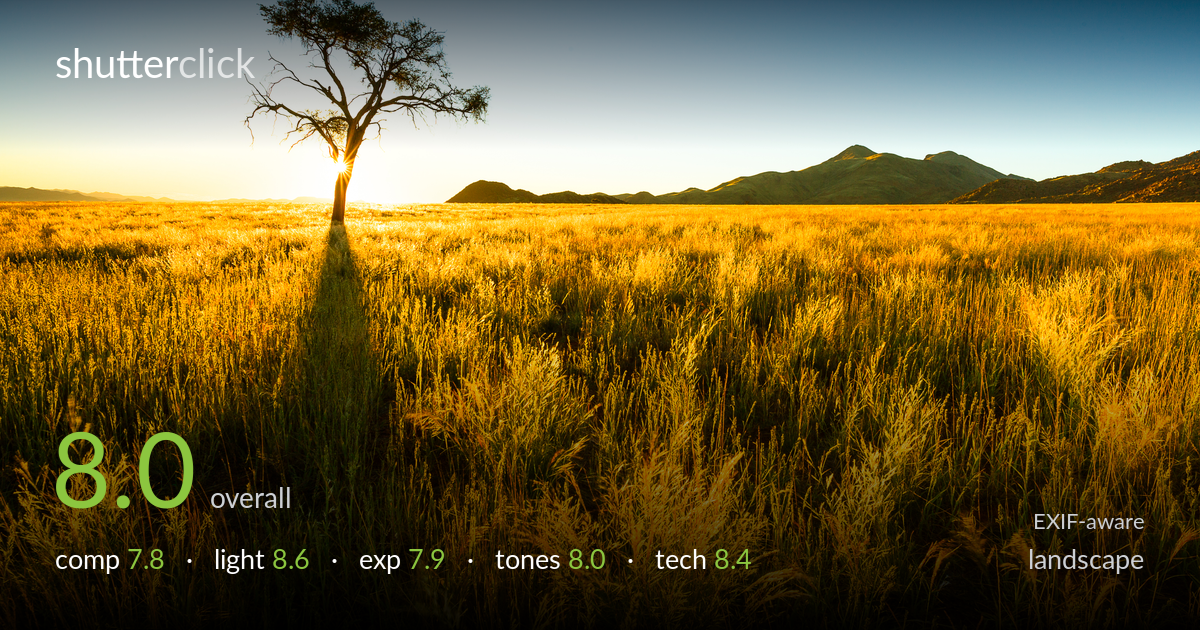
Golden savanna sunrise
Photo by Martin Sojka

| Focal length | 18 mm |
| Aperture | f / 16.0 |
| Shutter | 1/10 s |
| ISO | ISO 100 |
| Exp. comp. | 0.0 EV |
| Shot at | 04:31 · Apr 21, 2012 |
A textbook backlit savanna sunrise that earns its warmth through a precise sunstar tucked behind the lone acacia. The tree placed near the left third works, and the long shadow running toward the camera is the strongest compositional move in the frame, anchoring the foreground and pulling the eye through the golden grass to the distant hills. What holds it back is foreground organisation: the lower-right grass is busy and slightly undefined, and the shadow's diagonal isn't fully exploited as a leading line. The high horizon and golden saturation are well judged for the mood, though the warmth pushes toward heavy in the brightest grass.
The lone tree on the left third with its shadow spearing toward the camera is a clean, effective spine for the frame, and the high horizon gives the grass room to breathe. The distant mountains add scale and a quiet right-side counterweight. The foreground, though, is the weak point: the dense grass in the lower right reads as undifferentiated texture rather than leading interest, and the shadow line stops short of becoming a true leading line. A slightly lower angle would lift the foreground grass into stronger silhouette and shape.
Backlit golden-hour light is the heart of this image, and the timing is excellent. The low sun rim-lights individual grass heads, separates the tree as a near-silhouette, and the sunstar emerging from behind the trunk is a deliberate, well-placed accent that rewards the f/16 choice. Shadow direction running toward the camera gives genuine depth. The only caution is that backlight at this intensity flattens midtone detail in the brightest grass swathe, where glow tips into wash. Slightly earlier or a hair more sun angle would preserve more texture.
Exposure is handled well for a high-contrast backlit scene. The sky retains gradation from deep blue to pale horizon without clipping, and the tree silhouette holds just enough branch detail to read as form rather than a black mass. The brightest grass around the sunstar pushes near the top of the range and loses some texture, which is hard to avoid shooting straight into the sun. Shadow areas keep detail. A bracketed frame blended for the sun-adjacent highlights would recover that washed band without darkening the rest.
The warm-cool split between golden grass and blue sky is the image's signature, and it's appealing. Saturation in the grass is strong and largely justified by the genuine golden-hour light, though the most sunlit areas verge on oversaturated orange that flattens tonal separation between grass blades. White balance leans warm, which suits the mood. The blue sky gradient is clean and natural. Pulling saturation back slightly in the orange channel and lifting midtone contrast in the grass would restore the blade-by-blade definition the light is offering.
Settings are well matched to the intent. The Zeiss 18mm at f/16 delivers the deep front-to-back sharpness this kind of foreground-to-mountain composition demands, and that small aperture is also what renders the clean, defined sunstar — a deliberate and successful choice. ISO 100 keeps the file clean with full tonal latitude, and the 5D Mark II's sensor holds the wide dynamic range competently here. The 1/10s shutter is the one variable to watch: in this breeze-prone grass it risks softening the seed heads, and indeed some of the foreground grass shows slight motion smearing rather than crisp detail. On a tripod that's fine for the static tree and hills, but a touch faster shutter with a higher ISO, or shooting in a lull, would freeze the grass tips. Focus appears well placed for hyperfocal coverage at this focal length. Overall execution is technically sound and the gear is ideally suited to the scene.
What would elevate it
Tags
Shot something like this?
Expert photo critique, on demand — scored across six categories, EXIF-aware. Start with 3 free critiques, no credit card.
critique my photo — free