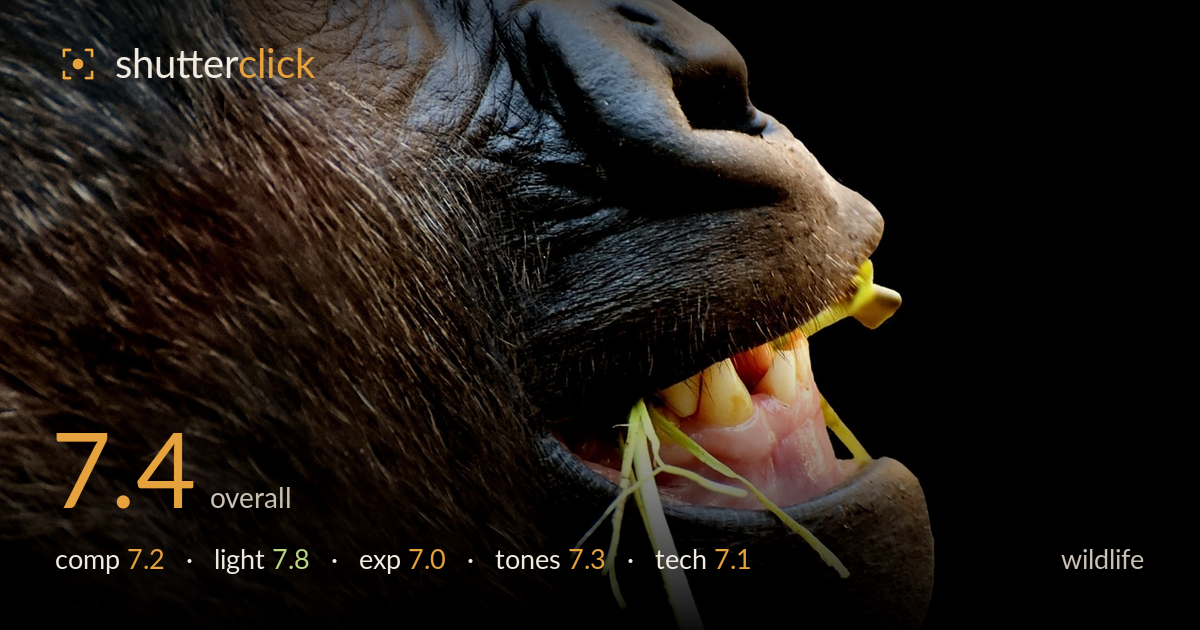
Gorilla feeding in profile
Photo by Alexas_Fotos

No EXIF metadata in this file
Technical analysis based on visual assessment only.
A strong behavioural moment — a gorilla feeding, caught mid-chew with a stem of vegetation trailing from its mouth — carried by a clean black background that isolates the subject beautifully. The profile framing emphasises the muzzle and the pink of the gums against dark fur, and the light does real work shaping the skin. What most holds the shot back is the eye: it sits near the top edge, partly lost in shadow, and lacks the sharp catchlight that anchors a wildlife portrait. The feeding action is the star, but a touch more room and a sharper eye would elevate this from good to memorable.
The profile orientation with the muzzle pointing into open black space on the right works, giving the feeding gesture room to breathe. The stem leading down and out of the frame adds a natural line drawing the eye to the mouth. The weakness is the crop at top: the brow ridge and part of the head are cut, and the eye sits crammed against the upper edge with little headroom. A slightly wider frame keeping the whole head and more space above would settle the composition.
Directional light from the front-right rakes across the muzzle and lifts the wrinkled skin texture and the wet sheen on the lips convincingly, giving real dimensionality. The pink gums and pale teeth catch enough light to register as the focal accent against the dark coat. The dark-on-black rendering is effective but the eye falls into near shadow, robbing the animal of its gaze. A hair more fill or exposure on the eye socket would keep the light's mood while restoring that connection.
Exposure is judged well for the difficult tonal spread: the black fur and background hold as true black without crushing all detail, while the highlights on the wet lips and teeth stay just this side of clipping. The pink of the mouth is nicely placed in the midtones. The eye is the exposure casualty — it sits too deep in shadow to read clearly, and the darkest fur loses separation. Recovering a stop in the shadows around the eye would help without flattening the drama.
The palette is restrained and works well — deep neutral blacks, warm brown fur, and the pink-and-yellow accents of mouth and vegetation providing the only saturated notes. White balance looks accurate, with the skin reading naturally rather than muddy. Contrast is high, suited to the subject, though it pushes the shadows into a near-uniform black that loses some fur texture on the left. A gentler shadow curve would recover gradation in the coat while keeping the overall punch.
Focus lands on the muzzle, lips and teeth, which is defensible given the feeding action is the story — the wet skin and the pink gums are crisply rendered with good micro-detail. Depth of field appears sufficient to hold the near face sharp. The trade-off is that the eye, further from the plane of focus and buried in shadow, reads soft and indistinct, which for a wildlife portrait is a meaningful miss since the eye is usually the anchor. Noise is controlled and the black background is clean without obvious banding, suggesting a sensible ISO. The stem of vegetation is sharp where it exits the mouth, which reinforces the moment. Overall execution is competent: the exposure discipline against a black background is not trivial and it's handled well. Placing the focus plane on the eye, or shooting at an aperture deep enough to hold both eye and muzzle sharp, would resolve the one real technical shortfall here.
What would elevate it
Tags
Shot something like this?
Expert photo critique, on demand — scored across six categories, EXIF-aware. Start with 3 free critiques, no credit card.
critique my photo — free