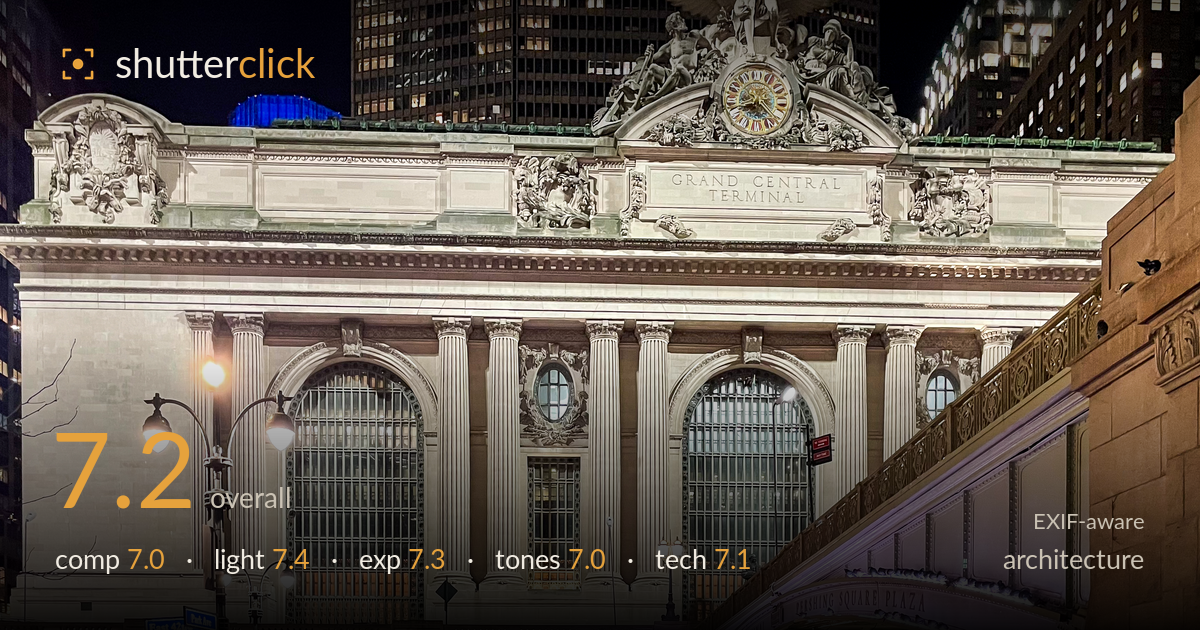
Grand central terminal at night

| Focal length | 4 mm |
| Aperture | f / 1.6 |
| Shutter | 1/40 s |
| ISO | ISO 320 |
| Exp. comp. | 0.0 EV |
| Shot at | 01:23 · Mar 10, 2023 |
A confident, information-rich frame of Grand Central's façade at night, with the Pershing Square viaduct ramp on the right adding depth and a second focal zone. The blue-hour-into-night sky sits clean and dark, and the warm interior glow of the terminal entrance draws the eye where it should. What most holds the image back is verticality: the columns lean and the whole façade tips slightly, betraying the wide phone lens shot from below. The busy street-level clutter also competes with the architecture. Tighter perspective correction and a moment with less foreground traffic would elevate a strong, well-observed frame.
The frame reads the whole façade top to bottom, with the Transportation sculpture and clock crowning it and the illuminated viaduct ramp anchoring the right — a genuine sense of layered depth. The tower directly behind the sculpture nicely echoes the terminal's centre. Weaknesses: the street level is cluttered with signage, cones, and parked cars that pull attention from the geometry, and the crop clips the ramp awkwardly on the right edge. A slightly higher vantage or a moment with cleaner foreground would let the architecture dominate more clearly.
The timing is well chosen — full dark sky against the floodlit stone gives strong separation and lets the warm terminal glow read as a focal point. The mix of cool sky, neutral façade lighting, and hot tungsten from the entrance and street lamps creates depth. The floods on the stone are fairly even and reveal the carving detail well. The lit windows of the background towers add texture without distracting. Slightly softer or more directional light on the façade would give the columns more three-dimensional modelling rather than flat frontal illumination.
A well-judged night exposure that holds the floodlit stone without blowing it while keeping the sky genuinely dark and clean. The bright entrance interior and the street lamp globes clip in the smallest highlights, which is acceptable and expected for these point sources. Shadow areas in the lower left retain usable detail. The overall balance between the dark sky and the lit façade avoids the muddy grey that trips up many night city shots. Pulling the brightest interior glow back a touch in post would recover a little more window detail.
White balance leans warm, which suits the tungsten street lighting and the terminal glow, though the stone façade tips slightly toward yellow-cream rather than neutral limestone. The contrast between cool dark sky and warm ground works in the image's favour. Saturation is restrained and believable. The lit signage introduces some competing magenta and purple that slightly fragments the palette. A cooler white balance on the stone, or a selective correction, would let the limestone read truer while keeping the warmth in the entrance where it belongs.
Shot on the iPhone 12 mini at its native 4mm wide, f/1.6, 1/40s, ISO 320 — reasonable choices for a handheld night frame, and the result is respectably sharp and low in noise for a small sensor. The 1/40s shutter is slow enough that moving cars show mild blur, but the static architecture is clean, so it worked out. The main technical limitation is inherent to the wide phone lens: strong converging verticals and slight perspective distortion, with the columns splaying outward and the whole façade tipping. There is no keystone correction, which architecture judged strictly penalises. Focus sits accurately on the façade with adequate depth throughout given the tiny sensor. A dedicated wide with a tilt-shift or in-camera lens correction, or a straightening pass in post, would fix the leaning verticals. Shooting from a bit further back at a longer equivalent focal length would also flatten the distortion and keep parallels closer to true.
What would elevate it
Tags
Shot something like this?
Expert photo critique, on demand — scored across six categories, EXIF-aware. Start with 3 free critiques, no credit card.
critique my photo — free