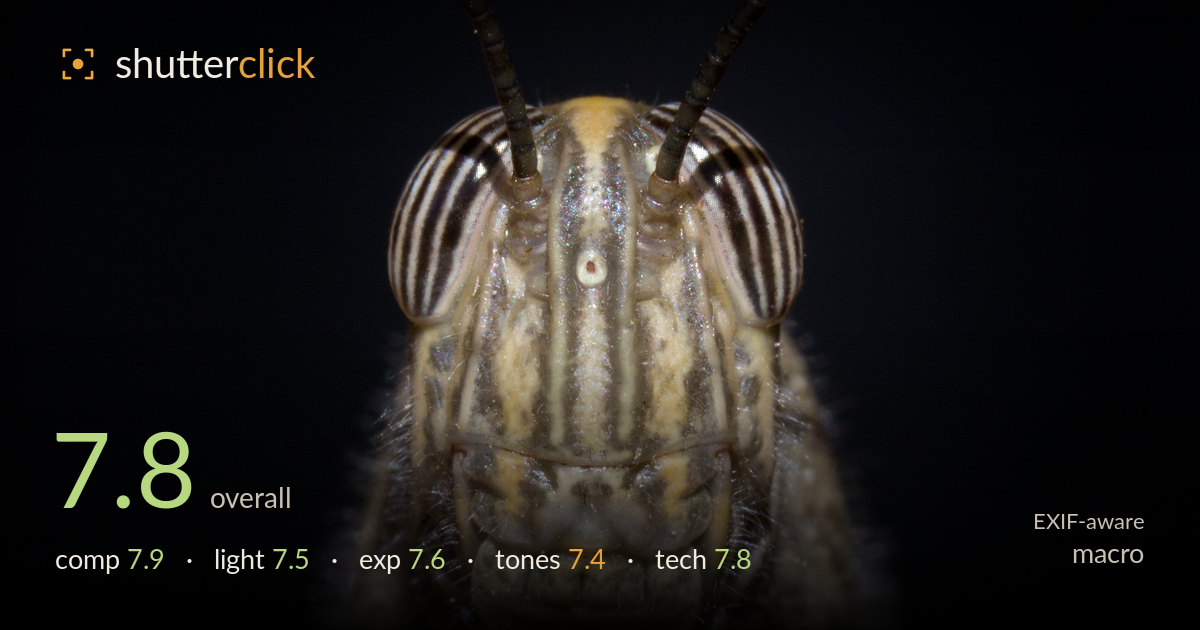
Grasshopper face head-on
Photo by Carlos Delgado

| Focal length | 100 mm |
| Aperture | f / 14.0 |
| Shutter | 1/200 s |
| ISO | ISO 800 |
| Exp. comp. | 0.0 EV |
| Shot at | 11:07 · Oct 27, 2013 |
A head-on grasshopper portrait that lands its most important asset: sharp, striped compound eyes rendered against a clean black background. The frontal symmetry is bold and the striped ocular pattern gives the frame its graphic punch. What most holds it back is depth-of-field management — the eyes, antennae bases, and mouthparts sit crisp, but the raised forelegs at the bottom drift soft and pull attention downward. The lighting is functional but slightly flat and warm, muting the fine cuticle texture that macro rewards. A cleaner light angle and either a tighter crop or a focus stack would push this from competent to striking.
The dead-centre, symmetrical framing suits an insect face and the black negative space isolates the subject cleanly. The antennae rising into the top corners give pleasing vertical energy and lead the eye up and out. Placement of the eyes on the upper third works well. The forelegs entering the bottom edge, however, are a distraction — soft and cropped mid-limb, they clutter the base rather than anchor it. A hair more headroom balance and a decision to either include or exclude those legs would tighten the read.
The light is even and reveals the eye stripes and facial ridges without harsh hotspots, which serves the symmetrical portrait. Direction is broadly frontal, so it flattens the cuticle relief and leaves the surface texture looking a touch soft and dimensionless. A few specular sparkles on the eyes add life. More raking side light would carve out the fine ridging and hairs that make macro subjects tactile, and would separate the face planes from the darker mouthparts. As it stands, the lighting is safe rather than sculptural.
Exposure is well judged for a dark-background macro — the eyes and pale facial markings hold detail without clipping, and the black surround stays clean rather than muddy grey. The forelegs and lower face retain shadow information. There is a slight overall warmth and the brightest cream tones on the cheeks edge close to blowing, but nothing is lost. The balance between a genuinely black background and a fully-detailed subject is handled competently, suggesting deliberate flash control rather than an accidental result.
The palette is a muted range of browns, creams, and greys with warm yellow accents around the mouth and crown — natural and appropriate to the animal. Contrast is moderate; the striped eyes carry the strongest tonal separation. White balance leans slightly warm, which suits the earthy subject but slightly flattens tonal distinction across the face. A touch more midtone contrast would help the cuticle patterns pop. The black background is neutral and clean, which is exactly what this kind of shot needs.
The 100mm f/2.8L macro is the ideal tool here, and f/14 is a sensible aperture choice for the depth this subject demands — yet even at f/14 the plane of focus only just covers the eyes and mid-face while the forelegs fall away into softness. That is the physics of this magnification, and the fix is focus stacking rather than a smaller aperture, which would only invite diffraction softening at this scale. Focus is placed accurately on the eyes and antennae bases, which is the correct priority. 1/200s with flash freezes the subject cleanly, and ISO 800 on the 60D introduces mild noise in the shadowed background but nothing objectionable. Sharpness where it counts is good. The main technical gain available is a multi-frame stack to bring the whole face and forelegs into crisp focus, giving front-to-back rendering that a single f/14 frame cannot deliver.
What would elevate it
Tags
Shot something like this?
Expert photo critique, on demand — scored across six categories, EXIF-aware. Start with 3 free critiques, no credit card.
critique my photo — free