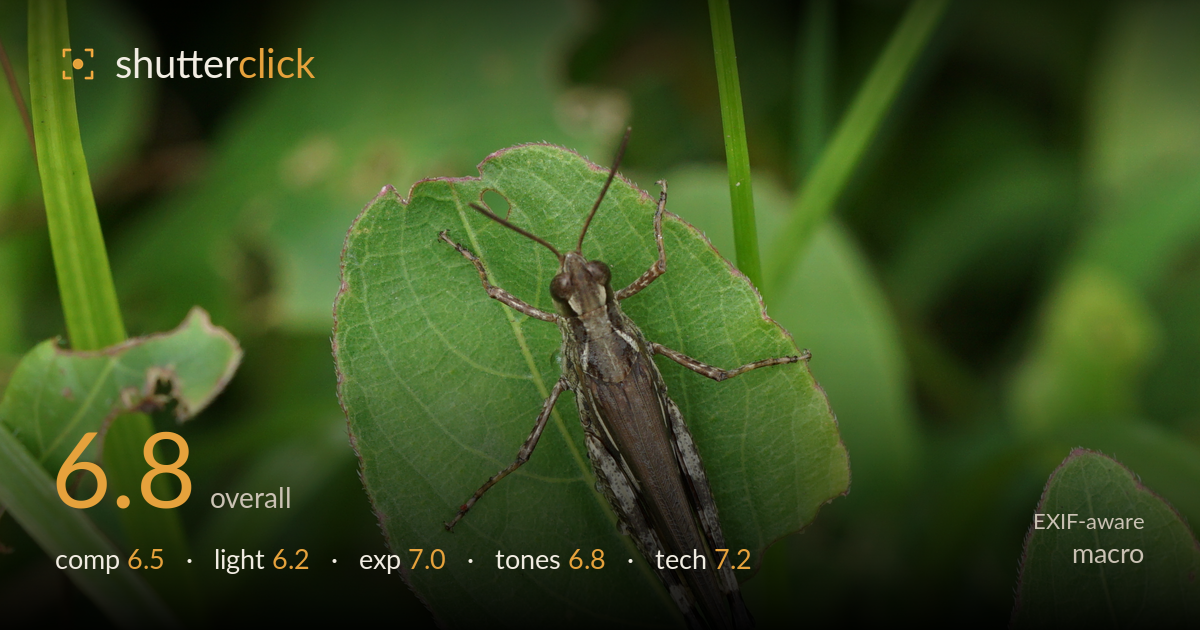
Grasshopper resting on a leaf
Photo by Vengolis

| Focal length | 150 mm |
| Aperture | f / 7.1 |
| Shutter | 1/200 s |
| ISO | ISO 200 |
| Exp. comp. | 0.0 EV |
| Shot at | 10:23 · Aug 22, 2015 |
A cleanly executed field record of a grasshopper resting diagonally on a leaf, with the body sharp and well resolved. The diagonal placement gives a natural line to follow, but the subject sits fairly central and the crossing blade of grass through the upper frame competes with the head and antennae. The muted brown insect blends into the green surroundings, which reads authentically but flattens separation. The main limitation is light: flat, overcast illumination keeps texture legible but adds little modelling or sparkle. Solid natural-history documentation that stops short of a standout image.
The diagonal orientation of the grasshopper across the leaf is the strongest compositional choice, giving the eye a clear path from head to hind legs. Placement is close to centre, though, and the busy background of crossing grass blades and torn leaves clutters the edges. The vertical blade passing over the antennae in the upper frame is the most intrusive element, cutting across the subject's head area. A slightly lower angle or a cleaner backdrop would isolate the insect more decisively and remove the competing lines.
Soft, diffuse overcast light keeps the whole insect evenly lit and avoids blown highlights on the shiny leaf, which suits detailed insect work. The trade-off is a lack of directional modelling: the grasshopper's segmented body and the leaf's veining stay flat, with little shadow to carve out form and texture. A touch of raking side light, or a subtle off-camera fill, would separate the body's ridges and add dimensionality. As it stands the lighting is safe and clean but not shaping the subject.
Exposure is well judged. The dark brown body retains detail without crushing to black, and the pale cream markings along the abdomen hold texture rather than clipping. The bright green foliage is exposed without highlight loss, and the histogram appears to sit comfortably in the midtones. At 0 EV the balance between a dark subject and a lighter surround is handled well. Shadow areas under the legs keep enough information to read the structure. A clean, deliberate-looking result with no obvious brightness problems.
The green-and-brown palette is natural and unforced, with believable white balance under overcast light. Contrast is on the gentle side, which reflects the flat lighting and leaves the image feeling slightly muted. The subject's earthy browns risk merging into the darker greens behind, reducing punch. A modest contrast lift and a nudge of clarity on the insect would help it stand out. Saturation is restrained and realistic, appropriate for documentation, though a hair more separation between subject and background tones would strengthen impact.
The 150mm f/2.8 macro lens is well suited to this working distance, and f/7.1 is a sensible aperture choice that carries most of the body in focus while keeping the background softly blurred. Focus lands accurately on the head, eye and thorax, which is exactly where it needs to be, and the resolution on the body ridges and leg spines is genuinely good. ISO 200 keeps noise negligible, and 1/200s is adequate for a static subject on a still day, though any breeze on that leaf would risk softness at this magnification. The main technical limitation is that depth of field, while covering the body, falls off at the hind legs and the far antenna, which sits soft against the background. Focus stacking a few frames would render the entire insect crisp. Overall the execution is clean and competent, with settings that match the subject well and no significant errors in capture.
What would elevate it
Tags
Shot something like this?
Expert photo critique, on demand — scored across six categories, EXIF-aware. Start with 3 free critiques, no credit card.
critique my photo — free