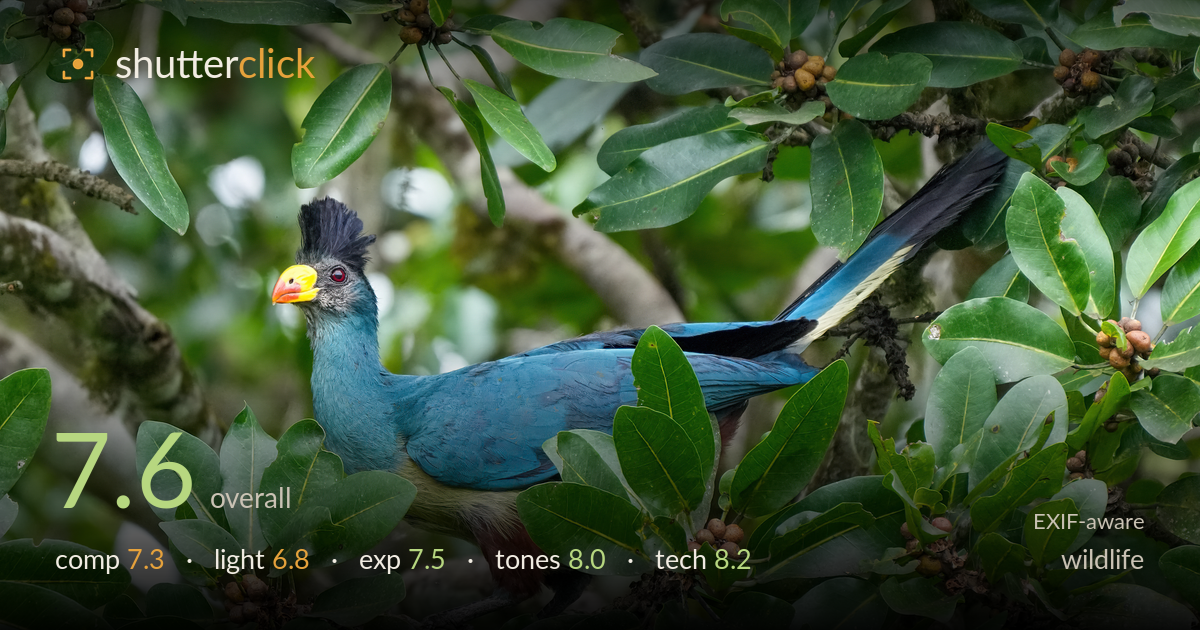
Great blue turaco among the leaves
Photo by Giles Laurent

| Focal length | 600 mm |
| Aperture | f / 6.3 |
| Shutter | 1/1000 s |
| ISO | ISO 3200 |
| Exp. comp. | 0.0 EV |
| Shot at | 11:06 · Dec 14, 2022 |
A clean, well-executed frame of a Great Blue Turaco with the eye sharp and the iridescent blue plumage rendered beautifully against a foliage-rich habitat. The bird's full profile, from crest to that sweeping tail, is captured with room to breathe. What most holds the shot back is the light: a flat, overcast quality that keeps the plumage from truly shimmering, and several leaves crossing the body that clutter the read. The head sits low-left in the frame, which works for the tail's diagonal but leaves the eye slightly buried among branches. Strong habitat portrait, one step from excellent.
The profile pose reads clearly and the long tail sweeps up to the right, giving a natural diagonal that carries the eye across the frame. Placing the head lower-left with the tail extending gives the bird room to occupy. The habitat framing suits a turaco. Less successful are the leaves crossing the breast and belly, which break the body's outline and steal separation. A branch bisects the tail. A slightly higher angle or a wait for a cleaner perch would let the full silhouette read without foreground interruption.
Soft, diffused overcast light keeps detail across the plumage and avoids blown highlights on the bright yellow-and-red bill, which is a genuine benefit here. The trade-off is flatness: the iridescent blues that make this species striking never catch a directional kick, so the feathers look matte rather than shimmering. The eye lacks a strong catchlight, dulling the gaze. Directional side light, or a break of sun angling across the body, would sculpt the plumage and add the sheen this bird is known for.
Exposure is well judged for a tricky scene with a dark bird among bright leaves. Highlights on the bill and pale belly hold detail, and the shadowed head and breast retain information without muddiness. The bright background patches through the canopy are near the top of the range but not distractingly clipped. Midtones sit comfortably. The overall brightness reads deliberate rather than accidental, and no important area is lost to crushed shadow. A touch of shadow lift on the face would surface the eye further.
Colour is the standout. The teal-to-cobalt gradient across the back and wings is rendered with rich, believable saturation, and the transition to the wine-red vent and pale belly is handled cleanly. The bill's yellow and orange pop without oversaturation. White balance sits natural against the varied greens of the foliage, which stay separated rather than collapsing into one wash. Contrast is moderate, matching the soft light. Excellent tonal control overall; only a fraction more micro-contrast in the plumage would add depth.
The 600mm at f/6.3 on the ILCE-1 is well matched to this subject, giving reach and enough background compression to soften the far canopy while keeping the near foliage recognisable. Focus is accurate on the eye, which is critical, and the bill and head feathers hold crisp detail. 1/1000s is ample for a perched bird and leaves headroom against any small movement. ISO 3200 is a sensible choice under the dim canopy, and the Sony's sensor handles it cleanly with minimal visible noise in the shadowed head and plumage. The chief technical limitation is depth of field: at f/6.3 and 600mm the plane of focus is thin, and the tail and rear body drift softer than the head. A step down to f/8 would have carried more of the bird sharp, at the cost of higher ISO. Overall a confident, well-controlled capture with strong execution across the board.
What would elevate it
Tags
Shot something like this?
Expert photo critique, on demand — scored across six categories, EXIF-aware. Start with 3 free critiques, no credit card.
critique my photo — free