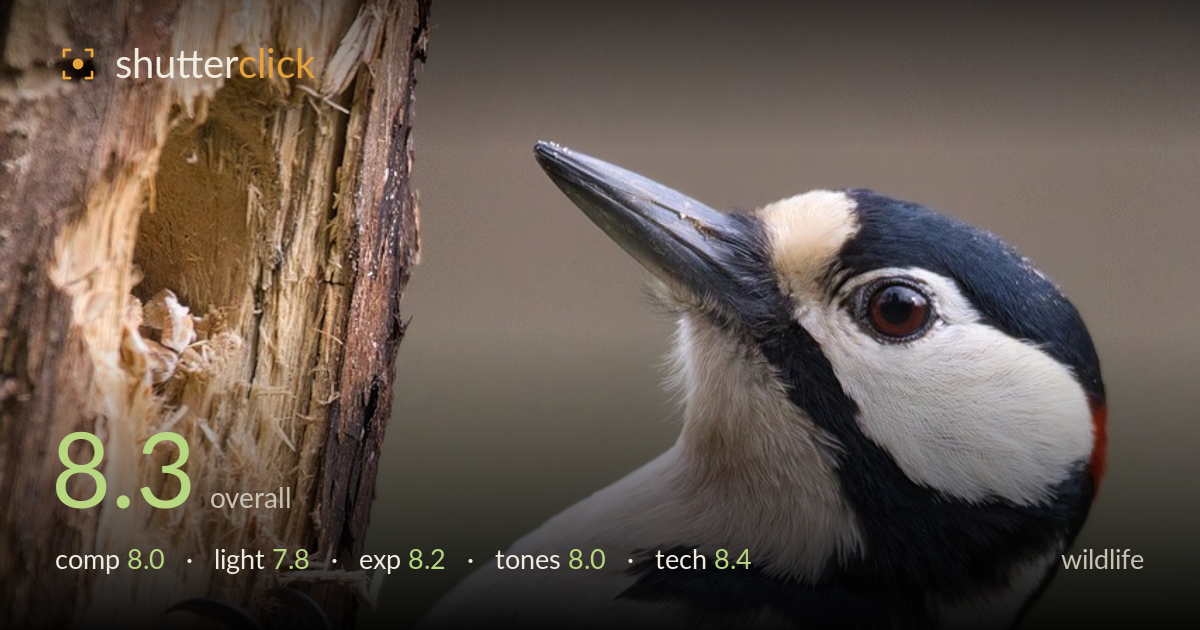
Great spotted woodpecker on weathered wood
Photo by Max_Gindele_Photography

No EXIF metadata in this file
Technical analysis based on visual assessment only.
A clean, well-executed great spotted woodpecker portrait, carried by tack-sharp detail on the head and a diagnostic pose on natural, weathered wood. The eye is sharp with a subtle catchlight, the gripping foot and claws add behavioural interest, and the smooth green background isolates the bird cleanly. What holds it back most is light quality: the flat, overcast illumination renders the plumage a touch soft in modelling, muting the crimson vent and the black-and-white contrast that make this species pop. Slightly more directional light and a fraction more room on the left would elevate an already accomplished frame.
The diagonal trunk anchors the left third and gives the bird a believable perch, while the woodpecker sits nicely off-centre with its gaze directed into open space on the right — good instincts for a portrait. The gripping foot and beak-to-bark relationship read as authentic behaviour. The crop is tight on the tail and the trunk hugs the left edge, leaving little breathing room; a touch more space beneath the tail and along the left would ease the containment. Background separation is excellent.
Soft, diffuse overcast light keeps highlights on the white cheek and breast under control and avoids harsh shadows, which suits detailed plumage. The trade-off is flatness: the modelling across the pale underparts is gentle to the point of appearing slightly washed, and the black wing lacks the depth stronger directional light would carve. The eye still holds a small catchlight, which saves the portrait. A low, raking side light would reveal feather texture and lend the form more dimensionality.
Exposure is well judged for a high-contrast subject against a bright background. The whites of the cheek and belly retain texture without clipping, and the dense blacks of the wing hold enough detail to read as feathers rather than empty shadow. The mid-tones on the grey underparts sit comfortably. The eye is exposed to reveal the dark iris without becoming a void. Overall a balanced, deliberate rendering that handles the demanding tonal range of this species with care.
The green background is smooth and unobtrusive, giving a natural, muted colour palette. White balance reads neutral and believable for overcast conditions. The crimson vent and nape patch are present but a little subdued — under flat light they lack the saturation punch this species can deliver. Contrast in the black-and-white plumage is honest rather than dramatic. The wood tones on the trunk are natural and add earthy warmth. A modest lift in vibrance on the reds would add life without straying into artificiality.
Focus lands precisely where it matters — the eye is critically sharp with fine detail carried across the cheek feathers and the beak. Depth of field is well chosen: enough to hold the head and body plane crisp while dissolving the background into clean, distraction-free green, a textbook wildlife separation. The gripping foot and claws are rendered with impressive detail, showing the shutter was fast enough to freeze this typically restless bird cleanly with no visible motion blur. Noise is well controlled and the overall image is clean. The pale plumage on the far side of the body softens slightly as it falls outside the plane of focus, which is a reasonable compromise given the shooting angle. The near-profile head angle is ideal for a diagnostic portrait. Sharpening appears sensible without haloing. This is confident, controlled long-lens execution — the kind of clean, sharp capture that separates a keeper from a snapshot.
What would elevate it
Tags
Shot something like this?
Expert photo critique, on demand — scored across six categories, EXIF-aware. Start with 3 free critiques, no credit card.
critique my photo — free