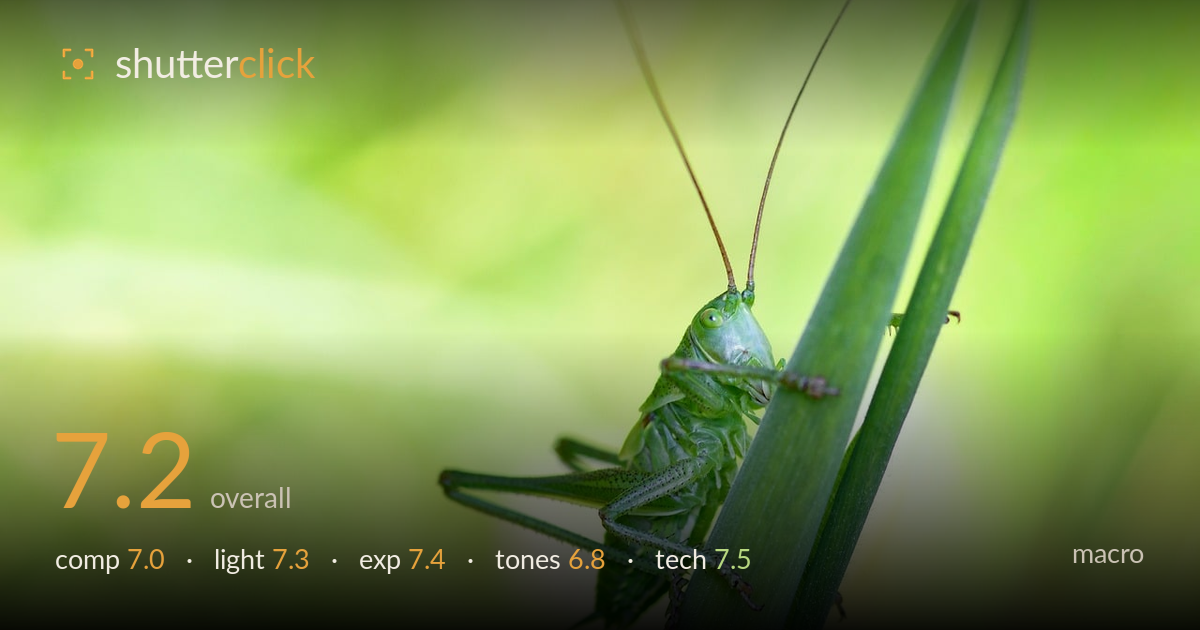
Green cricket on a blade of grass
Photo by christels

No EXIF metadata in this file
Technical analysis based on visual assessment only.
A clean, well-executed macro of a bush cricket clinging to a blade of grass, with the diagonal stem giving the frame welcome structure and the long antennae drawing the eye up and out of the frame. The head and near foreleg are sharp, and the pose reads well. What most holds it back is the near-monochromatic green palette, which blends subject and background and flattens separation, and a focus plane that falls off before reaching the hind leg and abdomen detail. Slightly more tonal contrast between insect and setting would lift it considerably.
The diagonal blade of grass is the strongest structural element, splitting the frame and giving the insect a solid anchor while the antennae trace elegant lines toward the top edge. Placing the cricket left of centre works, and the sweep of grass blades top-right adds balance. The lower body and hind leg, however, crowd the bottom edge and feel slightly cramped. A touch more room beneath the subject, and a hair less empty green upper-left, would tighten the read and give the pose space to breathe.
Soft, diffused daylight suits the subject, avoiding harsh specular hotspots on the shiny cuticle and keeping shadow detail open across the legs. The light appears frontal-to-slightly-side, which gives modest modelling to the head and thorax but leaves the body somewhat flat overall. A more raking, lower-angled light would rake across the segmented abdomen and leg spines to reveal texture that the current even illumination smooths over. The gentle backlight glow in the background is pleasant and keeps the mood airy.
Exposure is well controlled for a high-key green scene. The bright background is held just short of clipping, retaining faint gradation rather than blowing to pure white, and the subject sits at a comfortable midtone with detail preserved in both the lit head and the shaded underside. No crushed shadows on the legs. If anything the overall reading leans slightly bright, which contributes to the subject being lost against the setting; pulling exposure down a touch would deepen the insect's presence.
This is the weakest link: the frame is almost entirely one register of green, so the cricket, the grass blade, and the blurred background all share the same hue and similar luminance. The result is unified and natural but low in separation, and the subject nearly camouflages into its surroundings. White balance reads accurate and the greens are believable rather than oversaturated. A cooler or more neutral background, or a small warmth shift on the subject, would give the eye something to lock onto.
Focus is placed accurately on the head and the near foreleg, which are the details that matter most, and the eye holds crisp definition with visible facets. Depth of field is characteristically shallow for macro at this magnification, and it falls off before the hind leg and rear abdomen, leaving those areas soft — a focus stack of two or three frames would carry sharpness cleanly from head to hind leg. The background rendering is smooth and creamy, indicating a wide aperture and good subject-to-background distance, which isolates the insect well despite the colour overlap. Noise is not an issue and the file looks clean. The antennae remain sharp along much of their length, a nice touch that is easy to lose. Handholding at this scale is demanding; the frozen antennae and sharp eye suggest either good stabilisation or adequate shutter speed. Overall a technically sound capture where the main limitation is the single-plane depth rather than any handling error.
What would elevate it
Tags
Shot something like this?
Expert photo critique, on demand — scored across six categories, EXIF-aware. Start with 3 free critiques, no credit card.
critique my photo — free