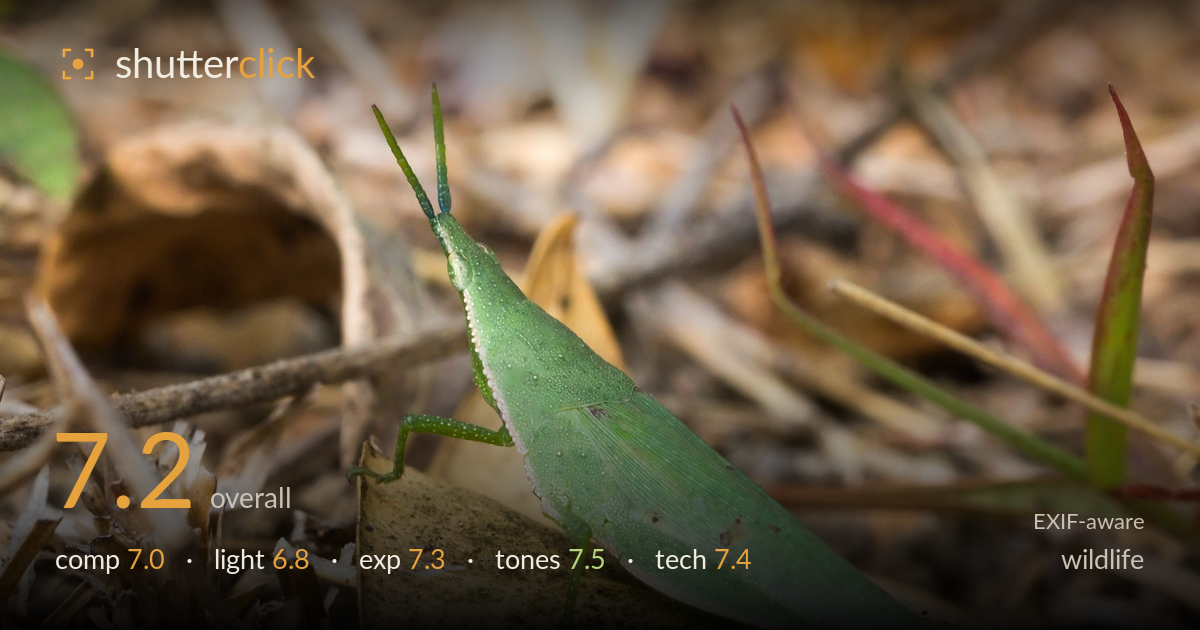
Green grasshopper on a dry leaf
Photo by Crisco 1492

| Focal length | 100 mm |
| Aperture | f / 11.0 |
| Shutter | 1/125 s |
| ISO | ISO 400 |
| Exp. comp. | 0.0 EV |
| Shot at | 08:07 · Sep 20, 2015 |
A clean, well-executed side profile of a green grasshopper that separates beautifully from a busy, warm background through colour contrast and shallow depth. The pointed head and antennae give strong graphic line, and the shooting angle keeps the whole body on one plane. The eye and head carry acceptable sharpness, though the peak of critical focus sits a touch behind, and the light is flat and midday-hard, denying the subject the modelling that raking light would provide. The green-against-brown palette does most of the heavy lifting. Sharper eye focus and softer, lower-angled light would lift this from competent to memorable.
The profile view reads clearly, with the grasshopper occupying the frame's lower-centre and the antennae leading up-left into negative space — a sensible arrangement. The dry leaf perch anchors the subject and echoes the head's triangular shape. The tail end runs close to the right edge, tightening breathing room on that side; a little more space ahead of the direction of travel would balance better. The diagonal twigs behind add clutter rather than support. Overall the subject placement is workable but not deliberate enough to feel resolved.
The light is bright but flat and fairly hard, typical of open midday sun, which flattens the body's dimensional form and leaves the green rendering slightly plasticky. There is no catchlight or specular sparkle to define the eye, and shadows fall directly beneath with little shaping. The dewy stippling on the body catches some light, which helps, but a lower, raking side light would carve out texture and give the exoskeleton depth. Timing and angle are the main missed opportunities here.
Exposure is well judged. Highlights on the green body and the pale leaf hold detail without clipping, and shadow areas retain information in the darker twig recesses. The midtones sit comfortably, giving the subject good tonal presence against the warmer surroundings. The bright background patches near the top edge push toward the highlight ceiling but stay recoverable. Nothing looks accidentally under- or over-exposed; the balance across a high-contrast, dappled scene is handled cleanly and deliberately.
The colour relationship is the image's strongest asset — cool, saturated green set against warm browns and the flash of red-tipped grass at right creates natural, pleasing contrast. White balance reads accurate, with the greens looking true rather than yellow-shifted. Saturation is healthy without tipping into artificial. The tonal range spans deep shadow to bright leaf with smooth gradation across the body. If anything, the warm background could be dialled back very slightly to keep attention on the subject, but the palette works.
The EF100mm f/2.8L Macro is ideally suited here, and f/11 is a reasonable call for a lateral insect at this magnification — it carries most of the body from head to abdomen within the depth of field. Focus lands on the head and forelegs, with acceptable eye sharpness, though the crispest plane appears to sit just behind the eye on the thorax; nudging focus forward would put the bite where it counts. 1/125s at ISO 400 is enough to freeze a stationary subject, but it leaves no margin for any twitch of the antennae, which show faint softness. Handheld at 100mm macro, 1/125s is near the edge of safe even with IS. Stopping to f/11 also introduces slight diffraction softening across fine detail. A shutter around 1/250–1/320s with ISO lifted to 640–800 would have added insurance against both motion and camera shake at negligible noise cost on the 60D. Solid execution overall, with focus precision the one thing to tighten.
What would elevate it
Tags
Shot something like this?
Expert photo critique, on demand — scored across six categories, EXIF-aware. Start with 3 free critiques, no credit card.
critique my photo — free