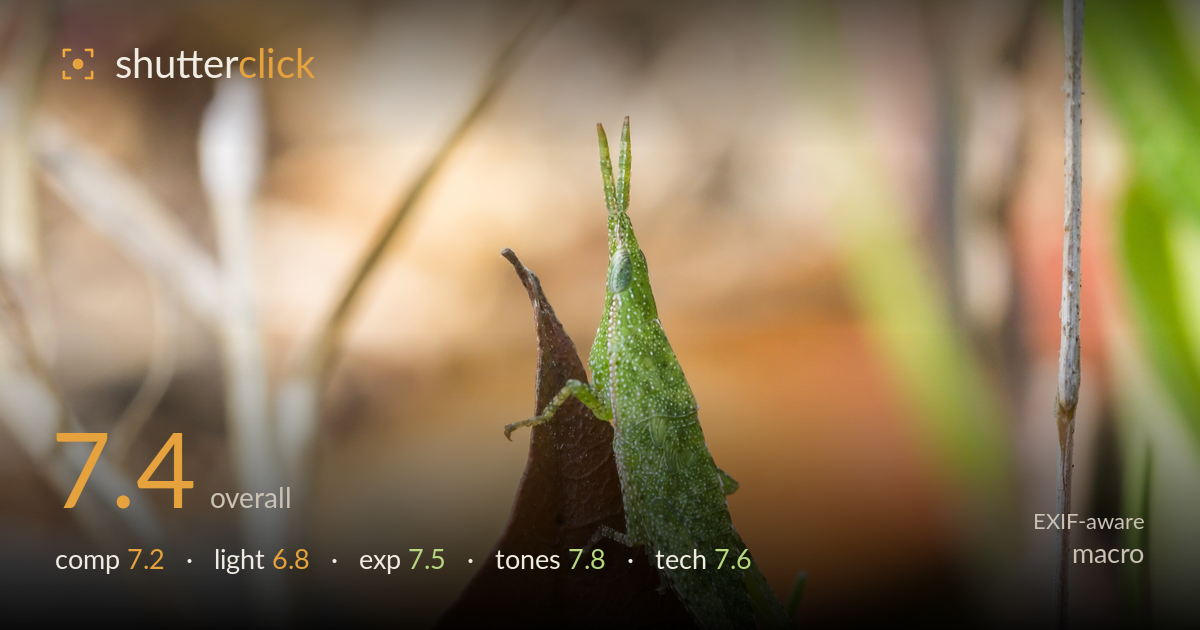
Green grasshopper on a leaf tip
Photo by Crisco 1492

| Focal length | 100 mm |
| Aperture | f / 8.0 |
| Shutter | 1/125 s |
| ISO | ISO 400 |
| Exp. comp. | 0.0 EV |
| Shot at | 08:07 · Sep 20, 2015 |
A well-timed capture of a nymph grasshopper poised on the tip of a dead leaf — the pyramid of the brown leaf and the diagonal of the green insect build a natural upward thrust that carries the eye. The green-on-warm-brown colour pairing is genuinely pleasing and the granular skin texture reads clearly. What most holds the shot back is focus placement: the eye and head, the critical plane in any creature macro, sit slightly softer than the mid-body, and the bright out-of-focus stem on the right pulls attention. Flatter frontal light also mutes the fine surface relief.
The leaf tip and the insect form a rising diagonal that gives the frame real energy, and placing the subject in the right two-thirds leaves the warm bokeh room to breathe. The head reaching toward the top edge is a touch tight — a little more headroom would let the antennae resolve without crowding the border. The bright vertical stem on the right competes for attention and clips the corner awkwardly. The overlapping brown leaf and green body read as a strong, layered relationship rather than clutter.
Soft, diffuse daylight keeps highlights controlled across the green body and avoids blown speculars on the shiny leaf, which suits the subject. The trade-off is that the light arrives fairly frontal and flat, so the granular skin texture and the leaf's veining lack the raking relief that would make them pop. A lower side angle or a touch of directional fill would carve more dimension into the head and abdomen. The warm background glow is attractive but does little to model the subject itself.
Exposure is judged well for a tricky green-on-bright-warm scene. The insect holds detail from the shaded lower legs up through the lit dorsal ridge, and the bright background bokeh stays short of clipping. Shadow areas in the leaf retain structure without muddiness. The overall placement sits comfortably in the midtones with no evidence of accidental under- or over-exposure. Zero exposure compensation was the right call here; the histogram would show a healthy spread without crushed blacks or lost highlights.
The colour work is the strongest element. The saturated green of the nymph plays cleanly against the russet leaf and the soft amber background, a complementary pairing that gives the image immediate appeal. White balance reads neutral-to-warm and feels accurate for the light. Contrast is moderate and appropriate, preserving the subtle tonal gradation across the body's speckled surface. Nothing looks oversaturated or artificially punched. The muted background tones keep the palette cohesive rather than distracting.
The EF 100mm f/2.8L Macro is the ideal tool here, and f/8 is a sensible aperture choice for a subject this size — deep enough to hold much of the body, shallow enough to melt the background into clean bokeh. The problem is where the plane of focus landed: the sharpest detail sits along the mid-body and thorax, while the eye and head fall slightly soft. In creature macro the eye is the make-or-break plane, so a small refocus or a focus-bracketed pair would lift the whole frame. At 1/125s handheld with IS, motion is adequately arrested and there's no visible shake, though a faster shutter would add insurance against subject twitch. ISO 400 is clean with no meaningful noise penalty. Given the light available, stepping to f/11 with a bump in ISO could have pulled the antennae tips and head into the same crisp zone as the abdomen without sacrificing background separation.
What would elevate it
Tags
Shot something like this?
Expert photo critique, on demand — scored across six categories, EXIF-aware. Start with 3 free critiques, no credit card.
critique my photo — free