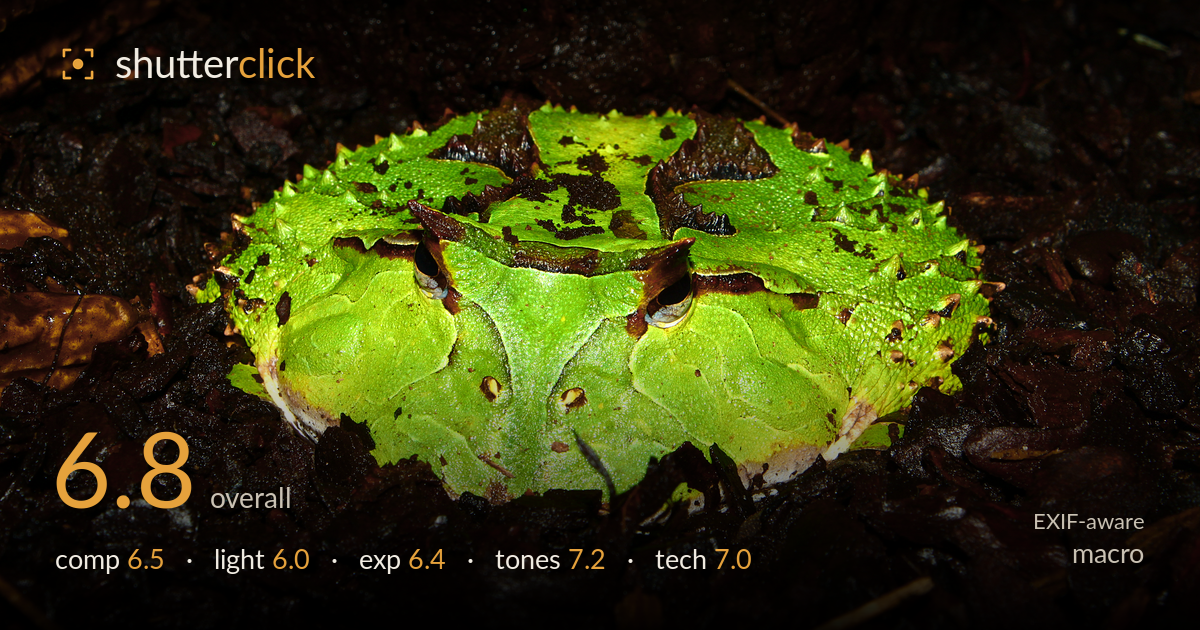
Green horned frog in the leaf litter
Photo by H. Zell

| Focal length | 55 mm |
| Aperture | f / 18.0 |
| Shutter | 1/30 s |
| ISO | ISO 100 |
| Exp. comp. | 0.0 EV |
| Shot at | 10:17 · May 21, 2011 |
A striking subject well served by its natural camouflage against dark substrate, but the lighting is the weakest link — a hard, direct source flattens the frog and blows small highlights on the wet debris while leaving the surroundings crushed to near-black. The frog sits low and centred, which suits the burrowed pose but leaves dead space above. The green-against-brown palette is genuinely arresting and the horned skin texture reads well. Softening and repositioning the light, and lifting the shadows slightly, would turn a solid record shot into a compelling portrait of the animal.
The frog is placed low-centre, which reinforces the burrowed, waiting posture and lets the dark substrate frame it as isolated colour. That works. But there is a large slab of undifferentiated dark bark occupying the upper third with no interest to justify it — the frame could sit tighter or lower to reduce that void. The head-on angle showcases the classic horned-frog symmetry and the eyes anchor the gaze effectively. A touch more room at the mouth line would prevent the chin feeling cramped against the lower edge.
This is the shot's main limitation. A hard, frontal-to-top light source picks out the frog cleanly but produces harsh specular hits on the wet substrate and glassy catchlights that read as hotspots rather than shaping. The falloff to black around the animal is dramatic but the transition is abrupt, giving a cut-out, flash-lit look rather than a modelled one. Diffused light or a bounce card would soften the highlights on the wet skin and reveal more of the tubercle texture across the back.
Exposure holds the green midtones and skin detail well, and the frog's tonal range is largely intact. The problem is the extreme contrast: the surrounding leaf litter is crushed to near-black in the corners, losing all detail, while scattered wet highlights on debris nudge toward clipping. The histogram is heavily weighted to the shadows by design, but a slight fill or a shadow lift in post would recover context without muddying the subject. The frog itself is exposed cleanly and deliberately.
The colour is the standout. The vivid greens of the skin play beautifully against the warm chocolate-browns of the bark, and the brown horned patches echo the substrate for a cohesive palette. White balance leans slightly warm on the litter, which flatters the earth tones. Saturation is strong without tipping into cartoonish. The dark shadows carry a clean neutral rather than a colour cast. Mid-tone gradation across the green skin is smooth and reads the varied surface texture convincingly.
At f/18 on the 55mm the depth of field is deep enough to hold the whole frog acceptably sharp, a sensible call for a subject with this much dimensional relief — front to back the animal stays in focus. ISO 100 keeps noise absent and the tones clean. The trade-off is the 1/30s shutter: handholding at that speed invites shake, and while the eyes and forward skin look adequately crisp, the finest tubercle detail is slightly soft, likely a mix of motion and diffraction at f/18. Focus lands correctly on the eyes and central face, which is the right plane. A tripod would have allowed the same aperture at a lower risk of blur, or a wider aperture around f/11 would have cut diffraction while still covering the depth needed. The 55mm working distance is reasonable for a subject this size. Overall the settings are thoughtfully chosen for depth, with sharpness the only compromise.
What would elevate it
Tags
Shot something like this?
Expert photo critique, on demand — scored across six categories, EXIF-aware. Start with 3 free critiques, no credit card.
critique my photo — free