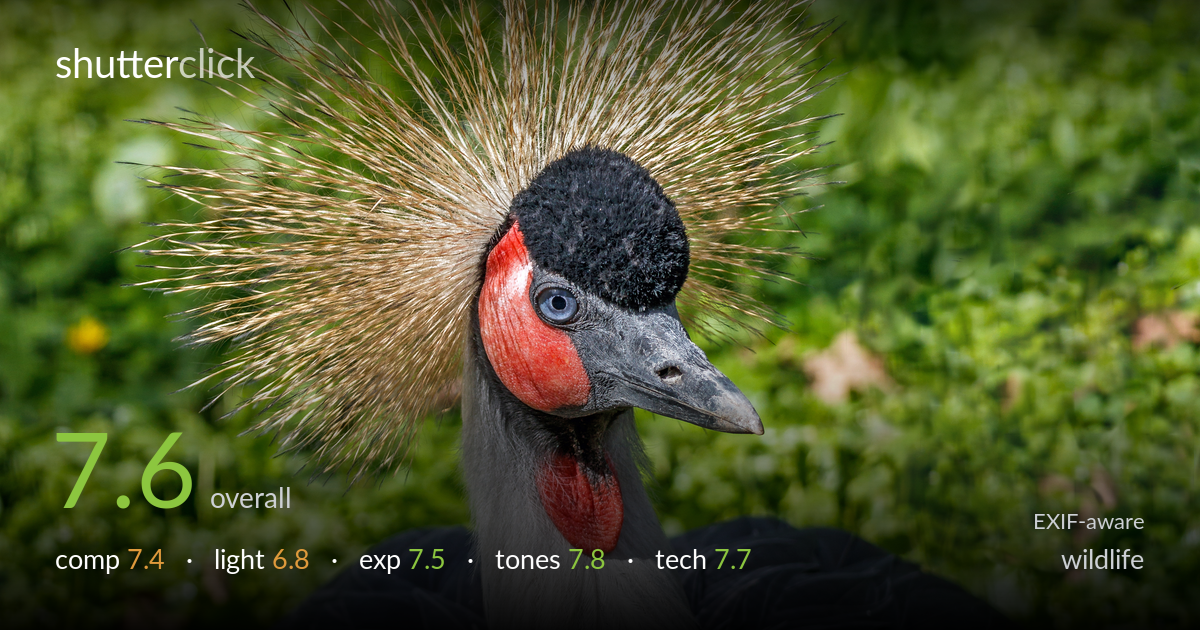
Grey crowned crane resting in the grass
Photo by H. Zell

| Focal length | 109 mm |
| Aperture | f / 6.3 |
| Shutter | 1/320 s |
| ISO | ISO 100 |
| Exp. comp. | 0.0 EV |
| Shot at | 12:51 · Apr 14, 2018 |
A striking portrait of a grey crowned crane that captures the species' golden crest and red wattle in fine detail. The bird sits low and centred, filling the frame with its plumage cascading down the foreground. The crest catches the light beautifully and the eye is sharp. What most holds the image back is the harsh, dappled sunlight, which throws bright hotspots and competing highlights across the green background and the bird's grey neck. The busy, sun-flecked backdrop pulls attention from the subject. Softer, more even light and tighter separation would elevate this from a strong record shot to a memorable portrait.
Centring the crane works here because the radiating crest is naturally symmetrical and the cascading neck plumage anchors the lower frame. The subject fills the space well and the slight downward gaze adds engagement. The background of greenery and dead leaves frames the body without clutter directly behind the head. The lower body and feet are cut off, which slightly truncates the form, and a touch more room above the crest would let the spiky crown breathe. The eye sits near a thirds intersection, which helps.
Direct sunlight backlights and rims the crest beautifully, making the golden filaments glow against the darker background. But the same hard, dappled light is the image's biggest weakness: bright sun-flecks scatter across the green backdrop and create hotspots on the grey neck feathers, fragmenting attention. Shadows under the chin go dense. Open shade or an overcast sky would render the grey plumage and red wattle more evenly and tame the competing background highlights. Timing the shoot for softer, lower-angle light would also warm the tones.
Exposure is well judged for a high-contrast scene. The brightest crest filaments hold detail rather than blowing out, and the grey neck retains gradation despite the sunlit highlights. The dark crown cap keeps some texture rather than crushing to black. ISO 100 keeps the file clean. A few specular hotspots on the background and the neck are near clipping, but these are scene-driven rather than errors. Pulling exposure compensation down a third of a stop would have given those highlights more safety margin without losing the eye.
The colour rendering is the image's strength: the vivid red wattle and cheek patch, the warm gold crest, and the cool grey plumage form a pleasing complementary palette against the saturated green. White balance looks accurate and the greys read neutral. The green background is intense but not oversaturated. The blue eye is a lovely accent. Contrast runs a little high because of the hard light, which deepens the chin shadows more than ideal. A gentle lift in the darkest tones would recover that detail.
The 109mm focal length on the 70-300mm gives a natural perspective for this seated subject, and at f/6.3 the depth of field is sufficient to hold the head and most of the body sharp while softening the background into clean bokeh. Focus is placed correctly on the eye, which is critical and well executed here. At 1/320s the shutter froze the stationary bird without issue, though it would offer little margin had the crane moved its head suddenly. ISO 100 keeps the file noise-free and maximises detail in the fine crest filaments. The main technical limitation is depth of field at this magnification: the near neck plumage and the back feathers fall slightly outside critical sharpness. Stopping down to f/8 would have brought more of the body into focus at the cost of a busier background, a reasonable trade either way. Overall the gear choices and execution are sound and the critical sharpness lands where it matters.
What would elevate it
Tags
Shot something like this?
Expert photo critique, on demand — scored across six categories, EXIF-aware. Start with 3 free critiques, no credit card.
critique my photo — free