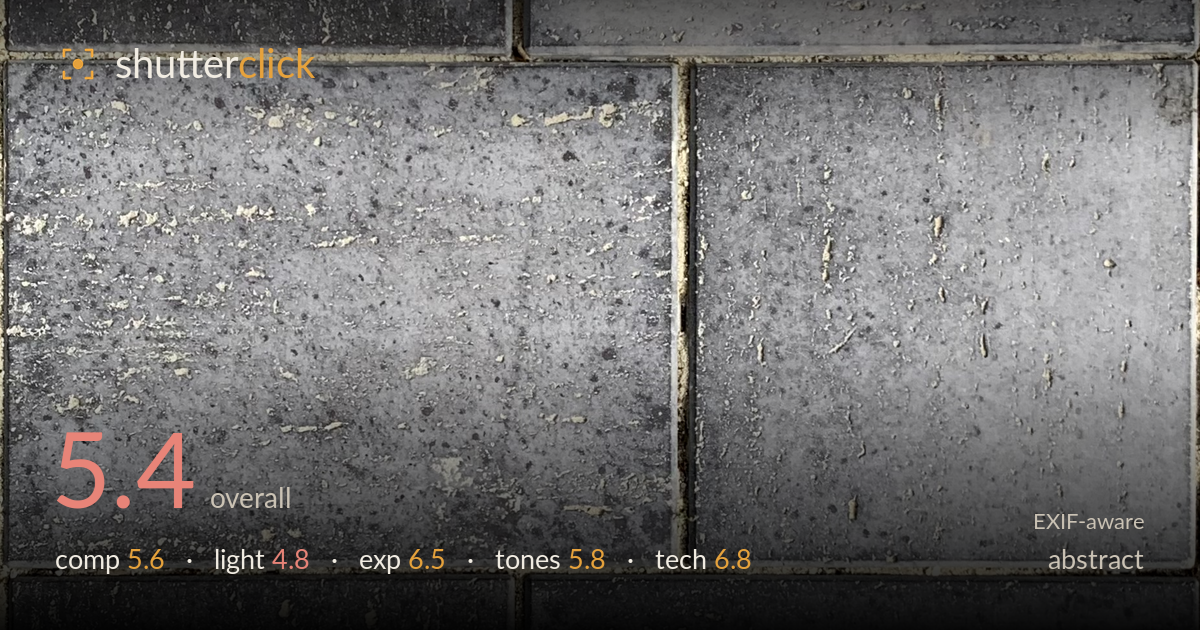
Grey paving stone grid
Photo by Neoclassicism Enthusiast

| Focal length | 4 mm |
| Aperture | f / 1.8 |
| Shutter | 1/936 s |
| ISO | ISO 25 |
| Exp. comp. | 0.0 EV |
| Shot at | 14:11 · Jun 3, 2023 |
The frame reads as a study of paving-stone geometry and surface texture, and the interlocking block pattern gives it a legible grid rhythm. What most holds it back is flat, directionless light that suppresses the very texture the subject depends on, and framing that stops short of a fully considered abstraction — the grid is present but not resolved into a deliberate crop or point of visual tension. The tonal palette of cool greys is coherent but muted. As an abstract, it needs the surfaces to sing, and right now they sit inert under even overhead light.
The staggered, interlocking arrangement of square and rectangular slabs creates a workable grid, and the mortar lines act as a network of dividing lines across the frame. But the composition feels found rather than resolved — the block boundaries land somewhat arbitrarily against the edges, with partial slabs cropped top and bottom in a way that reads accidental rather than chosen. For abstract work built on pattern, either a perfectly squared-on repetition or a single strong intersection point would carry more intent than this in-between framing.
This is the weakest element. Flat, diffuse overhead light — likely open shade or overcast — leaves the stone surfaces without raking directionality, so the pitting, streaking, and aggregate texture stay muted instead of being sculpted. Abstract surface studies live and die on grazing light that throws every ridge and pockmark into relief. The even illumination does keep tonal balance consistent across all six slabs, but it robs the frame of the dimensionality that would make the texture the subject rather than just a record of pavement.
Exposure is handled cleanly. At ISO 25 and 1/936s the histogram sits comfortably in the midtones with no meaningful highlight clipping in the pale grey slabs and retained detail in the darker charcoal blocks. The pale flecks of debris and lighter aggregate hold texture rather than blowing out. Dynamic range is modest here by nature of the subject and flat light, so there was little to fight — but the brightness placement is deliberate and the surface detail is preserved throughout, which serves the texture study well.
The palette is a restrained range of cool blue-greys and warmer sandy neutrals in the mortar, which gives a quietly coherent scheme. Contrast is low, matching the flat light, and that keeps the image feeling subdued and even. The subtle temperature shift between the bluish darker slabs and the warmer beige grout lines is the most interesting tonal event. A touch more contrast separation and slight clarity boost would help the greys read as distinct surfaces rather than blending into one muddy value band.
The capture is technically sound for the conditions. ISO 25 delivers a clean, noise-free file with full texture retention, and 1/936s is far faster than a static subject requires — no concern for a stationary pavement, just the phone defaulting to a bright reading. The fixed f/1.8 lens shot flat-on to the plane keeps the entire surface in acceptable focus, which is exactly what a texture study needs; there is no depth-of-field concern when the subject is a single flat plane parallel to the sensor. Sharpness is adequate but not biting — the fine aggregate detail is slightly soft, partly the small sensor and partly the lack of directional light to define edges. Holding the phone precisely parallel to the ground avoided keystoning, which matters for a grid subject, and the mortar lines run acceptably straight. For a subject like this, a lower angle catching side light, or a locked-down tripod frame squared to the pattern, would extract more from the same clean base capture.
What would elevate it
Tags
Shot something like this?
Expert photo critique, on demand — scored across six categories, EXIF-aware. Start with 3 free critiques, no credit card.
critique my photo — free