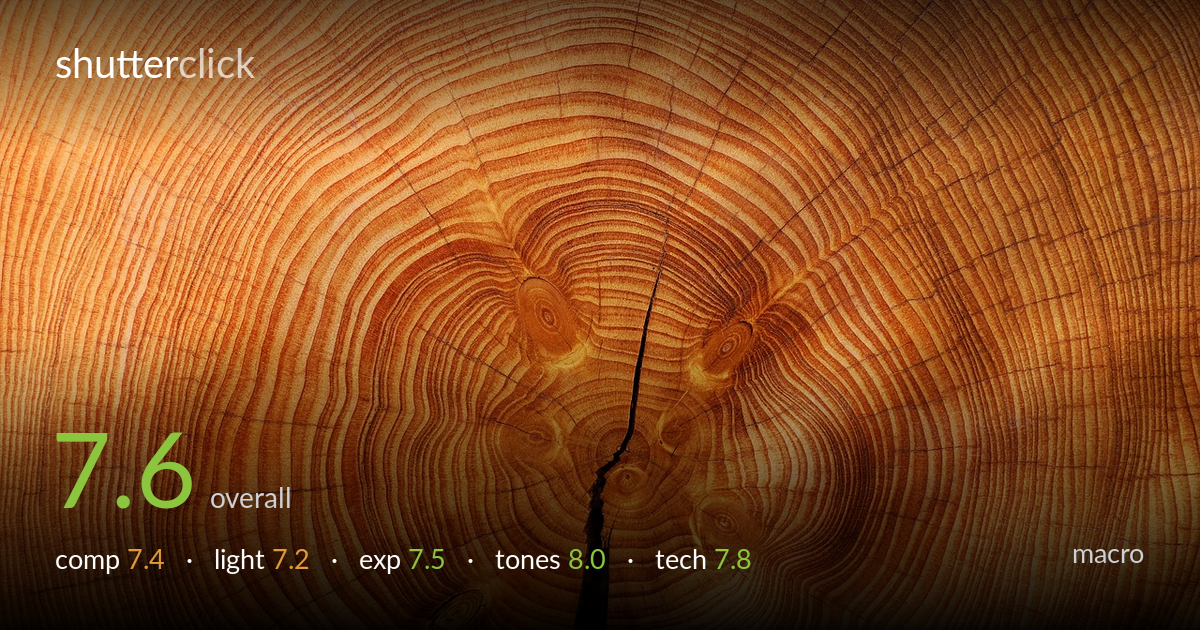
Growth rings of a tree
Photo by Couleur

No EXIF metadata in this file
Technical analysis based on visual assessment only.
A close study of a tree's cross-section that turns growth rings into concentric visual rhythm, carried by warm, glowing tones and fine ring detail. The radiating lines and the dark vertical crack give the frame a natural anchor and energy. What holds it back is a slightly clinical centre of gravity: the cluster of knots and the crack sit low and pull the eye downward without a fully resolved focal hierarchy, and the lighting is even enough to flatten some of the surface texture. A more raking light and a cleaner edge management would sharpen the graphic punch this subject clearly has.
The concentric rings provide strong built-in rhythm, and the dark fissure splitting the lower frame gives a welcome vertical break against all the curves. The knots near centre act as secondary focal points, creating eddies in the pattern. The weighting sits a little low, though, leaving the upper third less eventful and the eye drawn to the busy bottom edge where the crack and a partial knot crowd the corner. A composition built around the most active cluster, or a square crop centring the radial pull, would tighten the read.
The light is soft and warm, lifting the wood's natural amber and keeping the whole surface legible without harsh hotspots. That even illumination, however, is the main limitation here: the rings read more as tonal lines than as raised texture, and the grain's three-dimensional quality stays muted. A low, raking side light skimming across the cut face would carve shadow into each ring and emphasise the relief of the knots, giving the pattern far more depth and tactile presence than the current flat, frontal wash delivers.
Exposure is well controlled across a tricky warm-dominant scene. The brighter rings hold detail without blowing out, and the dark crack retains its deep value as a genuine black anchor rather than a muddy smear. Midtones sit comfortably, giving the ring structure room to separate. The upper-left and right edges run a touch hot and could be reined in slightly to balance the frame, but there's no distracting clipping. Overall a measured, deliberate-looking exposure that serves the subject's broad tonal range.
The tonal handling is the strongest element. A coherent amber-to-honey palette runs through the frame with enough variation between pale and rust-toned rings to keep it from going monochrome-flat. White balance leans warm, which suits the wood, though it edges close to orange saturation in the brightest zones. Contrast is judged well: the dark crack and grain lines read crisply against the lighter wood, and the gradation through the midtones is smooth. A hair less saturation in the hottest highlights would keep them from feeling slightly synthetic.
Focus is handled well for a near-flat subject: the ring detail stays crisp across most of the frame, and the fine grain lines hold resolution even toward the edges, suggesting a sensibly stopped-down aperture that kept the whole plane sharp. There's no obvious motion blur and noise is well suppressed, leaving clean midtones. The main technical opportunity is in capturing surface relief rather than just the two-dimensional pattern — the current rendering reads almost like a scan, accurate but lacking dimensional cues. Slight softness creeps into the extreme top corners, likely a combination of plane-of-focus and lens edge performance, though it's minor given the macro framing. Keeping the sensor plane perfectly parallel to the cut face, or focus-stacking if the surface isn't dead flat, would push every ring to equal sharpness. Overall the execution is competent and the detail capture is genuinely good; the gear choices clearly served the subject's demand for edge-to-edge clarity.
What would elevate it
Tags
Shot something like this?
Expert photo critique, on demand — scored across six categories, EXIF-aware. Start with 3 free critiques, no credit card.
critique my photo — free