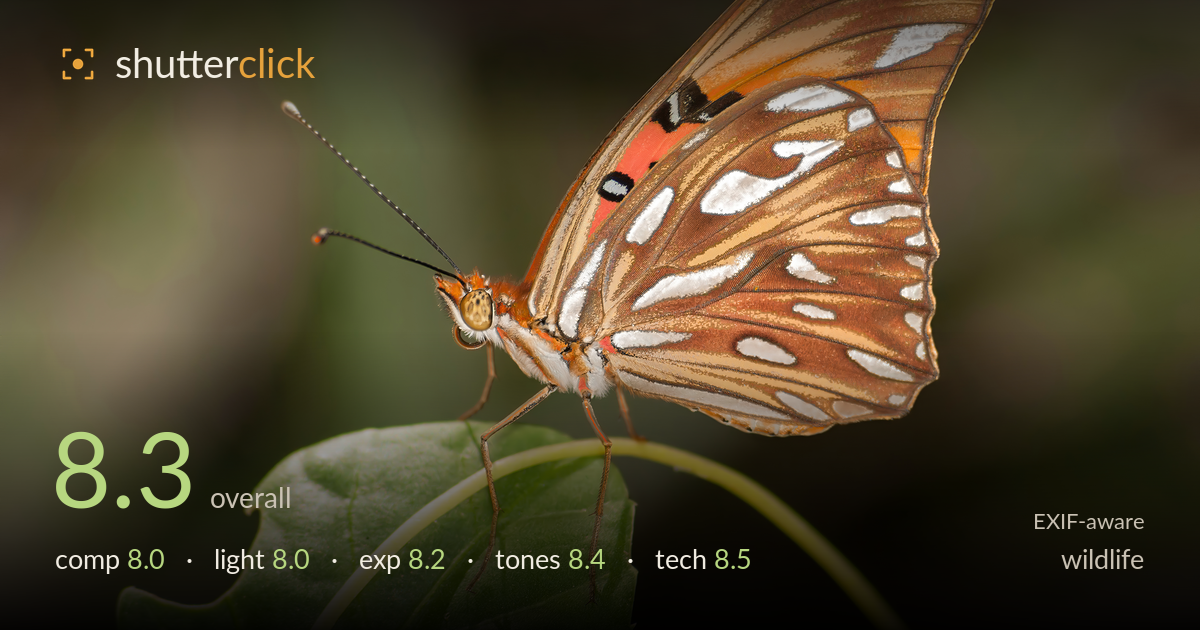
Gulf fritillary on a curling tendril
Photo by Wilfredor

| Focal length | 300 mm |
| Aperture | f / 10.0 |
| Shutter | 1/250 s |
| ISO | ISO 320 |
| Exp. comp. | 0.0 EV |
| Shot at | 12:41 · Dec 25, 2012 |
A clean, well-executed macro-style wildlife portrait of a gulf fritillary in perfect profile, with the silver-spangled wing rendered in crisp detail against a soft green wash. The eye, proboscis, and antennae are sharp, and the curling tendril adds a graceful anchor to the perch. What most holds the shot back is the wing tip crowding the right edge — the frame feels slightly cramped for such an expansive subject. The head and eye also sit low-left, leaving a large expanse of out-of-focus wing dominating. A touch more breathing room and a fraction more depth of field on the far wing would elevate it further.
The profile placement reads cleanly, and the curling yellow-green tendril gives the perch elegant structure while the diagonal leaf grounds the base. The butterfly faces into open space, which works well. The main weakness is the wing tip pressing hard against the right border — it clips the sense of the full spread and makes the frame feel tight. The head sits low and left, so the visual weight leans heavily to the underside wing. A little more room right and above the wing would balance the mass.
Soft, diffused light — likely open shade or overcast — suits the subject, avoiding harsh specular hotspots on the scaled wing and preserving the silver spots' luminosity. Directionality is gentle from the front-left, giving mild modelling on the head and thorax fur without heavy shadows. The eye catches enough light to read, though a stronger catchlight would add life. The even light keeps the intricate wing pattern legible across its full range, which is the right call for revealing this much detail.
Exposure is well judged for the subject's tonal range. The bright silver wing spots retain texture without clipping, and the dark browns and blacks hold detail in the veins and eye spots. The green background sits at a pleasing mid-brightness that lets the butterfly stand out. Shadow areas under the wing and along the legs remain open. Nothing appears blown or blocked; the histogram looks controlled with deliberate placement of the highlights just below clipping. A confident, accurate result.
The warm russet, orange, and cream palette of the wing plays beautifully against the cool desaturated green backdrop — a natural complementary relationship that gives the image its punch. White balance reads neutral and accurate, with the fur and scales showing true colour. Contrast is moderate and appropriate, keeping the silver spots bright while the veins stay dark. Saturation is restrained enough to feel realistic rather than pushed. The muted background greens are a strong choice, keeping attention on the subject.
At 300mm, f/10, 1/250s and ISO 320, the settings are well matched to the subject. The f/10 aperture delivers enough depth to hold the near wing, head, eye, and proboscis sharp while still melting the background into pleasing bokeh — a sensible compromise for a laterally posed butterfly. Focus is placed accurately on the eye and head, exactly where it counts, and the fine scale detail and antennae segmentation resolve crisply. 1/250s was adequate to freeze a stationary subject with no visible motion blur. ISO 320 keeps noise negligible on the D300. The one limitation shows in the far edge of the wing and rear legs drifting slightly soft — the plane of focus falls off before covering the full spread. A slightly smaller aperture or a more parallel sensor-to-wing alignment would have carried sharpness across the entire wing. Lens reach and working distance are ideal for not disturbing the insect. Overall a technically assured capture.
What would elevate it
Tags
Shot something like this?
Expert photo critique, on demand — scored across six categories, EXIF-aware. Start with 3 free critiques, no credit card.
critique my photo — free