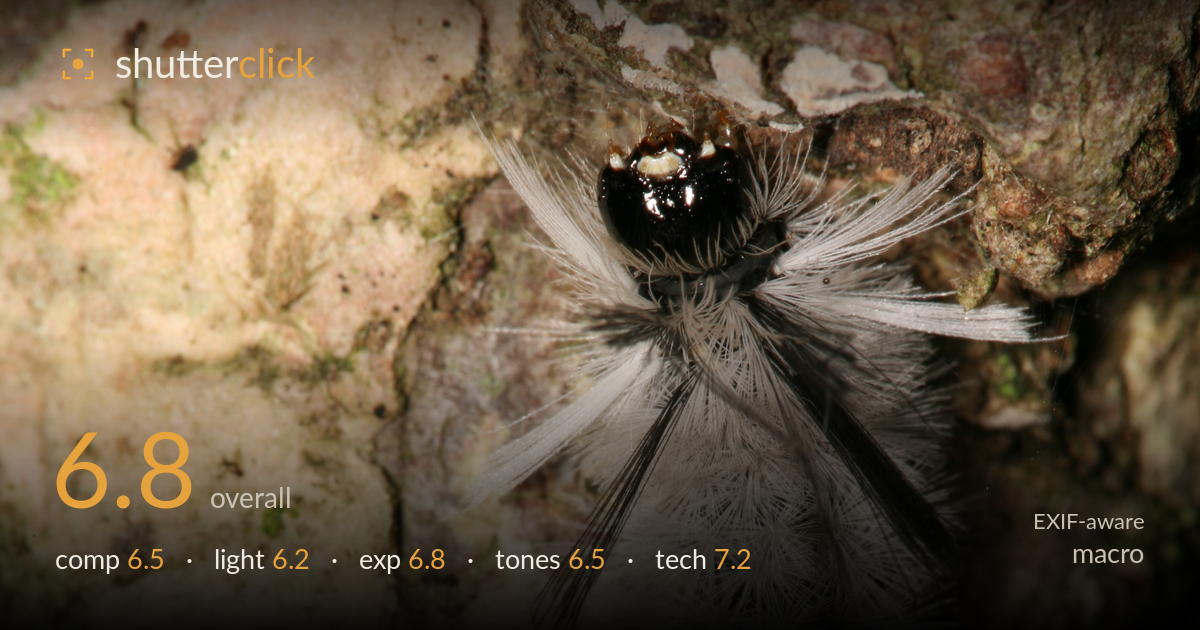
Hairy caterpillar clinging to bark
Photo by Daniel Schwen

| Focal length | 150 mm |
| Aperture | f / 16.0 |
| Shutter | 1/125 s |
| ISO | ISO 100 |
| Exp. comp. | 0.0 EV |
| Shot at | 20:03 · Sep 5, 2009 |
A textbook hickory tussock-type caterpillar rendered with fine detail in its white setae and glossy black head, but the busy bark background works against the subject rather than for it. The pale hairs blend into the equally pale lichen patches, weakening separation. The diagonal placement of the larva reads naturally as it clings to the trunk, and the wispy black lashes add drama. What holds this back most is the near-identical tonal value between subject and background, plus lighting that lies flat across the white fluff without carving its structure. A cleaner or darker backdrop would transform it.
The caterpillar runs on a pleasing top-to-bottom diagonal, and the black head anchoring the upper third gives the eye a clear entry point. The wispy black lashes extending left and right add welcome dynamism. However, the busy, high-detail bark competes constantly with the subject, and the pale hairs merge into the pale lichen on the left, killing separation. The subject sits slightly right of centre, which works, but a touch more breathing room below the tail hairs would let them resolve rather than crowd the frame edge.
The light is diffuse and even, which avoids blown highlights on the white setae but also flattens them — the individual hair tufts read as a soft mass rather than distinct, dimensional bristles. The glossy black head picks up a small specular highlight that gives it life, the strongest lighting moment in the frame. A raking side light would separate each starburst of hairs and reveal depth. As shot, the bark and subject receive the same flat wash, so nothing pops forward.
Exposure is well controlled for a tricky high-key subject against a mottled background. The white hairs retain texture without clipping, and the black head holds detail in its glossy surface rather than blocking up entirely. Shadow areas in the bark crevices keep information. The overall brightness sits a touch high, which contributes to the subject-background merge, but nothing is lost. A slight negative exposure compensation would have deepened the bark and helped the white setae stand apart from the lichen.
The palette is a natural range of bark browns, greens, and creams against the white larva — accurate but low in contrast, which is the core issue. Subject and background occupy nearly the same tonal band, so the eye works to isolate the caterpillar. White balance looks neutral, with the lichen greens reading believably. The glossy black head provides the only strong tonal contrast. A cooler, darker treatment of the surround, or added local contrast, would push the pale subject forward and lift the whole frame.
At 150mm and f/16 on the 5D, depth of field is stretched to cover the caterpillar's rounded body, and it largely succeeds — the head, setae, and tufts along the near flank are crisply resolved, with only the deepest hairs falling soft. That is a sensible aperture choice for the subject's depth, though f/16 on this sensor invites diffraction softening that slightly dulls the finest hair tips. ISO 100 keeps the file clean, and 1/125s is adequate for a mostly static subject on bark, though the long wispy lashes show faint movement blur at their tips — a faster shutter or flash would freeze them. Focus is placed accurately on the head and mid-body, the priority zone. Presumably natural or diffused light given the even rendering; a dedicated macro flash would have allowed a smaller working aperture with less diffraction penalty and crisper detail throughout. Solid, competent macro execution overall.
What would elevate it
Tags
Shot something like this?
Expert photo critique, on demand — scored across six categories, EXIF-aware. Start with 3 free critiques, no credit card.
critique my photo — free