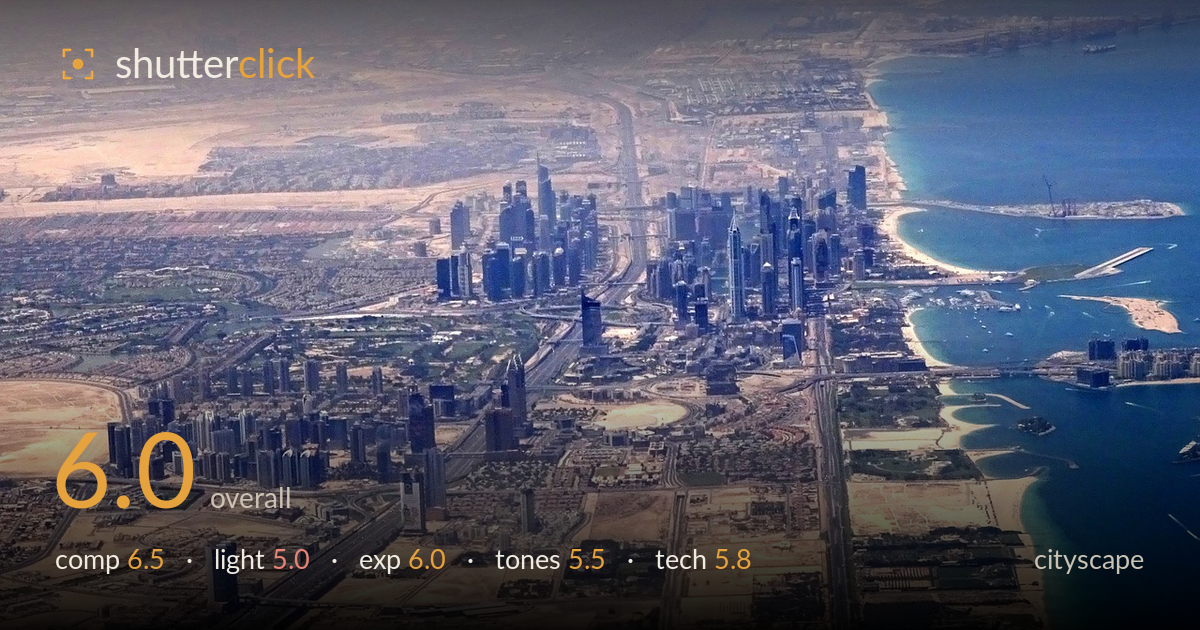
Hazy aerial view of a coastal skyline
Photo by wurliburli

No EXIF metadata in this file
Technical analysis based on visual assessment only.
An aerial cityscape of a coastal metropolis with genuine scale and a clear narrative — desert giving way to a dense high-rise corridor meeting the sea. The layered depth from foreground development back to the skyline is the strongest asset. What most holds it back is atmospheric haze, which flattens contrast and mutes the entire scene into a soft blue-grey wash, robbing the skyline of punch. The diagonal coastline provides a natural leading edge, but the skyline sits somewhat centrally without a single dominant anchor. Shot through what appears to be aircraft glass, softness compounds the haze. Strong potential, limited by conditions.
The diagonal sweep of the coastline from lower-right upward gives the frame a natural leading line and separates land from sea effectively. Depth is genuine — foreground development recedes into the dense skyline cluster and beyond into haze, conveying real scale. The skyline cluster sits roughly centre-frame without one dominant anchor to hold the eye, so attention drifts. A slightly tighter framing on the tallest towers, or more sky included for breathing room, would strengthen the hierarchy. The horizon is absent, which suits the aerial vantage.
Flat, high overhead light with heavy atmospheric haze does the scene few favours. The illumination is diffuse and directionless, so the towers lack the modelling and shadow definition that would give the skyline dimension. Nothing separates the buildings from one another or from the desert floor — everything reads as one soft plane. Aerial shooting rarely allows control over timing, but a lower sun angle or clearer air would have raked across the towers and carved out form. As captured, the light is the weakest element.
Brightness is broadly controlled — no blown highlights across the pale desert or sea, and shadows retain detail throughout. The exposure copes reasonably with a wide, flat scene. The trade-off is a compressed histogram: everything clusters in the mid-tones because the haze prevents true blacks or bright whites. This is more a lighting-condition consequence than an exposure error. A touch more headroom on the darker tower faces would have added depth, but nothing is clipped and the overall balance is safe and usable.
The palette is dominated by a hazy blue-grey cast that mutes the whole frame and drains the sea of its potential vibrancy. The desert tones read warm-beige and reasonably natural, but the buildings and distant haze pull cool and flat. Contrast is low, leaving the image feeling washed out. White balance drifts slightly cool. A dehaze pass with a contrast lift and selective saturation on the water would restore separation and let the coastline sing against the arid land.
Shot from an aircraft, the image carries the expected penalties: overall softness that increases toward the distant skyline, and a loss of fine detail from shooting through cabin glass and thick atmosphere. Sharpness in the nearer foreground is acceptable but never crisp, and the far towers dissolve into haze rather than resolving cleanly. There is no obvious motion blur, so the shutter handled the aerial speed adequately, and noise is not an issue in this bright light. Depth of field is effectively infinite here, which is appropriate for the subject. The main limitations are environmental rather than settings-based: the glass and haze cap the achievable resolution. Careful post-processing — dehaze, clarity, and localised sharpening on the skyline — would recover a meaningful amount of the lost definition. A polarising filter, where possible, would have cut some of the atmospheric scatter, though shooting through cabin windows complicates its use.
What would elevate it
Tags
Shot something like this?
Expert photo critique, on demand — scored across six categories, EXIF-aware. Start with 3 free critiques, no credit card.
critique my photo — free