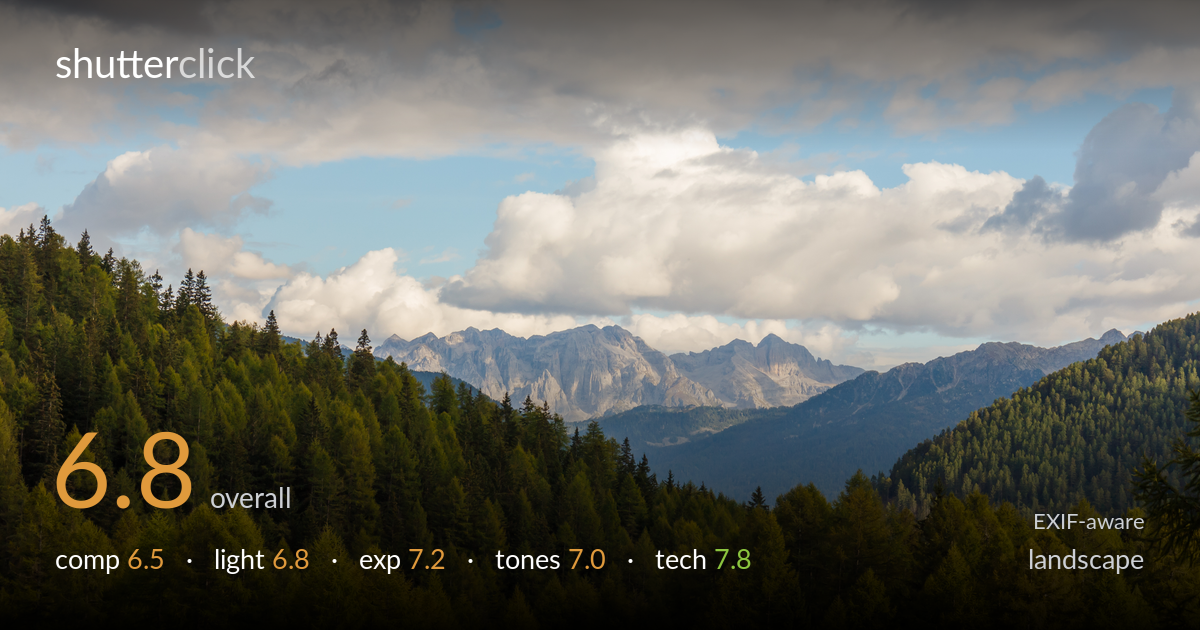
Hazy alpine ridgeline
Photo by Agnes Monkelbaan

| Focal length | 55 mm |
| Aperture | f / 11.0 |
| Shutter | 1/160 s |
| ISO | ISO 100 |
| Exp. comp. | 0.33 EV |
| Shot at | 16:19 · Sep 19, 2016 |
A clean, well-layered alpine scene with three distinct depth planes: forested foreground ridge, hazy blue mid-valley, and the pale jagged peaks beyond. The layering is the strongest asset, giving real atmospheric depth. What most holds it back is proportion: the sky occupies roughly half the frame and, while the clouds are pleasant, they don't carry enough drama to justify that much real estate. The mountains — the obvious draw — sit compressed in a thin band across the middle. Pulling more weight to the peaks and forest would sharpen the statement this view is clearly trying to make.
Three clear depth planes give this strong atmospheric layering — bright larch and spruce foreground, a blue haze-filled mid-valley, then the toothy distant range. That recession is the image's best quality. The weakness is the sky-to-land ratio: the upper half is given over to clouds that, while attractive, lack the drama to anchor so much space, pushing the mountains into a thin central band. Lowering the horizon to give the peaks and forest two-thirds of the frame would concentrate the interest where the eye wants to go.
Soft, slightly diffused afternoon light sits across the scene, with broken cloud cover keeping shadows gentle on the forest. The peaks catch enough directional light to read their texture and ridgelines, which helps separate them from the hazy mid-ground. It is pleasant but undramatic — the flat overcast quality on the foreground trees mutes the texture and dimensionality that raking, lower-angle light would reveal. Golden-hour timing would warm the larches and rake the ridge folds, lifting the whole scene from documentary to evocative.
Exposure is well controlled across a wide range. The bright cloud highlights hold detail rather than blowing out, and the shadowed evergreens retain structure without crushing to black. The slight +0.33 EV compensation keeps the overall scene bright and open. The pale rock of the distant peaks sits in good midtone territory, preserving their texture. Histogram usage looks balanced with no obvious clipping at either end — a clean, deliberate technical exposure that handles the contrast between bright sky and dark forest competently.
The colour palette is natural and pleasant: cool blue haze in the valley plays nicely against the warm yellow-greens of the larches. White balance reads accurate, with neutral cloud whites and believable rock greys. Contrast is moderate, suiting the soft light. The greens could be slightly over-saturated in places, giving the foreground a faintly synthetic edge. A touch more separation between the deep evergreens and the lime larch tones would add tonal richness. Overall a clean, realistic grade with good aerial perspective.
The settings are well chosen for a deep landscape. At 55mm and f/11, depth of field is ample and the whole scene — foreground larches through to distant peaks — holds acceptable sharpness, with f/11 on this kit zoom landing in its sharper aperture range while staying clear of diffraction softening. ISO 100 keeps noise negligible and tonal gradation smooth, ideal for the broad sky and haze. The 1/160s shutter is more than fast enough for a static scene at this focal length and easily handles any hand-held shake on the IS-equipped lens. Focus appears placed in the mid-to-far ground, which is sensible here. The 55mm reach compresses the layers attractively, drawing the distant range closer to the forest — a deliberate and effective choice over a wider framing. Technically this is a sound, low-risk execution with no real errors; the gear has been used to its strengths. The only gain available would be a polarizer to cut the valley haze and deepen the sky.
What would elevate it
Tags
Shot something like this?
Expert photo critique, on demand — scored across six categories, EXIF-aware. Start with 3 free critiques, no credit card.
critique my photo — free