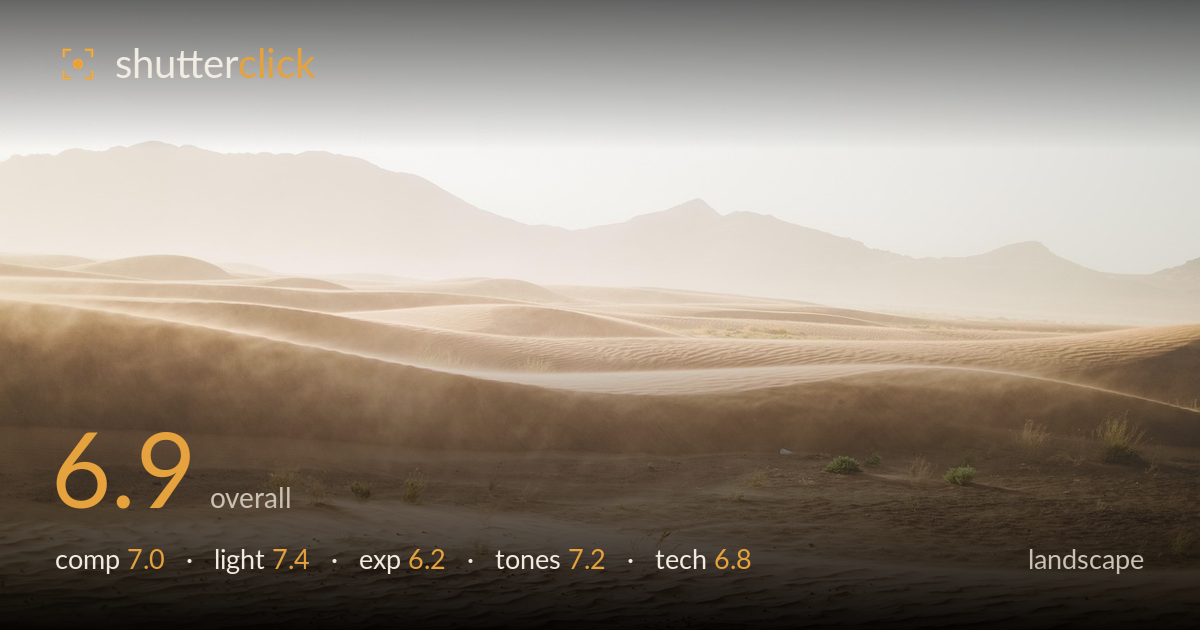
Hazy light over desert dunes
Photo by Pexels

No EXIF metadata in this file
Technical analysis based on visual assessment only.
A quietly atmospheric desert scene that trades on haze, layered dunes, and warm backlight rather than a dominant subject. The blowing sand and receding mountain ridges build genuine depth and a sense of scale. What most holds it back is the blown-out sky, which occupies the upper third with almost no tone, and a foreground that, while richly textured, lacks a single anchoring element to lead the eye. The stacked layering of dunes into mountains is the real strength. Reining in the highlights and finding one point of interest would lift this from evocative to memorable.
The layered recession from textured foreground sand through wind-blurred dunes to hazy mountain ridges is the composition's biggest asset, creating real depth. The horizon sits low, giving the dunes room to breathe. However, the frame lacks a clear focal anchor — the eye wanders across ripple patterns without landing anywhere. The scattered scrub bushes are too small and evenly distributed to serve as subjects. A stronger foreground element, or a diagonal dune ridge used as a leading line into the frame, would give the composition a spine to travel along.
Soft, hazy backlight rakes across the dunes and catches the blowing sand, which is the atmospheric core of the image. This low, diffuse light flatters the rippled foreground texture and separates the dune layers through aerial perspective, each ridge paler than the last. The mountains reduce to flat silhouettes in the haze, reinforcing depth. The trade-off is that the light is soft enough that dune contours lack strong modelling in the mid-ground. A slightly lower sun angle would carve more definition into the sand forms.
The exposure is pushed high to render the atmospheric haze, and the sky pays the price — the upper third is effectively pure white with no recoverable tone or gradient. That may be partly intentional to convey glare, but it reads as clipped rather than deliberate. The foreground sand holds detail well and the shadow side of the dunes retains information. Pulling the whole exposure down half a stop, then lifting the shadows selectively, would preserve some sky luminosity and prevent the top of the frame from emptying out.
The warm sandy palette is cohesive and suits the desert mood, with amber foreground tones fading to pale cream at the horizon. The near-monochromatic warmth gives the image unity, and the muted green scrub provides subtle relief. The haze softens contrast pleasingly, though the overall rendering leans slightly flat and could use a touch more separation in the mid-tones. White balance is warm and appropriate. A hint more contrast in the dune ripples would let the textures read more crisply without breaking the atmospheric feel.
Focus appears set on the foreground sand, which shows crisp ripple detail and fine texture — a sensible choice for a landscape prioritising foreground interest. Depth of field carries reasonably through the frame, though the mid-ground dunes soften partly from genuine airborne sand rather than focus error, which is atmospheric rather than a fault. The wind-blown haze reduces overall micro-contrast across the scene, so distant detail is inherently limited by conditions, not the lens. Noise is well controlled and the image looks clean. The main technical weakness is the handling of highlights: the sky has clipped hard, suggesting the histogram was pushed too far right without protecting the brightest values. Bracketing exposures and blending, or simply exposing for the highlights and lifting shadows in post, would retain more tonal range. A small aperture held focus adequately, but a wider dynamic-range capture would have served this high-contrast, hazy scene better.
What would elevate it
Tags
Shot something like this?
Expert photo critique, on demand — scored across six categories, EXIF-aware. Start with 3 free critiques, no credit card.
critique my photo — free