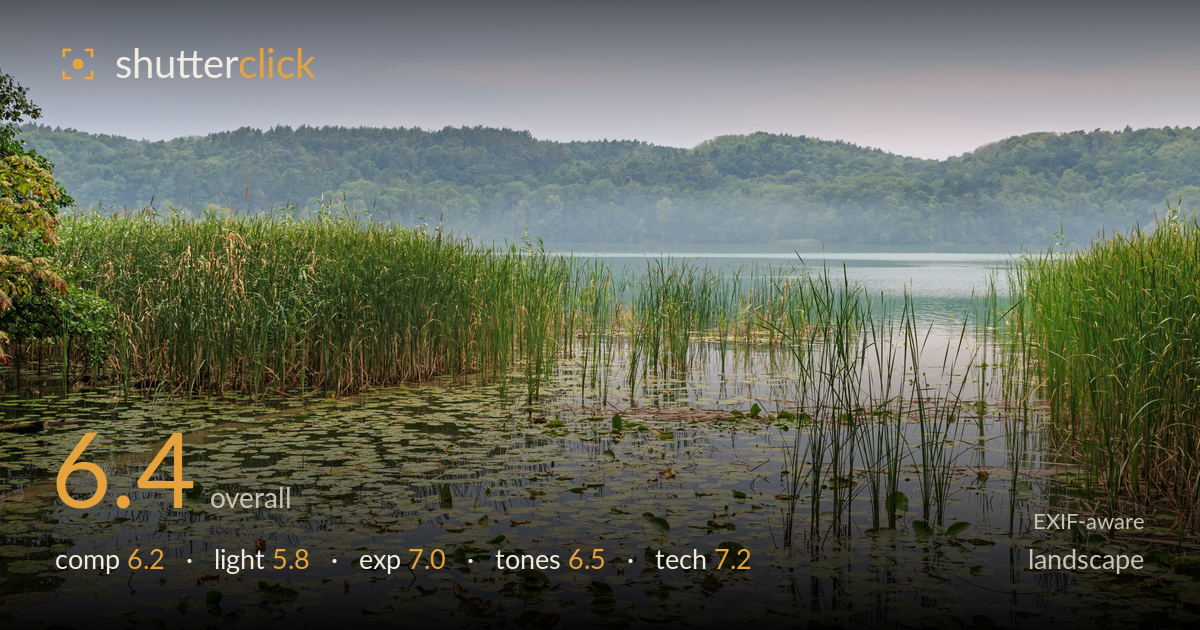
Hazy morning over the reed lake
Photo by A.Savin

| Focal length | 28 mm |
| Aperture | f / 7.1 |
| Shutter | 1/200 s |
| ISO | ISO 100 |
| Exp. comp. | 0.0 EV |
| Shot at | 15:19 · Aug 15, 2015 |
A serene wetland scene with genuine layered depth — lily pads and reeds in the foreground, an open channel of water midframe, a wooded ridge and hazy sky beyond. The layering is the photo's real strength. What most holds it back is a lack of a clear focal anchor: the eye wanders across an even carpet of pads without a resting point, and the flat overcast light drains the scene of dimension. A soft haze mutes the distant hills, which reads as atmospheric but also robs contrast. The reed clumps break the horizon awkwardly. With stronger light or a defined subject, this location could sing.
The three-tier structure works — foreground lily pads, the reed-lined water channel, and the distant wooded ridge build real depth. The gap of open water centred in the frame acts as a natural draw into the scene. But the composition lacks a single anchor; the pads spread evenly with no dominant element to hold attention. The horizon sits high, which suits the foreground emphasis, yet the reed clumps interrupt it unevenly on both sides. A stronger foreground focal point — a single bloom or a converging line of reeds — would give the eye somewhere definite to land.
Flat, diffuse overcast light blankets the scene with no directional modelling. It renders the greens evenly and avoids harsh highlights on the water, but the lily pads and reeds fall flat without the raking side light that would carve out their texture and separate them from the water surface. The distant haze adds a gentle atmospheric layering to the ridge, which is the light's one redeeming contribution. Early golden hour, or the moment mist catches low sun, would transform this same composition into something with far more presence and dimension.
Well-judged exposure for the conditions. The sky retains its subtle pink-to-blue gradient without clipping, and shadow detail holds in the reed bases and foreground pads. The histogram sits comfortably in the midtones with no accidental crushing, appropriate for a bright overcast scene. The reflective water surface keeps its highlights in check. If anything, the whole frame reads slightly bright and low-contrast, but that is a tonal-grading matter rather than an exposure fault. The metering handled the mixed brightness of sky, water, and foliage cleanly at 0 EV.
The palette is dominated by muted greens across the reeds and pads, with a cool blue-grey water and a delicately warm sky. White balance leans slightly cool, which reinforces the hazy morning mood but leaves the greens a touch flat and desaturated. Contrast is low throughout, partly from the overcast light and partly from the atmospheric haze softening the distance. A gentle contrast lift and a touch more separation between the yellow-greens and the blue water would add vibrancy without breaking the tranquil register the scene establishes.
The settings are well chosen for a static landscape. At 28mm and f/7.1 on the 7D Mark II's APS-C sensor, depth of field is deep enough to hold sharpness from the nearest lily pads to the distant ridge, and the aperture sits in the lens's sweet spot for edge-to-edge resolution. ISO 100 keeps noise negligible and preserves clean tonal gradation in the sky and water. The 1/200s shutter easily freezes any breeze in the reeds. Focus appears set well into the scene, giving broadly acceptable sharpness, though the very nearest foreground pads look marginally soft — a focus point slightly closer, or f/9–f/11 with a mild hyperfocal approach, would have secured front-to-back critical sharpness. The 17-50mm zoom performs well here; no obvious distortion or chromatic aberration intrudes. Overall a technically sound capture with no significant errors — the limitations are creative rather than mechanical. A tripod and a polariser would open further options for cutting surface glare.
What would elevate it
Tags
Shot something like this?
Expert photo critique, on demand — scored across six categories, EXIF-aware. Start with 3 free critiques, no credit card.
critique my photo — free