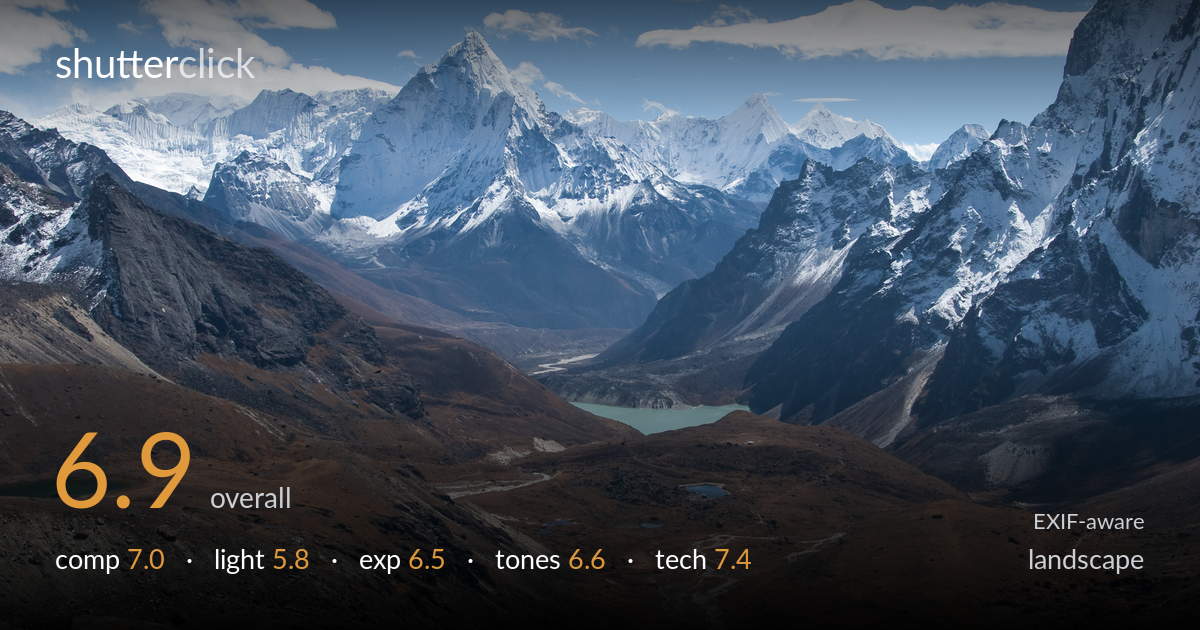
Himalayan valley vista
Photo by Vyacheslav Argenberg

| Focal length | 22 mm |
| Aperture | f / 10.0 |
| Shutter | 1/400 s |
| ISO | ISO 200 |
| Exp. comp. | 0.0 EV |
| Shot at | 11:53 · Oct 18, 2009 |
A grand high-altitude Himalayan vista with strong natural depth, anchored by Ama Dablam's distinctive peak and a glacial valley winding back toward it. The layering from foreground rubble through the brown valley to the snow ridges genuinely carries the eye. What most holds it back is midday light: flat, high-sun illumination that drains the snow of modelling and leaves the brown slopes muddy. The foreground rock in the lower frame is largely dead space rather than true interest. Stronger directional light and a foreground element with form would lift this from a good documentary record toward a memorable landscape.
The valley acts as a natural leading line drawing the eye to Ama Dablam, which is well placed off-centre in the upper third. The turquoise glacial lake provides a useful midground anchor, and the framing mountains on both flanks give a satisfying funnel toward the peak. The weakness is the lower foreground: a broad expanse of undifferentiated brown slope and rubble that fills nearly a third of the frame without offering a distinct anchor. A lower, closer foreground feature would convert that dead area into genuine depth.
This is shot under high midday sun, and it shows. The snow faces are evenly lit but flat, lacking the raking shadow that would carve out ridges and the ice flutings on Ama Dablam. The brown valley slopes read muddy because there is little shadow definition to separate folds of terrain. The sky is bright and the scene is legible, but the light does little to dramatize an inherently dramatic landscape. Early or late side light would transform the modelling here.
Exposure is broadly competent. The bright snow holds detail without major clipping, which is a real achievement against midday sun, and the shadowed rock retains information. The histogram leans toward the bright end, and the brown midtones sit a touch dark and heavy, costing some separation in the valley terrain. Nothing is badly blown or crushed. A slight lift in the midtones, or a graduated approach balancing the bright snow against the darker foreground, would even out the tonal weight across the frame.
White balance is neutral and believable, with a clean blue sky and convincing snow whites. The turquoise glacial lake reads accurately and provides welcome colour contrast against the dominant browns. The overall palette, though, is dominated by an unrelenting muddy brown across the valley that feels flat and low in saturation. Contrast is moderate but the midtones lack punch, leaving the terrain undifferentiated. Selective contrast on the slopes and a gentle vibrance lift on the warm tones would give the landscape more dimensionality.
The settings are well chosen for the scene. f/10 is a sensible aperture for deep landscape depth of field on the Micro Four Thirds sensor, keeping foreground rubble and distant peaks acceptably sharp without straying far into diffraction softening. ISO 200 is the native base for this E-P1, keeping noise negligible and dynamic range at its best. The 22 mm focal length (roughly 44 mm equivalent) gives a natural, slightly compressed perspective that suits this valley-into-peaks composition, though a touch wider could have integrated the foreground more deliberately. 1/400 s is far faster than needed for a static handheld landscape, but it guarantees no shake. Detail rendering across the snow ridges is good given the sensor's age, and focus appears well placed through the midground. The main technical limitation is sensor-era dynamic range struggling slightly with the bright-sky-to-dark-rock range, but exposure was handled to keep both ends within reach.
What would elevate it
Tags
Shot something like this?
Expert photo critique, on demand — scored across six categories, EXIF-aware. Start with 3 free critiques, no credit card.
critique my photo — free