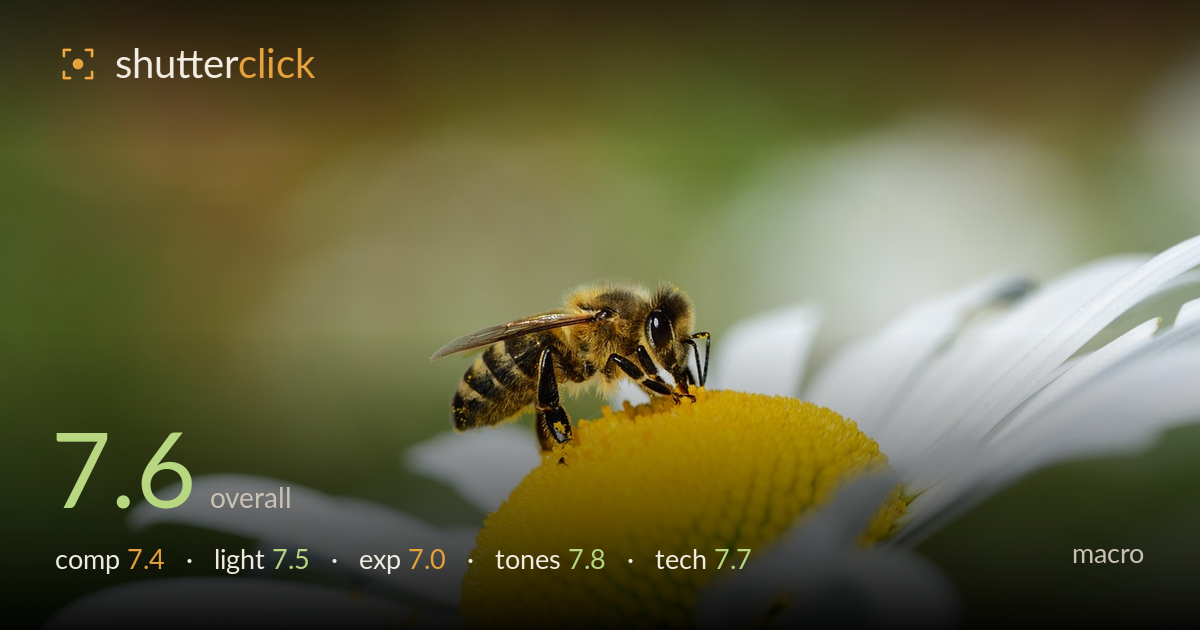
Honeybee on a daisy
Photo by ulleo

No EXIF metadata in this file
Technical analysis based on visual assessment only.
A honeybee perched on the rim of an oxeye daisy, caught mid-feed with the head and thorax rendered sharply — a genuinely strong macro moment. The soft green-and-red bokeh sets the subject apart cleanly and the yellow disc anchors the frame with warmth. What most holds the image back is the placement of the bee slightly high and central against a large empty upper half, and a few white petals that drift toward blown highlights on the right. Tightening the negative space and taming those highlights would lift a good frame to an excellent one.
The bee sits near the frame's centre with a large expanse of soft background filling the upper half. That negative space breathes, but it is unweighted — the subject would carry more tension placed lower-left with the bee facing into the open space it now turns away from. The diagonal sweep of daisy petals from lower-left to upper-right gives pleasing structure and scale. The yellow disc grounds the bottom edge well, though it crowds the frame slightly. A touch more room ahead of the bee's head would improve the read.
Soft, diffused daylight wraps the bee gently, revealing the fine hairs on the thorax and the translucency of the folded wing without harsh shadow. The direction is largely frontal-to-side, giving just enough modelling to separate the legs and abdomen from the flower. It is flattering, natural light well suited to the subject. A slightly lower, more raking angle would carve more texture into the fuzzy body and the pollen-dusted disc. As it stands the mood is clean and pleasant, if not dramatic.
Midtones on the bee and the yellow disc are well placed, holding good detail across the body and floret texture. The weakness is the white petals on the right, which push toward clipping and lose some edge definition where they meet the bright background. The dark eye and legs retain shape without blocking up. Pulling highlight recovery down a half stop, or metering a touch darker in-camera, would preserve the petal tips that currently run hot. Overall a controlled, deliberate-looking exposure with one recoverable trouble area.
The colour palette is the image's quiet strength — muted greens and dusky reds in the background play warmly against the crisp whites and the saturated yellow core. White balance reads accurate and natural, with no colour cast on the petals. Contrast is gentle and appropriate for the delicate subject, and the amber tones of the bee's body sit harmoniously with the disc. Saturation is restrained rather than punchy, which suits the soft macro mood. The gradation in the out-of-focus background is smooth and pleasing.
Focus lands accurately on the bee's head, eye, and thorax — the critical plane for a macro insect shot — and the fine hairs and wing venation resolve crisply. Depth of field is shallow, as expected at macro magnification, which throws the abdomen and rear legs slightly soft and leaves the far petals dissolving into blur. That is a reasonable trade for the subject isolation gained, though a marginally smaller aperture, or a short focus stack, would carry sharpness across the whole insect without sacrificing the creamy background. Noise is well controlled and the rendering is clean. The background separation is excellent, a hallmark of good macro technique. Handling a live, moving insect at this magnification and nailing the eye is the hard part, and that is achieved here. The main opportunity is squeezing a touch more of the bee into the sharp zone and stabilising the frame to allow it.
What would elevate it
Tags
Shot something like this?
Expert photo critique, on demand — scored across six categories, EXIF-aware. Start with 3 free critiques, no credit card.
critique my photo — free